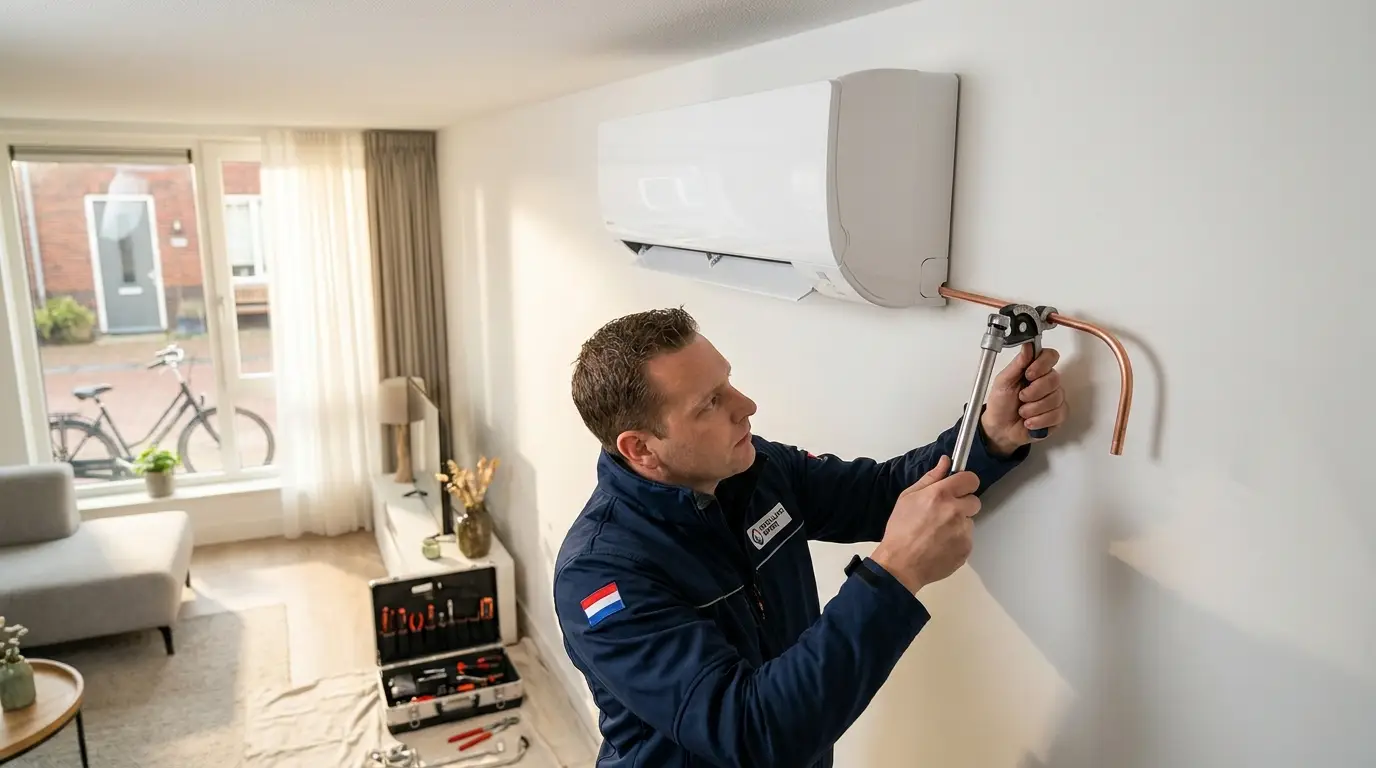
Cost of installing or replacing an air conditioner: everything you need to know
Installing or replacing an air conditioner in the Netherlands costs between €1,200 and €4,500 on average, depending on the type of system and the number of indoor units. The price is made up of the unit itself, the HVAC technician's installation costs, and any line work. With the right preparation and a good contractor, you can save hundreds of euros.
In this article
- ›What does it cost to install or replace an air conditioner?
- ›Prices by type of air conditioner
- ›What determines the price?
- ›Hire a contractor or do it yourself?
- ›How does the installation work?
- ›Money-saving tips
- ›Frequently asked questions
Need a contractor for this?
Describe your job and get quotes from contractors near you.
average price
€2,200
single split AC incl. installation
average hourly rate
€65
contractor hourly rate (€55–80/hour)
turnaround time
1–2 days
depending on scope
€ Average price by type
| Type of AC | Range | Average price |
|---|---|---|
| Portable air conditionerno installation needed, plug & play | €250 – €700 | €450avg. |
| Single split AC (most popular)1 outdoor and 1 indoor unit, 1 room | €1,200 – €2,800 | €2,000avg.incl. installation |
| Dual split AC1 outdoor and 2 indoor units, 2 rooms | €2,000 – €4,000 | €3,000avg.incl. installation |
| Multi split AC1 outdoor and 3+ indoor units, multiple rooms | €3,500 – €6,500 | €5,000avg.incl. installation |
| Replacing an AC system (existing lines)replacing the unit without new line work | €800 – €2,500 | €1,600avg.incl. installation |
Prices include the unit and standard installation; extra work for additional line work or special wall penetrations is not included. Based on Google price research.
Material and labor costs
HVAC technician hourly rate on average €55–€80/hour. Refrigerant work requires an F-gas certificate.
Hiring a contractor vs. doing it yourself
| Job | Do it yourself | Via a contractor | Savings doing it yourself |
|---|---|---|---|
| Setting up a portable air conditionerPlug & play via an outlet, no line work or refrigerant | DoableNo certificate or tools needed | €250–€700 | up to €150 |
| Installing a split AC (charging refrigerant)Charging F-gas and pressurizing the system | Not recommendedProhibited by law without an F-gas certificate (EU F-gas Regulation) | €300–€700 labor | No legal savings possible |
| Replacing an AC unit (existing lines)Removing the old unit, connecting the new unit to existing lines | Not recommendedRecovering refrigerant requires an F-gas certificate; incorrect connections cause leaks | €200–€500 labor | No legal savings possible |
| Installing a condensate drainSmall PVC drain pipe from the indoor unit to the sewer or exterior wall | With experienceDoable with basic plumbing experience; incorrect slope causes leaks in your home | €40–€120 materials | up to €100 |
| Applying for a permitRequired for a visible outdoor unit in a protected historic district or historic building | DoableOnline via omgevingsloket.nl; no technical knowledge needed | €0–€100 in fees | up to €150 |
In the Netherlands, installing a split AC legally requires an F-gas certificate (European F-gas Regulation). This certificate is required for any work in which refrigerant, such as R32 or R410A, is charged, recovered, or transferred. Without this certificate, installing or replacing is illegal, the manufacturer's warranty is void, and you risk a fine from the Inspectie Leefomgeving en Transport (ILT, the Dutch Human Environment and Transport Inspectorate). Removing an existing unit to install a new one also falls under this: the refrigerant must first be professionally recovered. What you can do yourself: set up a portable air conditioner (no refrigerant, just a plug), install the condensate drain if you have some plumbing experience, and apply for the permit through the online omgevingsloket (the Dutch government's permit portal). For everything else (placement, connection, and commissioning of a split or multi split system), a certified HVAC technician is essential. When in doubt, always ask for the technician's F-gas certificate number.
The full process step by step
Site survey and sizing advice
The HVAC technician inspects the room on site: they determine the required cooling capacity based on floor area, insulation value, and window area, and assess the best position for both the indoor and outdoor unit. They also check the available wall thickness for the penetration and whether a dedicated electrical circuit is needed.
30–60 min
Placing and anchoring the outdoor unit
The compressor (outdoor unit) is mounted on a wall bracket or floor stand, with at least 20 cm of clearance on all sides for ventilation. The technician checks whether the structure can support the unit's weight (usually 30–60 kg) and places anti-vibration rubber pads.
1–2 hours
Wall penetration and line work
The HVAC technician drills a hole through the exterior wall (usually 65–80 mm) and runs the refrigerant line, condensate drain, and control cable outside in protective conduit. The lines are neatly routed along the wall or through a cavity and sealed with caulk to prevent cold and moisture from getting in.
1–2 hours
Mounting and connecting the indoor unit
The indoor unit is hung on the wall bracket and connected to the lines with flare fittings. The wiring is connected to a circuit in the breaker panel in the meter cabinet (where the electricity meter and the breaker panel are); systems above 3.5 kW often require a dedicated 16A circuit. The condensate drain is routed with the correct slope.
1 hour
Evacuating, leak testing, and charging refrigerant
The technician evacuates the lines with a vacuum pump to remove moisture and air. They then perform a leak test (at least 30 minutes under pressure) and charge the correct refrigerant (R32 or R410A) in the exact amount that matches the line length. All of this is recorded in the F-gas logbook.
45–90 min
Test run and adjustment
The system is started in both cooling and heating mode. The HVAC technician checks the intake and outlet air temperatures, the power draw, and whether the defrost cycle works correctly. Any adjustment of the air louvers is carried out.
30–45 min
Handover and instructions
The technician explains how to operate the system via the remote or app, hands over the warranty documents and the F-gas registration form, and gives maintenance tips (cleaning the filters annually). You receive a written service report stating the type and amount of refrigerant charged.
15–30 min
6 smart money-saving tips
Frequently asked questions
What does it cost to install an air conditioner on average?
On average €2,000 for a single split AC, including the unit and installation. Range: €1,200–€2,800 for a single split; €3,500–€6,500 for a multi split system.
How long does it take to install an air conditioner?
A standard single split AC is installed in 4–8 hours. A multi split system with multiple indoor units can take 1–2 days. Replacing an existing system is usually faster.
Do I need a permit for an air conditioner?
In most cases, no. If the outdoor unit is visible from the public road, or you live in a protected historic district or a historic building, a permit may be required. Always check with your municipality.
Can I install an air conditioner myself?
No, not a split AC. Charging and recovering refrigerant (F-gas) is legally reserved for certified HVAC technicians with an F-gas certificate. Installing it yourself is illegal and can void your warranty.
Which is cheaper: a new installation or replacing the air conditioner?
If the existing lines are still in good shape, replacing is cheaper (€800–€2,500). If the system is older than 10–15 years or the lines are worn, a completely new installation can be cheaper in the long run thanks to higher energy efficiency.
How much energy does an air conditioner use?
A modern split AC with energy label A++ uses 500–1,500 kWh per year with normal use. Portable air conditioners are usually less efficient. The COP (efficiency factor) of good systems is above 4: for every kWh of electricity, the unit delivers 4 kWh of cooling.
Related jobs
Ready to have your air conditioner installed or replaced?
Describe your job for free. Checked HVAC technicians near you respond, and you choose who to continue with.
Within 24 hours
response from a contractor
Verified
all contractors checked
Competitive price
compare quotes