Cost of installing paving: everything you need to know
Installing paving is more than laying stones: the subbase, the type of material, and the laying pattern largely determine the price. For an average yard or driveway of 40 m², expect a total price between €1,500 and €4,000, including materials and labor. A good paving contractor makes sure you get a stable foundation and a level, durable finish.
In this article
- ›Average cost of installing paving
- ›Prices by type of paving
- ›Material and labor cost breakdown
- ›Hire a contractor or do it yourself?
- ›How does installing paving work step by step?
- ›Smart money-saving tips
- ›Frequently asked questions
Need a contractor for this?
Describe your job and get quotes from contractors near you.
average price
€2,500
for a yard or driveway of approx. 40 m²
average hourly rate
€45
paving contractor (€35–60/hour)
turnaround time
1–3 days
depending on area and material
€ Average price by type
| Paving type | Range | Average price |
|---|---|---|
| Concrete tilesstandard 30x30 or 50x50, simple laying pattern | €700 – €1,600 | €1,150avg.incl. installation |
| Concrete pavers (most popular)size 21x10.5 or 20x30, running bond or herringbone pattern | €1,200 – €2,800 | €2,000avg.incl. installation |
| Clay brick pavers (waaltjes)traditional, durable, authentic look | €2,000 – €4,200 | €3,100avg.incl. installation |
| Natural stone (granite / bluestone)decorative, heavy, suitable for driveway and patio | €3,500 – €7,000 | €5,200avg.incl. installation |
| Permeable pavingopen joint pattern or grass pavers, eco-friendly | €1,800 – €4,000 | €2,800avg.incl. installation |
Prices include labor and materials for an area of approx. 20–50 m²; debris removal and edge work are estimated separately. Based on Google price research.
Material and labor costs
Paving contractor hourly rate on average €35–€60/hour. Many paving contractors charge per m² (€15–€25 for labor alone); large jobs are often quoted as a whole.
Hiring a contractor vs. doing it yourself
| Job | Do it yourself | Via a contractor | Savings doing it yourself |
|---|---|---|---|
| Laying concrete tiles on a small patioLevel subbase, max. 10–15 m², simple bond | DoableFew tools needed: a level, rubber mallet, and sand are enough | €200–€500 | up to €500 |
| Laying concrete pavers in a herringbone patternGarden path or patio, 20–40 m², with sand bed | With experienceProperly compacting the sand bed and a tight laying pattern take patience and tools | €400–€900 | up to €900 |
| Installing a driveway with concrete paversVehicle traffic, drainage, foundation 20–35 cm deep | Not recommendedFoundation thickness and correct slope are critical; mistakes lead to sinking and cracking | €800–€1,800 | No recommended savings |
| Laying clay brick pavers or cobblestonesIrregular size, heavy material, authentic laying pattern | Not recommendedThe material is heavy, fitting is labor-intensive, and uneven settling shows quickly | €1,000–€2,500 | No recommended savings |
| Installing permeable pavingGrass pavers or open-joint pavers, yard or parking space | With experienceThe infiltration layer under the pavers requires knowledge of soil type and drainage | €300–€700 | up to €700 |
A paving contractor is essential as soon as you pave a driveway that has to carry vehicle traffic, or when you work with heavy or irregular material such as clay brick pavers, cobblestones, or natural stone. The foundation (compacting the gravel layer and precisely screeding the sand bed) is the most technical part: a layer that's too thin or poorly compacted leads to sinking within a few years, and repairs can easily cost more than the original job. For a simple garden path or a small patio of concrete tiles on level, stable ground, doing it yourself is realistic, provided you have a plate compactor (available to rent for approx. €75/day) and a level. Always check the slope: rainwater should flow away from the house, not toward it.
The full process step by step
Inspection, measuring, and material advice
The paving contractor inspects the existing subbase, measures the area precisely, and discusses the chosen material, the laying pattern, and the desired slope (drainage). They also assess whether extra drainage or a heavier foundation is needed: vehicle traffic calls for a different standard than a footpath.
30–60 min
Excavating and clearing the subbase
The top layer is excavated to the required depth: 10–15 cm for garden paths and patios, 25–35 cm for a driveway with vehicle traffic. Existing paving, roots, and loose debris are removed. The paving contractor then checks the soil for load-bearing capacity.
2–4 hours
Laying and compacting the foundation
A layer of gravel or crushed stone (approx. 15–25 cm) is applied and compacted with a plate compactor into a stable base. This is followed by an even sand bed of 3–5 cm that is precisely screeded with a straightedge. This is the most critical part: an uneven or too-thin foundation causes sinking later on.
2–4 hours
Setting the edging
Concrete or plastic edging is set along the edges and anchored with mortar or sand. It forms the border of the paved area and keeps pavers or tiles from spreading or shifting over time.
1–2 hours
Laying the paving in the chosen pattern
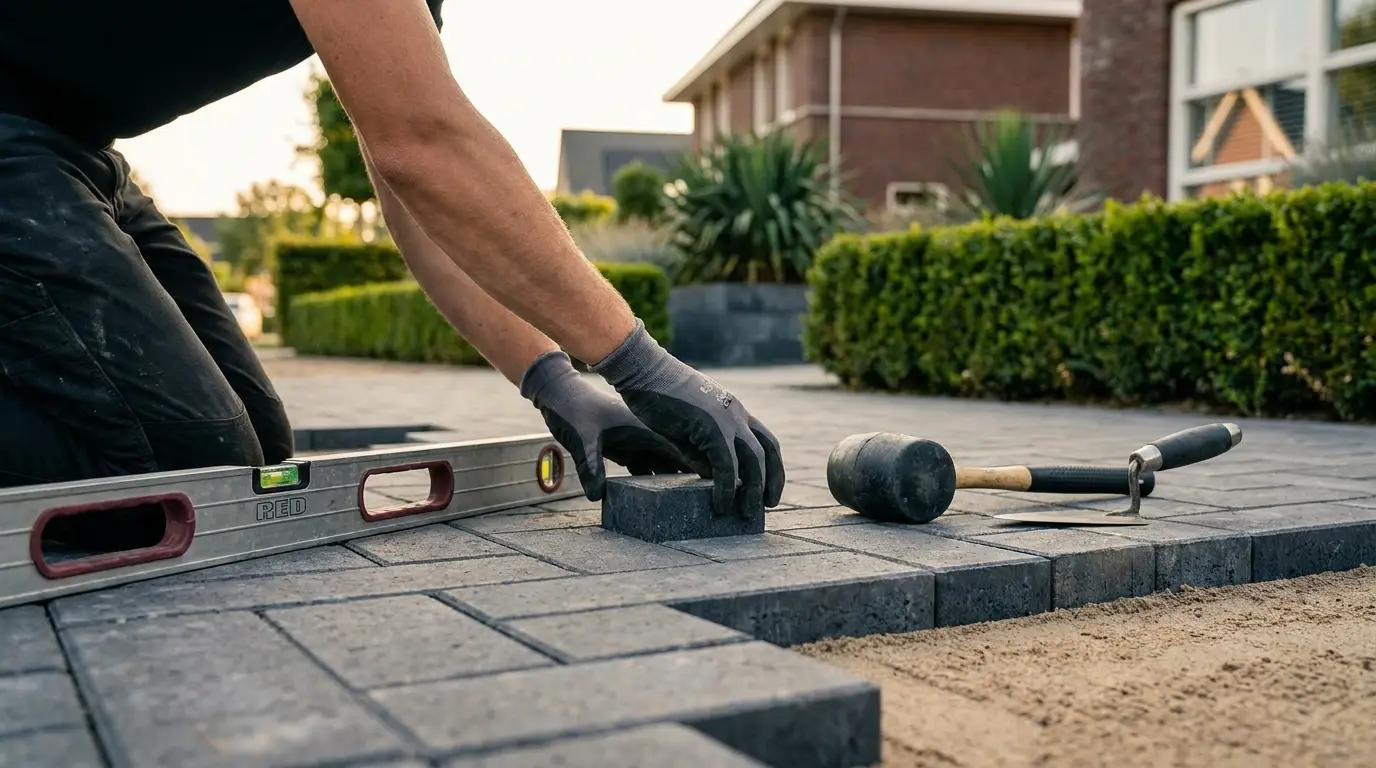
The pavers or tiles are laid on the sand bed in the agreed pattern: running bond, herringbone, or Old Dutch. The paving contractor uses a string line as a guide and a rubber mallet to tap the stones precisely into place. Along edges and obstacles, stones are cut to size.
4–8 hours (depending on area and pattern)
Compacting, jointing, and final inspection
The laid paving is compacted with a plate compactor (with a protective rubber mat) so the pavers settle deeper into the sand bed. Then joint sand or joint mortar is swept in and compacted again. Finally, the paving contractor checks the surface for height differences and the slope for proper drainage.
1–2 hours
6 smart money-saving tips
Frequently asked questions
What does installing paving cost on average?
On average €50–€115 per m², including materials and labor. For 40 m², expect €2,000–€4,600 in total. Concrete pavers are the most popular because of their good value for money.
How long does it take to install paving?
An area of 30–50 m² takes 1 to 3 workdays on average. Larger jobs or special laying patterns take more time. The foundation (leveling the sand bed) often takes up half of the working time.
Do I need a permit for paving?
In most cases, no. However, some municipalities have requirements for permeable paving to prevent flooding. Check with your municipality before you start.
Can I install paving myself?
You can lay simple concrete tiles on level ground yourself. For a driveway, complex patterns, or large areas, a paving contractor is recommended: a poor foundation leads to sinking and higher repair costs.
What does a paving contractor charge per hour?
A paving contractor's hourly rate is on average between €35 and €60 per hour. Many paving contractors charge per m² instead of per hour: expect €15–€25 per m² for labor alone.
How long does paving last?
Quality paving with a good foundation lasts 20 to 40 years. Clay brick pavers and natural stone last even longer than concrete pavers, which can discolor or crumble over time.
Related jobs
Ready to have your paving installed?
Describe your job and receive quotes from verified paving contractors near you.
Within 24 hours
response from a contractor
Verified
all contractors checked
Competitive price
compare quotes