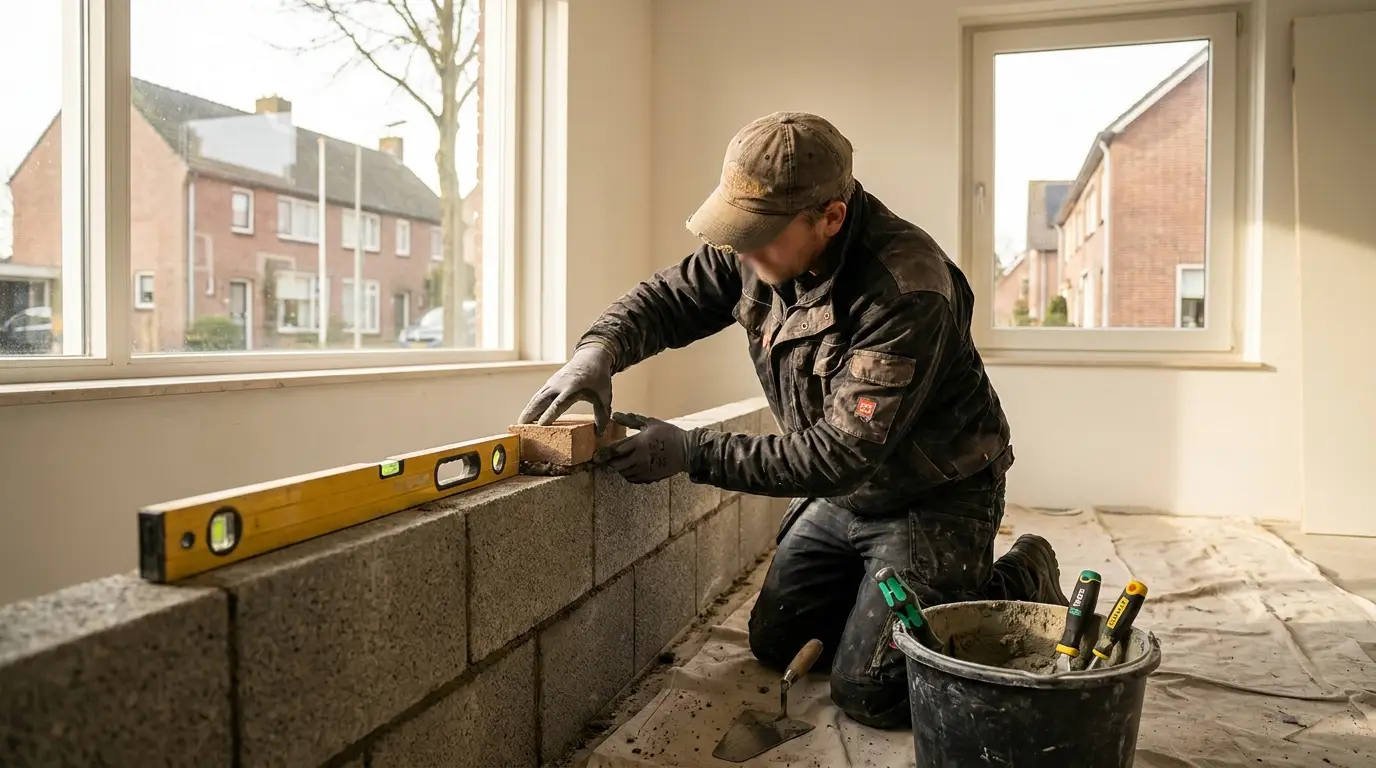
Cost of building an interior masonry wall: everything you need to know
Building an interior masonry wall is a substantial job where skill, the right blocks or bricks, and good preparation make all the difference. The cost depends on the type of brick or block, the wall thickness, the surface area, and additional work such as a foundation or plumbing and wiring. With the right contractor, costs are usually between €70 and €120 per m², including material and labor.
In this article
- ›What does building an interior masonry wall cost?
- ›Prices by type of wall
- ›Material and labor costs
- ›Hire a contractor or do it yourself?
- ›How does the process work?
- ›Money-saving tips
- ›Frequently asked questions
Need a contractor for this?
Describe your job and get quotes from contractors near you.
average price
€2,200
complete average project (approx. 20 m²)
average hourly rate
€35
contractor hourly rate (€30–40/hour)
turnaround time
1–3 days
depending on scope
€ Average price by type
| Interior wall type | Range | Average price |
|---|---|---|
| Large-format blocks (calcium silicate)Popular choice for interior walls, quick to install and well insulating | €70 – €95 | €82avg.incl. installation |
| Half-brick clay brick wall (most chosen)Classic clay brick interior wall, sturdy and durable | €90 – €120 | €105avg.incl. installation |
| Concrete blocks / aerated concreteLight and quick to work with, good sound insulation | €65 – €90 | €78avg.incl. installation |
| Interior cavity wallDouble wall with a cavity, better sound and thermal insulation | €120 – €180 | €150avg.incl. installation |
| Decorative brick or face brick finishInterior wall with visible decorative bricks as a finish | €130 – €200 | €165avg.incl. installation |
Prices include material and labor, per m² of finished masonry, excluding plastering or painting afterward. Based on Google price research.
Material and labor costs
Bricklayer/general contractor hourly rate averages €30–€40/hour. Prices may vary by region; always request multiple quotes.
Hiring a contractor vs. doing it yourself
| Job | Do it yourself | Via a contractor | Savings doing it yourself |
|---|---|---|---|
| Building a non-load-bearing partition wallBuilding a new interior wall from calcium silicate or aerated concrete | With experienceA level first course, even joint thickness, and square corners take quite a bit of practice | €900–€1,400 | up to €700 |
| Building or replacing a load-bearing interior wallStructural wall that supports floor joists, an upper floor, or the roof | Not recommendedPoor workmanship leads to settling or risk of collapse; a structural engineer and contractor are required | €1,800–€3,500 | No recommended savings |
| Cutting a door opening in existing wallsMaking an opening for a new interior door in a masonry wall | Not recommendedRequires temporary shoring, the right lintel, and knowledge of the structure above the opening | €400–€900 | No recommended savings |
| Repairing or touching up mortar jointsRepointing an existing interior wall or replacing loose mortar joints | DoableWith pointing mortar, a jointer, and patience, you can do this job yourself with few tools | €150–€400 | up to €300 |
| Building a small niche or filling a wall openingBuilding in a niche or filling an existing hole in an interior wall | With experienceFinding matching bricks and getting a flush fit is tricky; a color difference with the existing masonry is a risk | €200–€500 | up to €250 |
With some do-it-yourself experience, you can build a non-load-bearing interior wall of aerated concrete or calcium silicate yourself, provided you have a level, a trowel, a mason's block, and the know-how to lay a good first course. But as soon as it involves a load-bearing wall, a door opening in existing masonry, or a wall next to gas lines or electrical wiring, a certified bricklayer or general contractor is essential. Mistakes in a load-bearing structure fall under structural liability and can create a risk of collapse. A contractor also works in line with the Bouwbesluit (the Dutch building code) and, unlike doing it yourself, provides a workmanship warranty.
The full process step by step
Site visit, measurement, and quote
The bricklayer visits the site, measures the exact wall area, and assesses whether the wall is load-bearing or not. They check the subfloor's load capacity and see where electrical, water, or gas lines run that need to be built into the wall. Based on this visit, you receive an itemized quote with the type of brick or block, mortar type, and an overview of openings.
1–2 hours
Setting up the work area and delivering materials
The space around the future wall is cleared and protected with plastic sheeting or hardboard. Bricks or blocks, masonry mortar, reinforcement mesh, and tools are delivered and stored. The bricklayer carefully marks the wall line on the floor and ceiling using a line laser or tape measure and marking pencil.
2–3 hours
Checking the base and laying a level first course
The base of the wall (a threshold, concrete strip, or existing floor) is checked for flatness. Any height differences are leveled out. The first course is laid very carefully, level and on the marked line; this course determines how straight and plumb the entire wall will be.
2–4 hours
Building the wall course by course
Using masonry mortar, the bricks or blocks are laid course by course in a bond pattern. Openings for doors, niches, or pipe chases are included right away using door frames or temporary props. For walls longer than 5 meters or taller than 2.6 meters, horizontal reinforcement is embedded in the joints in line with building code requirements.
1–2 days depending on m²
Lintels above openings
Above each door opening or other opening, a concrete or steel lintel is installed to carry the weight of the wall above. The lintel is supported at the correct bearing depth on both sides and bricked in. After installation, the bricklayer checks that the lintel is level before construction continues.
1–2 hours per opening
Finishing the joints
Once the wall is complete, the joints are leveled. For exposed masonry (a decorative brick finish), the joints are carefully tooled with a jointer; for walls that will be plastered, the joints are roughly filled and lightly smoothed so the plaster adheres well.
2–4 hours
Handover and drying time instructions
The bricklayer checks the finished wall for plumb, flatness, and any imperfections. Construction debris and excess mortar are removed. The customer receives verbal advice on the drying time (at least 4–6 weeks for calcium silicate) before plastering or painting can be done.
1 hour
6 smart money-saving tips
Frequently asked questions
What does building an interior masonry wall cost on average?
On average €70–€120 per m², all-inclusive. For a typical 20 m² room divider wall, expect €1,400–€2,400 in total, depending on the type of brick or block and the complexity.
How long does it take to build an interior masonry wall?
A 15–25 m² wall is usually finished in 1 to 3 workdays. Factors such as openings for doors, plumbing and wiring, and the type of brick or block can extend the timeline.
Do I need a permit for an interior wall?
For a non-load-bearing interior wall, you usually don't need a permit. If the wall is load-bearing or changes the structure of the home, contact your municipality or ask your bricklayer for advice.
Can I build an interior masonry wall myself?
It's technically possible, but masonry takes skill: straight surfaces, even joints, and a solid foundation. A mistake can lead to cracks or unevenness. For load-bearing walls, a contractor is always required.
Which type of brick or block is best for an interior wall?
Calcium silicate (large-format blocks) is the most popular choice thanks to its good sound dampening and speed of installation. Aerated concrete is lighter and insulating. Clay brick is chosen for an attractive, visible finish or high strength.
What are the additional costs of having an interior masonry wall built?
Think of a foundation or threshold connection (€100–€400), openings for doors or pipes, the trip charge, and possibly plastering or painting afterward. Add these to the price per m² for the total bill.
Related jobs
Ready to have your interior wall built?
Describe your job and receive quotes from verified bricklayers near you.
Within 24 hours
response from a contractor
Verified
all contractors checked
Competitive price
compare quotes