Cost of installing or replacing indoor window coverings: everything you need to know
Indoor window coverings make your home more comfortable by keeping out sun, heat, and prying eyes. The cost depends on the type (roller shade, blind, pleated shade, or Roman shade), the dimensions, and the operation. Motorized versions cost more but are built for comfort. On this page, you'll find current prices for all of the Netherlands.
In this article
- ›What does it cost to install or replace indoor window coverings?
- ›Cost by type of indoor window covering
- ›Material and labor cost breakdown
- ›Hiring a contractor vs. doing it yourself
- ›How does installation work step by step?
- ›Money-saving tips for indoor window coverings
- ›Frequently asked questions
Need a contractor for this?
Describe your job and get quotes from contractors near you.
average price
€280
per window incl. installation
average hourly rate
€55
contractor hourly rate (€45–65/hour)
turnaround time
1–2 days
depending on number of windows
€ Average price by type
| Type of indoor window covering | Range | Average price |
|---|---|---|
| Roller shadestandard fabric panel, manual, per window | €90 – €220 | €150avg.incl. installation |
| Pleated or Roman shade (most popular)suits all window shapes incl. roof windows | €150 – €380 | €250avg.incl. installation |
| Blinds (aluminum or wood)horizontal slats, adjustable light | €120 – €450 | €280avg.incl. installation |
| Vertical blindssuitable for wide windows and sliding doors | €180 – €500 | €320avg.incl. installation |
| Electric or motorized window coveringsremote control or smart home connection | €300 – €700 | €480avg.incl. installation |
Prices include standard installation per window; custom-made products and electric systems usually fall in the higher range. Based on Google price research.
Material and labor costs
Window covering installers charge an average of €45–65/hour. Electric systems usually require an extra visit from an electrician for the power connection.
Hiring a contractor vs. doing it yourself
| Job | Do it yourself | Via a contractor | Savings doing it yourself |
|---|---|---|---|
| Hanging a roller shadeStandard fabric panel with included clip or screw brackets | DoableThe manual is enough; a level and cordless drill are all the tools you need | €90–220 | up to €75 saved |
| Installing a pleated shade in a roof window or slanted frameSpecial clip tracks for Velux or other roof window brands | With experienceSize requirements are strict per manufacturer; the wrong model can't be returned | €150–380 | up to €75 saved |
| Installing aluminum or wood blindsHorizontal slats at the exact width of the frame | With experiencePrecise measuring is crucial; a 5 mm difference makes the product unusable | €120–450 | up to €80 saved |
| Vertical blind track systemTrack spanning the full width of a sliding door | With experienceMounting the track perfectly level is tricky over long spans; sagging is visible | €180–500 | up to €110 saved |
| Electric or motorized indoor window coveringsMotor, limit setting, and power connection | Not recommendedConnection to the 230V grid must be done by a licensed electrician in line with NEN 1010 | €300–700 | No recommended savings |
For standard roller shades and manual pleated shades, installing them yourself is very doable for most people: the products come with measurement drawings and screw templates, and a cordless drill with a level is enough. Do make sure you keep the inside measurement (in the frame) and the outside measurement (on the frame) clearly apart: a mistake here leads to an unusable product that can't be returned. For roof windows, motorized operation, or unusual frame shapes, a contractor is essential. Electric systems must be connected to the 230V circuit; this falls under the NEN 1010 standard (the Dutch standard for electrical installations) and may only be done by a licensed electrician. A motorized system without correct limit settings can also overload and break down: repair costs then exceed the savings on installation.
The full process step by step
Measure and choose the type
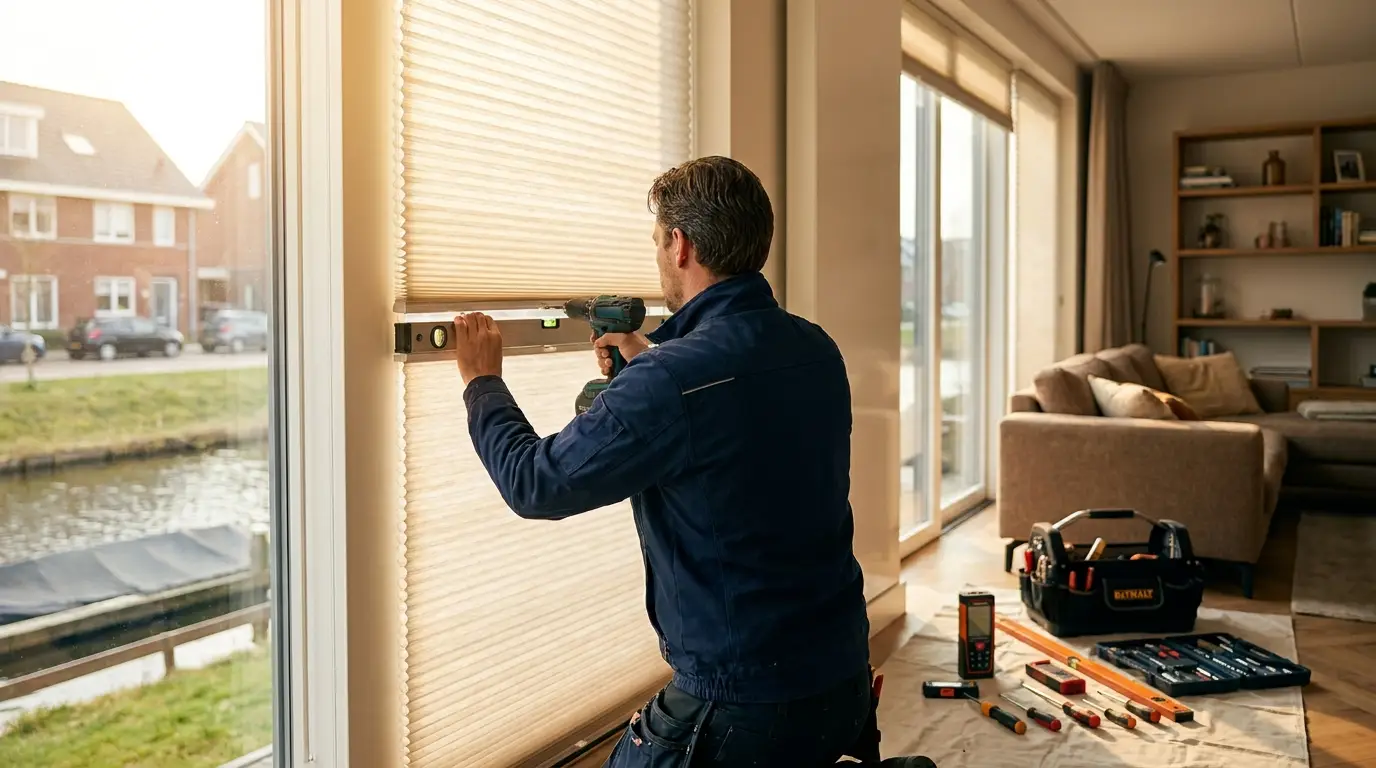
The contractor measures each window: the inside measurement (in the frame) for inside mounting and the outside measurement (on the frame) for outside mounting. For roof windows or slanted windows, the angle and brand are also determined. Based on this, the right type and exact size are set.
15–30 min per home
Confirm product and material choice
Fabric, color, operation (manual or electric), and mounting method are finalized. Custom products such as wood blinds or custom Roman shades are ordered; standard sizes are available right away. The contractor checks that the delivered sizes match the measurements.
1–3 weeks delivery for custom work
Mark the mounting points
Brackets or track ends are laid out level on the frame or wall and marked. For concrete or steel frames, the contractor uses a special drill bit and anchors with higher pull-out strength. The spacing between mounting points determines whether the product hangs straight later.
10–20 min per window
Install and anchor the track or brackets
The brackets are screwed into the drilled points; track systems are clipped or fastened onto the brackets. The contractor checks that the track can carry the weight of the product, especially with wide vertical blinds or heavy fabrics.
10–15 min per window
Hang and adjust the window coverings
The shade, blind, or pleated shade is hung in the brackets or track. For manual products, the operation and return brake are adjusted. For electric systems, the contractor connects the motor to the power circuit and sets the upper and lower limits so the motor can't overload.
10–25 min per window
Check, align, and hand over
The contractor tests the operation, light blocking, and even hanging. All windows in the same room are aligned at the same height. Packaging and drill dust are cleaned up. For electric systems, the resident gets an explanation of the remote control or app connection.
15–30 min total
6 smart money-saving tips
Frequently asked questions
What does it cost on average to install indoor window coverings?
On average €150 to €450 per window, including installation. A basic roller shade starts at around €90 excluding installation; blinds or a motorized version can run up to €700 per window.
How long does it take to install indoor window coverings?
A contractor installs one window in 20 to 45 minutes. For an average home with 6 to 10 windows, you're usually done in one day. Custom-made products have a delivery time of 1 to 3 weeks.
Do I need a permit for indoor window coverings?
No, indoor window coverings don't require a permit. It's an interior change with no effect on the building's structure or the streetscape.
Can I install indoor window coverings myself?
Standard roller shades and pleated shades can be installed yourself using the included instructions. For electric or motorized systems, a contractor is recommended because of the electrical connection.
Which is cheaper: indoor or outdoor window coverings?
Indoor window coverings are considerably cheaper than outdoor ones. Outdoor coverings easily cost €500 to €3,000 per unit; indoor coverings start at just €90 per window. Outdoor coverings block heat more effectively before it reaches the glass.
Which type of indoor window covering do most Dutch people choose?
Pleated and Roman shades are the most popular because of their versatility: they fit roof windows, slanted windows, and standard frames. Roller shades are the cheapest choice and are widely used in bedrooms.
Related jobs
Ready to have your indoor window coverings installed or replaced?
Describe your job and receive quotes from verified window covering contractors near you.
Within 24 hours
response from a contractor
Verified
all contractors checked
Competitive price
compare quotes