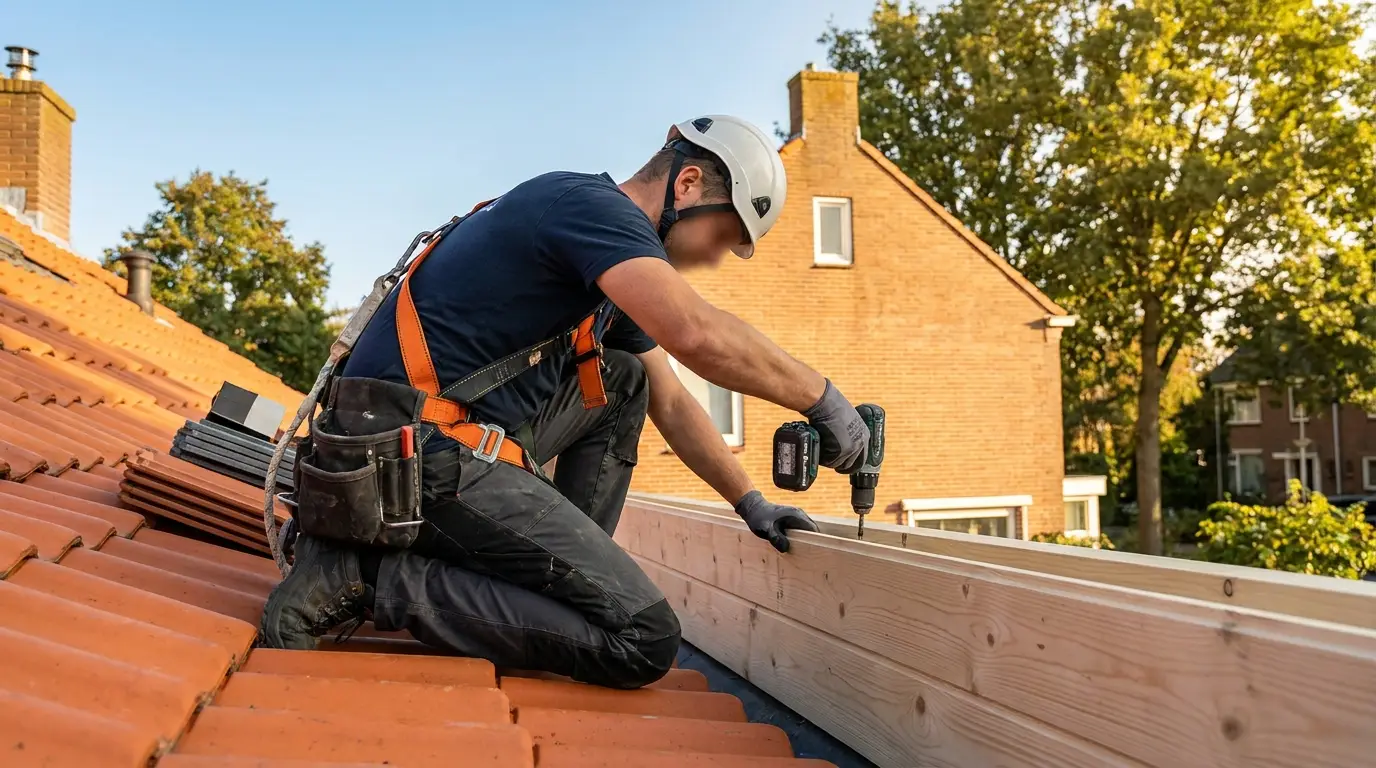
Cost of replacing fascia boards: everything you need to know
Fascia boards protect the roof edge and exterior walls from rain and moisture. The cost of replacing them depends on the material you choose (wood, PVC, Keralit, or Trespa), the total length, and the condition of the structure underneath. On average, for a row house you'll pay between €700 and €2,500, including labor and materials.
In this article
- ›What does replacing fascia boards cost?
- ›Prices by material type
- ›What are the additional costs?
- ›Hire a contractor or do it yourself?
- ›How does the replacement process work?
- ›Money-saving tips for fascia boards
- ›Frequently asked questions
Need a contractor for this?
Describe your job and get quotes from contractors near you.
average price
€1,200
including materials and labor
average hourly rate
€45
roofer hourly rate (€40–55/hour)
turnaround time
1–2 days
depending on scope and material
€ Average price by type
| Fascia board type | Range | Average price |
|---|---|---|
| Wood fascia boardspine or spruce, including base treatment | €700 – €1,200 | €950avg.incl. installation |
| PVC fascia boards (most popular)PVC, low maintenance, 25+ year lifespan | €900 – €1,800 | €1,300avg.incl. installation |
| Keralit fascia boardscellular PVC, wood look, paintable | €1,100 – €2,000 | €1,550avg.incl. installation |
| Trespa fascia boardsresin-pressed panel, exterior grade, premium | €1,400 – €2,500 | €1,950avg.incl. installation |
Prices include labor and standard fasteners for an average row house; scaffolding or aerial lift costs may be charged separately. Based on Google price research.
Material and labor costs
Roofer hourly rate averages €40–55/hour. Rates vary by region and contractor; in complex situations (two stories, end-of-row house) contractors usually charge more hours.
Hiring a contractor vs. doing it yourself
| Job | Do it yourself | Via a contractor | Savings doing it yourself |
|---|---|---|---|
| Installing PVC fascia boards at ground-floor levelOne short strip along the roof edge, one story max, flat wall | With experienceRequires a stable rolling scaffold and basic sawing and screwing skills along the roof edge | €250–€500 | up to €300 |
| Applying a finish coat of paint to wood fascia boardsMaintenance paint job after installation, no structural replacement | DoableVery doable on a one-story home with a household ladder or small scaffold and quality exterior paint | €100–€300 | up to €200 |
| Replacing wood fascia boards on two storiesEntire side of the roof, working height above 5 meters | Not recommendedSerious fall risk; precise alignment and watertight sealing require expertise | €500–€900 | No recommended savings |
| Entire home all around (all roof sides including rake boards)Full replacement, multiple corners and connections to gutters | Not recommendedComplex corner joints, great working height, and the required scaffolding setup make this unsuitable for do-it-yourselfers | €700–€1,500 | No recommended savings |
| Temporarily sealing a loose, damaged fascia boardEmergency repair with sealant or tape as a stopgap until full replacement | DoableSimple, temporary fix at a reachable height; use a suitable MS polymer exterior sealant | €30–€80 | up to €60 |
With fascia board work, the biggest risk factor is working height. As soon as the roof edge is higher than five meters, which is already the case with two stories, a certified roofer with professional scaffolding equipment is the safest and most reliable choice. A roofer also knows how to get the measurements right and how to seal corners and gutter connections watertight, a common stumbling block for do-it-yourselfers. Small subtasks, however, are easy to do yourself: applying a finish coat of exterior paint to existing wood fascia boards on a one-story home, or temporarily sealing a loose board with exterior sealant, are things a capable do-it-yourselfer can safely do without specialized training. There are no legal certification requirements for replacing fascia boards, but for work at height the Arbowet (the Dutch Working Conditions Act) requires a safely set-up work environment, which makes a rolling scaffold or certified aerial lift essential.
The full process step by step
Inspection and measuring
The roofer inspects the existing fascia boards for rot, loosening, and moisture damage. They measure the total linear meters per roof side and assess the condition of the purlins and roof sheathing behind them, so hidden damage is identified before the job starts.
30–60 min
Setting up scaffolding or an aerial lift
A rolling scaffold or mobile aerial lift is set up for safe work along the roof edge. With more than one story, an inspected scaffolding system is required. The scaffolding is positioned so all roof sides to be replaced can be reached.
1–2 hours
Removing the old fascia boards
The existing boards or profiles are unscrewed or pried loose and hauled away. At the same time, the roofer checks the purlins, rake boards, and gutter connections for rot or warping. Any rot damage becomes visible now and is discussed right away.
1–3 hours
Cutting and installing new fascia boards
The new boards or PVC profiles are cut to size and fastened to the purlins with stainless steel screws or nails. With PVC and Keralit, expansion gaps are left to prevent warping as temperatures change.
2–5 hours
Finishing corners, connections, and sealing
Outside corners, inside corners, and gutter connections are finished with matching trim profiles or paintable exterior sealant. For wood fascia boards, the primer is applied now; the finish coat follows once it's dry.
1–2 hours
Cleanup, scaffolding removal, and handover
Waste material is hauled away, the area around the home is cleaned, and the scaffolding is removed. The roofer walks through the finished fascia boards with you so you can approve the installation and finish.
30–60 min
6 smart money-saving tips
Frequently asked questions
What does replacing fascia boards cost on average?
On average €1,200 including materials and labor for a row house. The range is €700–€2,500, depending on the type of material, the size of the home, and the condition of the structure underneath.
How long does replacing fascia boards take?
For a row house, a contractor usually needs 1 day. For larger detached homes or multiple sides of the roof, plan on 1 to 2 days. Drying time for any finish coat isn't included.
Do I need a permit for new fascia boards?
No, for a like-for-like replacement (same dimensions, similar appearance) you don't need a building permit. Do you live in a protected historic district or own a landmark building? Then always check with the municipality first.
Can I replace fascia boards myself?
It's technically possible if you have roofing experience and can work safely at height. You'll need scaffolding or an aerial lift in any case. For most customers, hiring a contractor is cheaper and safer, especially with two or more stories.
What's the difference between a boeiboord and a boeideel?
The terms are used interchangeably. A boeiboord (or boeideel) is the wood or PVC board along the roof edge that covers the roof structure and protects it from moisture and wind. Rake boards are the sloped pieces on the sides of the roof.
How long do new fascia boards last?
Wood fascia boards last 20–30 years with good maintenance. PVC and Keralit last 30–50 years without painting. Trespa has a similar lifespan and is highly weather-resistant.
Related jobs
Ready to have your fascia boards replaced?
Describe your job and get quotes from verified roofers near you.
Within 24 hours
response from a contractor
Verified
all contractors checked
Competitive price
compare quotes