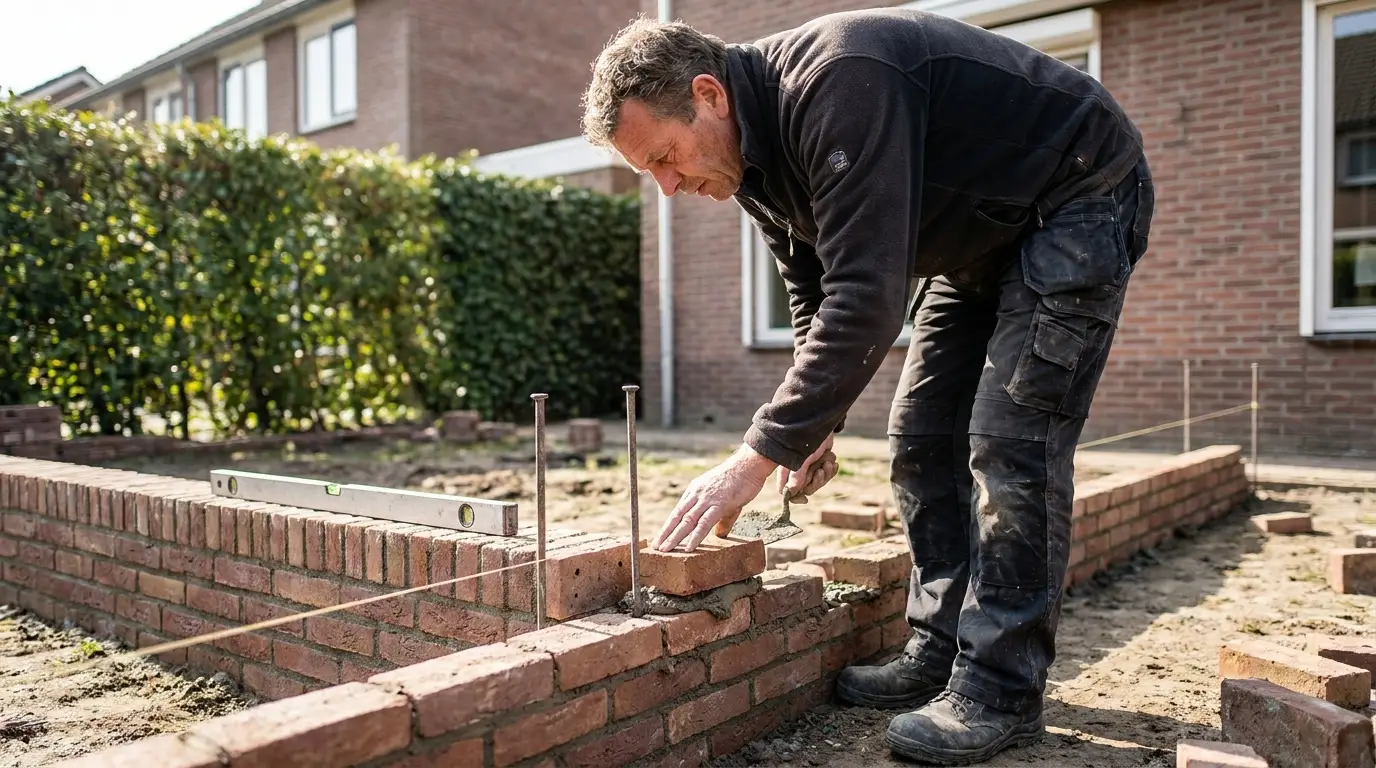
Cost of building a brick exterior wall or garden wall: everything you need to know
Building a brick exterior wall or garden wall takes frost-resistant bricks, a solid foundation, and a contractor who knows how to keep moisture and cracking out. The cost depends on the type of brick, the height and length of the wall, the foundation, and the finish. For facade masonry, expect €150–€250 per m² including material and labor; a garden wall usually costs €100–€180 per m², plus €80–€150 per linear meter for the foundation.
In this article
- ›What does it cost to build a brick exterior wall or garden wall?
- ›Prices by type of wall
- ›Material and labor costs
- ›Hire a contractor or do it yourself?
- ›How does the process work?
- ›Money-saving tips
- ›Frequently asked questions
Need a contractor for this?
Describe your job and get quotes from contractors near you.
average price
€3,400
average garden wall (approx. 15 m² incl. foundation)
average hourly rate
€35
mason hourly rate (€30–40/hour)
turnaround time
2–4 days
depending on scope and weather
€ Average price by type
| Type of exterior wall or garden wall | Range | Average price |
|---|---|---|
| Concrete block garden wall (stacking blocks)Budget-friendly garden wall of concrete blocks, smooth or rough finish | €100 – €140 | €120avg.incl. installation |
| Half-brick garden wall (most popular)Classic brick garden wall of frost-resistant brick | €120 – €180 | €150avg.incl. installation |
| Brick facade wall (cavity wall)Exterior facade with cavity, insulation connection, and flashing | €150 – €250 | €200avg.incl. installation |
| Natural stone garden wallGarden wall of natural stone or stone veneer strips, rugged look | €180 – €300 | €240avg.incl. installation |
| Brick boundary wall with piers and rounded copingWall with brick columns and a finished rowlock course as a cap | €160 – €260 | €210avg.incl. installation |
Prices include material and labor, per m² of finished masonry, excluding the foundation (€80–€150 per linear meter) and any excavation. Based on Google price research.
Material and labor costs
Mason hourly rate averages €30–€40/hour. Prices may vary by region; always request multiple quotes.
Hiring a contractor vs. doing it yourself
| Job | Do it yourself | Via a contractor | Savings doing it yourself |
|---|---|---|---|
| Building a low garden wall (up to 1 meter)Short wall as a border divider or around a patio | With experienceDoable with a good foundation, frost-resistant bricks, and a level first course. Take plenty of time for it | €800–€1,500 | up to €600 |
| Facade wall or load-bearing exterior masonryExterior facade with cavity, flashing, and connection to the structure | Not recommendedMistakes in the cavity, lead flashing, or expansion joints lead to leaks and structural damage; a contractor is essential | €3,000–€7,500 | No recommended savings |
| Pouring a foundation for a garden wallDigging a trench to frost-free depth and pouring a concrete strip | With experienceDigging and pouring is physically demanding; the strip must be level, at depth, and of the right concrete grade | €800–€1,500 | up to €500 |
| Repairing the pointing of an existing wallRaking out worn or loose joints and repointing | DoableEasy to do yourself with pointing mortar, a jointer, and patience; only for large surfaces is a pointing contractor worth it | €200–€600 | up to €400 |
| Building a tall boundary wall (over 1.8 meters)Tall wall with piers that must withstand significant wind load | Not recommendedWind load requires piers and reinforcement; above 1 meter in front of and 2 meters behind the facade, a permit is also required (check with your municipality) | €2,500–€5,000 | No recommended savings |
You can build a low garden wall on a solid foundation yourself with some DIY experience, as long as you use frost-resistant bricks and lay the first course perfectly level. Once the wall gets taller, borders a public road, or is part of the facade, it becomes real skilled work: wind load, expansion joints, flashing, and a damp-proof base course against rising damp all need precision. A brick wall that falls over or cracks isn't just a waste of money; with a boundary wall, it's also a liability risk toward neighbors and passersby. A contractor also knows the permit rules and, unlike doing it yourself, provides a workmanship warranty.
The full process step by step
Site visit, measurement, and quote
The mason inspects the location, measures the length and height of the wall you want, and assesses the ground. They discuss the type of brick and the finish (rounded coping, rowlock course, or wall caps), and check whether there are cables or pipes in the ground and whether a permit is needed. Based on this, you receive an itemized quote including the foundation and excavation.
1–2 hours
Excavation and pouring the foundation
A trench is dug for the wall to frost-free depth, usually 60–80 centimeters. A concrete strip footing is poured into it, with reinforcement where needed. The frost-free depth is essential: a foundation that's too shallow gets pushed up by freezing ground, which cracks the wall. The concrete needs a few days to cure before bricklaying begins.
1 day + curing time
Laying the damp-proof base course and flashing
The bottom courses are laid as a damp-proof base course: water-resistant mortar and clinker bricks that block rising damp from the ground. For facade work, lead flashing or DPC membrane is also built into the joints, so water that penetrates is drained outward instead of into the structure.
2–4 hours
Building the wall course by course with expansion joints
The wall is laid in a bond pattern, with a perfectly level first course as the base. On long walls, vertical expansion joints are added every 6 to 8 meters to absorb expansion and shrinkage from temperature changes: without these joints, exterior masonry is almost guaranteed to crack. Piers (brick columns) give tall or long walls extra stability against wind.
1–2 days depending on m²
Capping the wall: rounded coping or wall caps
The top of the wall is finished with rounded coping (a sloped rowlock course), concrete wall caps, or natural stone coping slabs. This capping lets rainwater run off and prevents water from soaking into the masonry from above, the main cause of frost damage to garden walls.
2–4 hours
Finishing the pointing
Once the mortar has set enough, the joints are finished: flush, recessed, or brushed, depending on the look you want. Good pointing protects the wall against water penetration and largely determines the final appearance of the masonry.
3–5 hours
Handover and aftercare
The mason checks the wall for plumb, flatness, and neat pointing, and cleans up construction debris and excess mortar. Fresh exterior masonry needs protection from driving rain and frost for the first few days, for example with plastic sheeting. Outdoor work always depends on the weather: no bricklaying is done below 5 degrees or in persistent rain, so allow for possible delays in the schedule.
1 hour
6 smart money-saving tips
Frequently asked questions
What does it cost per m² to build a brick exterior wall or garden wall?
Facade masonry costs an average of €150–€250 per m², including frost-resistant brick, cavity, and labor. A garden wall is simpler to build and costs €100–€180 per m². For a garden wall 10 meters long and 1.5 meters high, that comes to €1,500–€2,700 for the masonry, plus €800–€1,500 for the foundation.
Do I need a permit for a brick boundary wall?
A boundary wall up to 1 meter high can almost always be built without a permit. Behind the front building line, a maximum of 2 meters usually applies; in front of the facade, anything above 1 meter usually requires a permit. The exact rules depend on your lot and the bestemmingsplan (the local zoning plan): always check with your municipality first.
Does a garden wall need a foundation?
Yes, almost always. A brick wall easily weighs hundreds of kilos per linear meter and will settle and crack without a foundation. A concrete strip footing at frost-free depth (60–80 cm) costs €80–€150 per linear meter. Only for very low walls on stable, paved ground can a lighter solution sometimes be enough.
Which brick is best for exterior masonry?
Always choose a frost-resistant brick. Hard-fired clay brick (clinker brick) is the standard for facades and garden walls: strong, colorfast, and resistant to moisture and frost. Concrete brick is cheaper and has a clean look; natural stone is the most expensive but very durable. Soft interior bricks aren't suitable outdoors: they flake apart in frost.
How long does it take to build a brick exterior wall or garden wall?
A garden wall of 10–15 m², including the foundation, is usually finished in 2 to 4 workdays: one day of digging and pouring, a few days of curing, and then one to two days of bricklaying and pointing. Outdoor work also depends on the weather: no bricklaying is done in frost or persistent rain.
Can I build a garden wall myself?
A low garden wall up to about 1 meter is doable with some DIY experience, as long as the foundation is sound and you use frost-resistant bricks. Taller walls, facades, and load-bearing work are a job for a contractor: they make sure of the right expansion joints, flashing, and a wall that stays upright for decades.
Related jobs
Ready to have your exterior wall or garden wall built?
Describe your job and receive quotes from verified masons near you.
Within 24 hours
response from a contractor
Verified
all contractors checked
Competitive price
compare quotes