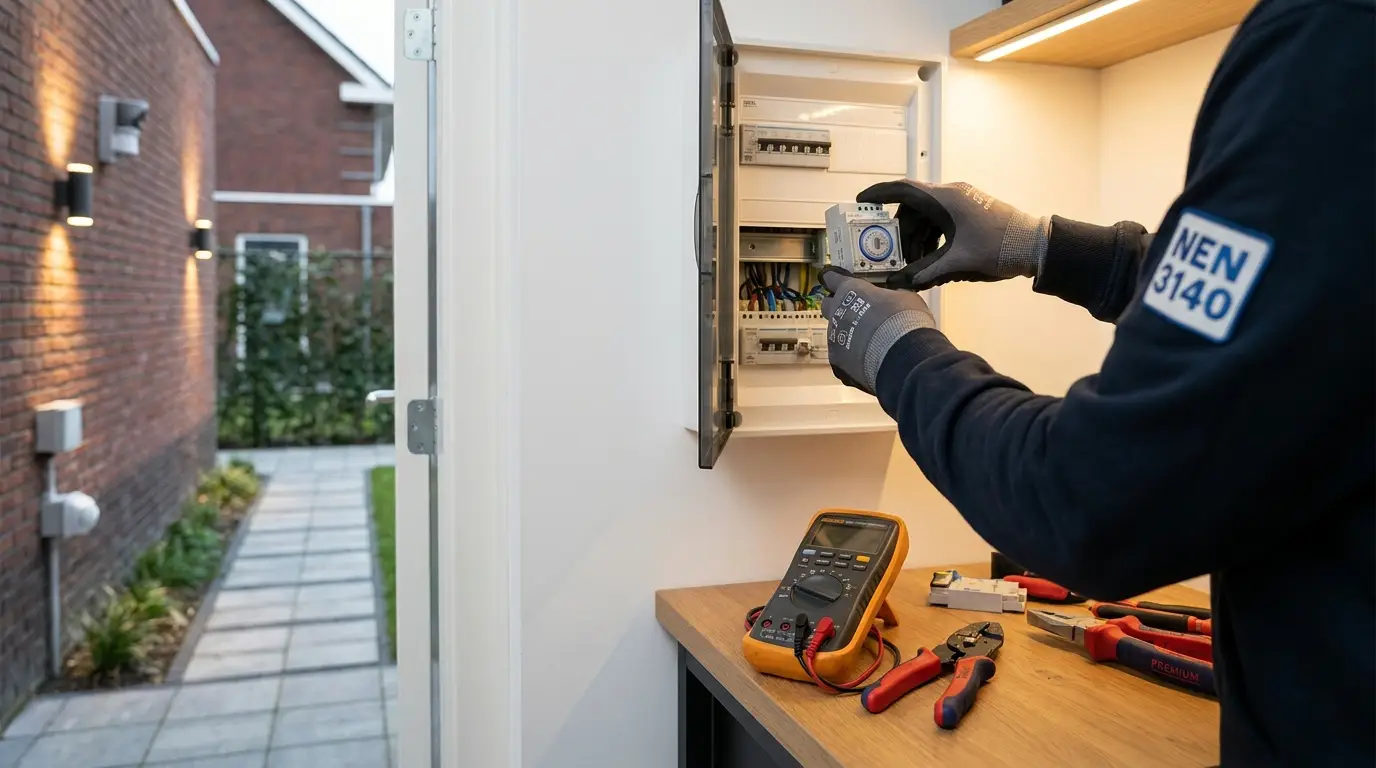
Cost of outdoor lighting with a sensor or timer: everything you need to know
Outdoor lighting with a motion sensor or timer makes your home safer and more comfortable, and it saves energy. The total cost depends on the number of light fixtures, the type of sensor (motion, dusk-to-dawn, or timer), and whether there's already existing outdoor wiring. An electrician typically spends one to three hours of installation time per light fixture.
In this article
- ›What does outdoor lighting with a sensor or timer cost?
- ›Cost by type of installation
- ›Material and labor costs
- ›Hire an electrician or do it yourself?
- ›How does the installation work?
- ›Money-saving tips for outdoor lighting
- ›Frequently asked questions
Need a contractor for this?
Describe your job and get quotes from contractors near you.
average price
€450
1–2 outdoor lights with sensor, including labor
average hourly rate
€65
contractor hourly rate (€55–80/hour)
turnaround time
1–2 days
depending on number of light fixtures
€ Average price by type
| Type of outdoor lighting | Range | Average price |
|---|---|---|
| Simple replacement of existing fixtureExisting outdoor outlet or connection, only the fixture replaced, including sensor | €150 – €350 | €250avg.incl. installation |
| 1–2 light fixtures with motion sensor (most popular)Standard situation: new wiring up to 5 m, fixture with PIR sensor, connection to existing circuit | €300 – €650 | €450avg.incl. installation |
| Complete installation with timer and dusk-to-dawn switch2–4 light fixtures, sensor/timer combination, possibly a dedicated circuit in the breaker panel | €550 – €1,000 | €750avg.incl. installation |
| Extensive system with multiple light fixtures4+ fixtures, extensive cable trenches, separate circuit, smart home integration possible | €900 – €1,800 | €1,300avg.incl. installation |
Prices include materials and VAT; cable work over more than 5 meters or extra circuits in the breaker panel increase the cost. Based on Google price research.
Material and labor costs
Electrician hourly rate averages €55–€80/hour. Most businesses charge a separate trip charge (€25–€50).
Hiring a contractor vs. doing it yourself
| Job | Do it yourself | Via a contractor | Savings doing it yourself |
|---|---|---|---|
| Replace a plug-in outdoor light with sensorExisting outdoor outlet (230V) present; only swap the fixture with built-in PIR sensor | DoableNo fixed wiring: just plug in and mount | €40–€120 materials | up to €130 saved |
| Install 12V garden path lighting with timerLow-voltage system via a garden transformer, cables buried shallow or along the edge | DoableRuns on safe low voltage, no electrician's license needed | €80–€220 materials | up to €180 saved |
| Install a solar light with dusk-to-dawn switchStandalone solar panel light without wiring, placed directly in the ground or on the exterior wall | DoableCompletely wire-free, no electrician or tools needed | €30–€150 materials | up to €100 saved |
| Run wiring for a new 230V light fixtureCable from the breaker panel or existing junction point through or along the exterior wall, watertight entry | Not recommendedCertified electrician required by law (NEN1010); outdoors = extra moisture risk | €300–€650 contractor | No legal savings possible |
| Separate circuit in the breaker panel for outdoor lightingInstall a new RCD or circuit breaker in the breaker panel for a dedicated outdoor circuit | Not recommendedBreaker panel work requires a licensed electrician; inspection by the grid operator may follow | €200–€450 contractor | No legal savings possible |
Outdoor lighting has a clear boundary: as soon as you work with fixed 230V wiring (running a new cable along or through the exterior wall, branching off an existing circuit, or making changes in the breaker panel), you're required by law to hire a certified electrician. Outdoors, the combination of voltage and moisture is extra dangerous: connections that aren't watertight (IP rating lower than IP44) can lead to short circuits, fire, or electrocution. A licensed electrician installs in accordance with NEN1010 (the Dutch standard for electrical installations), uses the right outdoor cable (VMVL or NYM-J), and works with certified junction boxes and cable glands. What you can do yourself: replace plug-in fixtures on an existing outdoor outlet, place solar spotlights, and connect 12V garden systems to a garden transformer. If you're unsure about the existing wiring or the IP rating of your fixture, always have an electrician check it first.
The full process step by step
Assess the site and determine locations
The electrician inspects the exterior wall and the property, determines the best position for each fixture (sensor field of view, height, lighting zone), and plans the cable route. They check whether outdoor wiring is already present, what the IP protection rating of the existing connections is, and whether the existing circuit has enough spare capacity.
30–60 min
Prepare the cable route and install wall penetrations
Where needed, cable channels are mounted or narrow grooves are cut along the exterior wall. Wall penetrations are fitted with watertight seals (at least IP65) so moisture can't creep inside through the cable entry. In masonry walls, the opening is sealed with caulk or mortar after the cable is pulled.
30–90 min
Pull the wiring and connect it to the circuit
The outdoor cable (VMVL or NYM-J, suitable for outdoor and underground use) is run to the meter cabinet or an existing junction point. For a new light fixture, the electrician installs a suitable circuit breaker or residual current device (RCD), the European counterpart of a GFCI, in the breaker panel in accordance with NEN1010. All outdoor connections are made in certified IP65 junction boxes.
30–75 min
Mount the fixture and seal it watertight
The outdoor light is mounted in the planned position (on the exterior wall, a post, or a soffit) and connected. The entry between the fixture and the cable is sealed watertight with a sealing ring or caulk. With multiple fixtures, each mounting is checked separately for sturdiness and watertightness.
15–45 min per fixture
Adjust the sensor, timer, and dusk-to-dawn switch
The PIR sensor is adjusted for detection range (typically 5–12 m), sensitivity, and on-time (30 sec to 10 min). For a timer or dusk-to-dawn switch, the schedules or threshold values are programmed. The electrician checks that nearby heat sources (heating pipe, glass) don't cause false triggers and adjusts the sensor's direction.
15–30 min
Testing, measuring, and handover
Each light fixture is tested separately: switch, sensor, timer, and dusk-to-dawn function. The electrician measures the leakage current and checks the insulation resistance of the outdoor wiring. The customer gets a short explanation of how to adjust the sensor and timer and receives the installation documentation for any future inspections.
15–30 min
6 smart money-saving tips
Frequently asked questions
What does outdoor lighting with a sensor cost on average?
On average €450 for 1–2 light fixtures, including labor and materials. The range runs from €150 (simple replacement) to €1,800 (extensive system with multiple fixtures and a dedicated circuit).
How long does the installation take?
For 1–2 light fixtures, an electrician usually needs 1 to 3 hours. For more extensive systems with cable trenches or extra circuits in the breaker panel (inside the meter cabinet, where the electricity meter and the breaker panel are), the job can take one to two days.
Do I need a permit?
No, regular outdoor lighting at a home doesn't require a building permit. For a landmark building or a home in a protected historic district, the municipality has additional rules.
Can I do it myself?
You can install plug-in models and 12V systems yourself. As soon as fixed 230V wiring or a new circuit in the breaker panel is involved, a certified electrician is required by law in the Netherlands.
Which type of sensor is best for outdoor lighting?
A PIR motion sensor is ideal for driveways and entrances. A dusk-to-dawn switch with a timer is handy for accent lighting that turns on automatically in the evening and off in the morning. Combination models offer the most flexibility and are the most popular.
How much will I save on my energy bill?
With LED fixtures and a motion sensor, the light is on 80–90% fewer hours than a light that's always on. That saves an average of €30–€60 per light fixture per year at the current electricity rate of about €0.40 per kWh.
Related jobs
Ready to have your outdoor lighting with a sensor or timer installed?
Describe your job for free. Checked electricians near you respond, and you choose who to continue with.
Within 24 hours
response from a contractor
Verified
all contractors checked
Competitive price
compare quotes