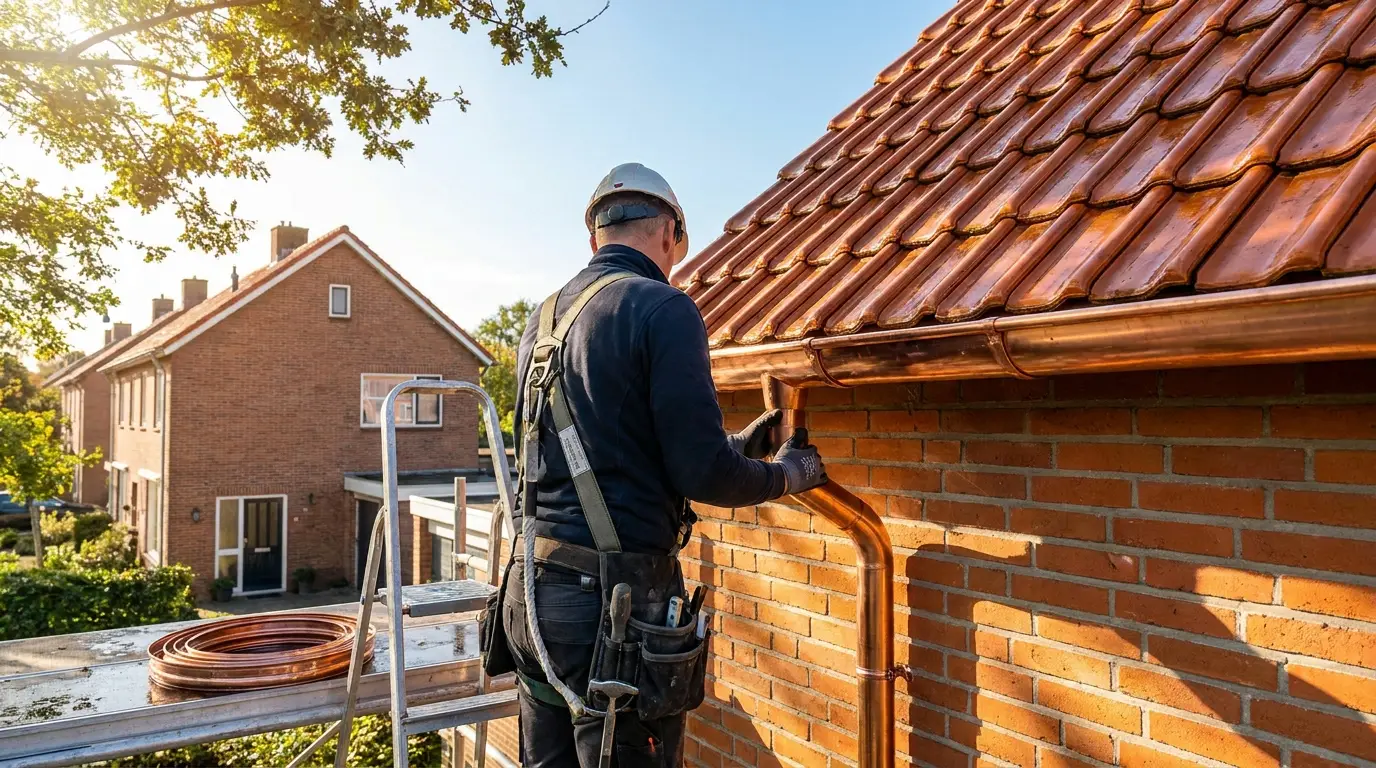
Cost of installing or replacing gutters and downspouts: everything you need to know
Gutters and downspouts protect your home against water damage and damage to the facade. The cost depends heavily on the material (PVC, zinc, aluminum, or copper), the length of the roof section, and accessibility. In this overview you'll find current Dutch prices and practical tips to save money.
In this article
- ›Average cost of gutters and downspouts
- ›Prices by material (PVC, zinc, aluminum, copper)
- ›Material and labor cost breakdown
- ›Hire a contractor or do it yourself?
- ›Step by step: how does the job work?
- ›Money-saving tips for gutters
- ›Frequently asked questions
Need a contractor for this?
Describe your job and get quotes from contractors near you.
average price
€1,100
complete row house (front and back)
average hourly rate
€52
contractor hourly rate (€45–60/hour)
turnaround time
1–2 days
depending on length and material
€ Average price by type
| Gutter type / job | Range | Average price |
|---|---|---|
| PVC guttercheapest option, lifespan 15–20 years | €400 – €900 | €600avg.incl. installation |
| Zinc gutter (most chosen)most popular choice, durable and low-maintenance | €700 – €1,800 | €1,100avg.incl. installation |
| Aluminum gutterlightweight, rustproof, and modern look | €700 – €1,600 | €1,050avg.incl. installation |
| Copper gutterpremium material, lifespan 50–80 years | €1,500 – €4,000 | €2,500avg.incl. installation |
| Downspout replacement (each)including brackets and fittings, about 4 meters | €200 – €600 | €380avg.incl. installation |
Prices include material and installation for a standard row house; detached houses or hard-to-reach roof edges are 20–40% higher. Based on Google price research.
Material and labor costs
Roofer hourly rate on average €45–€60/hour. Scaffolding or an aerial lift is charged separately and isn't included in the hourly rate.
Hiring a contractor vs. doing it yourself
| Job | Do it yourself | Via a contractor | Savings doing it yourself |
|---|---|---|---|
| Replace a PVC gutterSnap-fit system without special tools, suitable for one roof section | DoableTechnically feasible as long as you can work safely at height with solid scaffolding or an articulating ladder | €150–€350 | up to €300 |
| Replace a downspout (PVC)Screw and socket connections, about 3–5 meters per pipe | DoableMake sure it connects correctly to the sewer or infiltration point and the brackets are mounted properly | €60–€120 per pipe | up to €200 |
| Install a zinc gutterRequires soldering connections and checking the slope | With experienceOnly feasible if you have proven roofing experience and own the right soldering equipment | €350–€900 | No recommended savings |
| Install an aluminum gutterThermal expansion requires precise bracket and connection technique | With experienceIncorrect bracket installation leads to sagging or leaks when temperatures change | €300–€800 | No recommended savings |
| Install a copper gutterSpecialized folding and soldering skills required, expensive material | Not recommendedMistakes in copper work are costly to fix and cause leaks at the facade and foundation | €800–€2,500 | No legal savings possible |
Working at height is by far the biggest risk in gutter work. As soon as the roof edge is higher than 3 meters or scaffolding is unavoidable, the savings on labor don't outweigh the risk of falling. Snap-fit PVC systems can technically be installed by a handy do-it-yourselfer, but only if a stable scaffolding system or a certified articulating ladder is available. With zinc, aluminum, and copper, the risks are different: soldering technique and precise slope calculations require a contractor's experience. A gutter installed too flat collects water, wears out faster, and can lead to wood rot in the fascia board or damage to the facade and foundation: repair costs that are many times the labor costs you saved. For materials other than PVC, a roofer is almost always the sensible choice.
The full process step by step
Inspection and measuring
The roofer assesses the condition of the existing gutters, brackets, and downspouts for cracks, warping, corrosion, and loose connections. The total gutter length per roof section and the number of downspouts are measured. The contractor also determines which type of scaffolding or alternative (aerial lift, articulating ladder) is needed based on the height of the roof edge and accessibility.
30–60 minutes
Discuss the quote and order materials
Based on the measurements, the material is specified: PVC, zinc, aluminum, or copper, including brackets, connectors, outlets, and elbows. The contractor discusses the choice of material and price differences with you. Once you agree, the material is ordered. Typical delivery times are 1–3 business days.
1–3 business days (preparation)
Set up scaffolding or use an aerial lift
For a safe workspace, scaffolding is set up along the roof edge, or an aerial lift is used for larger and less accessible buildings. This is usually arranged by the roofer or a scaffolding company. The scaffolding cost is invoiced separately.
1–3 hours
Remove old gutters and brackets
The existing gutters are detached and removed. Rusted or broken brackets are replaced at the same time. The roof edge and fascia board are checked for wood rot or mold; if any is found, the contractor reports it before continuing, so it can be fixed as additional work.
1–2 hours
Mount new brackets at the correct slope
The new brackets are installed at the right slope: at least 3 millimeters per linear meter toward the outlet to the downspout. A slope that's too flat is the most common cause of standing water and premature gutter wear. The roofer checks the slope with a level or slope gauge.
1–2 hours
Install gutter sections and finish connections
The gutter sections are placed in the brackets and joined with connectors, elbows, and end caps. With PVC, connections are snapped together and glued; with zinc and copper, joints are soldered. The outlets to the downspouts are installed and checked for leaks.
2–4 hours
Connect downspouts, test, and hand over
The downspouts are connected to the outlets and fastened to the facade with brackets. The connection to the municipal sewer, an infiltration crate, or a rain barrel is checked. The entire installation is tested under pressure with a garden hose. Once approved, the old material is hauled away and the scaffolding is removed.
1–2 hours
6 smart money-saving tips
Frequently asked questions
What does replacing gutters cost on average?
On average €1,100 for a row house. The range runs from €400 (small PVC job) to €4,000 (copper gutters all around a detached house). Most customers pay €700–€1,800.
How long does installing or replacing gutters take?
A standard row house is done in 1 workday. For a detached house with gutters on all sides or with difficult access, the job can take 2 days.
Do I need a permit for gutters?
No, in the vast majority of cases you don't. Only for historic buildings or in a protected historic district can the municipality set additional requirements for the material or color.
Can I replace PVC gutters myself?
Technically yes: PVC systems use snap-fit connections that can be installed without special tools. You do need a sturdy ladder or scaffolding, though. Zinc and copper require soldering and are almost always installed by a contractor.
What's the difference between repairing and replacing?
Small leaks or loose brackets can be repaired for €100–€350. If the gutters are warped, heavily corroded, or more than 20 years old, replacement is more cost-effective in the long run.
Which material is the most cost-effective in the long run?
Zinc offers the best value for money: more durable than PVC (25–35 years), a lot cheaper than copper, and virtually maintenance-free. Copper wins on lifespan (50–80 years) but costs 3–4 times as much to buy.
Related jobs
Ready to have your gutters installed or replaced?
Describe your job and receive quotes from verified roofers near you.
Within 24 hours
response from a contractor
Verified
all contractors checked
Competitive price
compare quotes