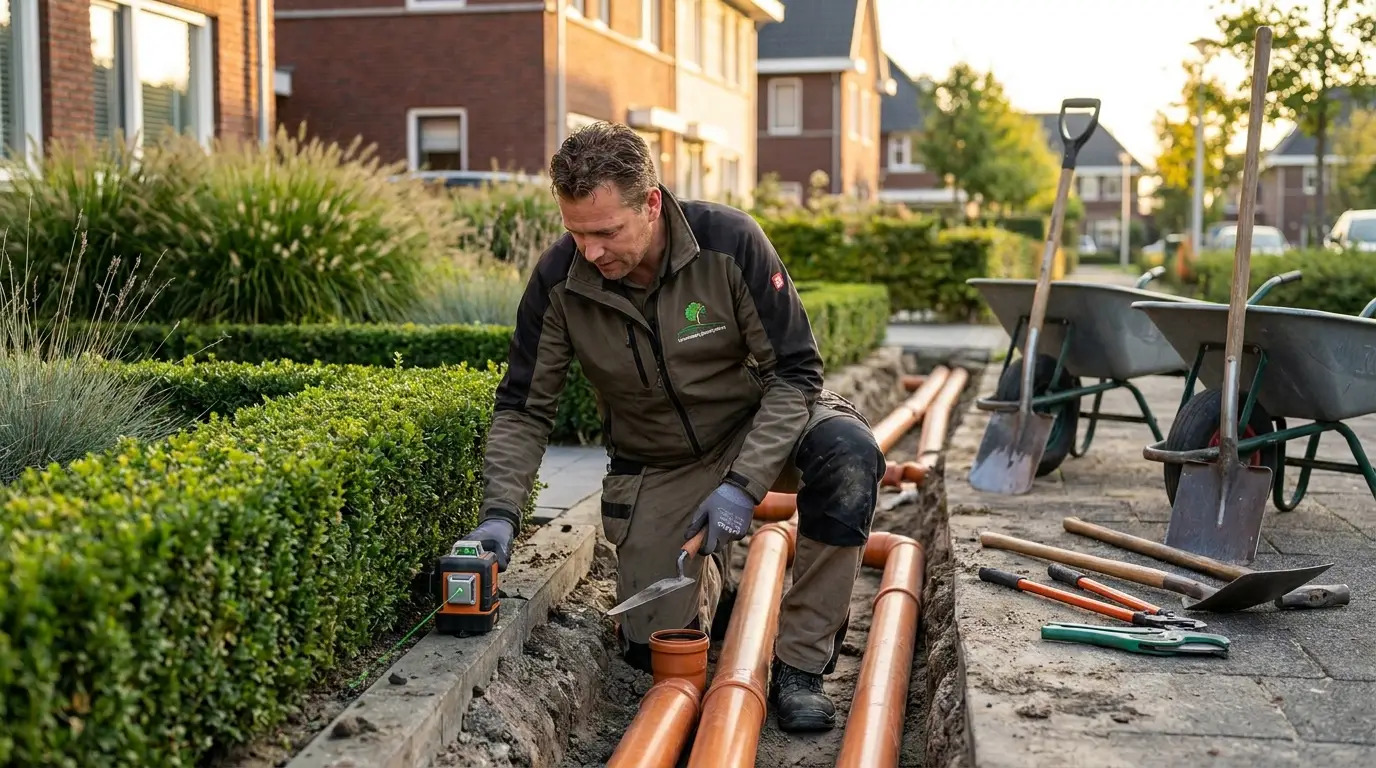
Cost of installing drainage: everything you need to know
Installing drainage prevents flooding in your yard and around your home. The cost depends on the type of system, the soil conditions, and the length of the drain line. On average, you'll pay between €800 and €2,200 for a complete drainage system.
In this article
- ›Average cost of installing drainage
- ›Prices by type of drainage system
- ›Material and labor costs
- ›Hire a contractor or do it yourself?
- ›How does installing drainage work?
- ›Money-saving tips for installing drainage
- ›Frequently asked questions
Need a contractor for this?
Describe your job and get quotes from contractors near you.
average price
€1,300
complete drainage system incl. labor costs
average hourly rate
€55
contractor hourly rate (€45–65/hour)
turnaround time
1–3 days
depending on scope and soil type
€ Average price by type
| Drainage system type | Range | Average price |
|---|---|---|
| Basic drainage, sandy soilSingle drain pipe, short length (up to 20 m), loose soil | €500 – €1,000 | €750avg.incl. installation |
| Standard yard drainage (most popular)Drain pipe with filter wrap, 30–60 m, including inspection well | €900 – €1,600 | €1,300avg.incl. installation |
| Drainage for clay soil or a high water tableAdvanced system with drainage around the house, deeper digging required | €1,400 – €2,500 | €1,950avg.incl. installation |
| Drainage around a foundation or basementPerimeter drainage or basement drainage pit, including pump and well | €2,000 – €4,500 | €3,250avg.incl. installation |
Prices include labor costs and standard materials; soil removal and special pumps are charged separately. Based on Google price research.
Material and labor costs
Paver/landscaper hourly rate averages €45–65/hour. Excavation equipment can add extra costs with clay soil or narrow access.
Hiring a contractor vs. doing it yourself
| Job | Do it yourself | Via a contractor | Savings doing it yourself |
|---|---|---|---|
| Basic yard drainage on sandy soil (up to 20 m)Dig a short drain pipe into loose sandy soil, discharge into an adjacent ditch or wadi | With experienceDoable with basic excavation skills and a level: a slope of at least 0.5% is crucial | €500–€1,000 | up to €400 |
| Installing an inspection wellSet a prefab plastic inspection well in the ground and connect it to the drain pipe | DoableAn easy job if the trench is already open; prefab wells are easy to install | €60–€180 | up to €100 |
| Standard yard drainage with filter wrap (30–60 m)Drain pipe with geotextile, gravel bed, inspection well, and connection to the municipal sewer | Not recommendedConnecting to the sewer requires municipal permission; an incorrect slope leads to flooding | €900–€1,600 | No recommended savings |
| Drainage for clay soil or a high water tableDeep digging (60–80 cm), multi-line pipe network, soil analysis required | Not recommendedClay soil requires heavy excavation equipment and soil expertise; mistakes are costly and hard to fix | €1,400–€2,500 | No recommended savings |
| Perimeter drainage around a foundation or basementDeep perimeter drainage, sump pit, submersible pump: structurally critical work | Not recommendedIncorrect installation can cause ground subsidence and structural damage to the house | €2,000–€4,500 | No legal savings possible |
For most drainage jobs, a contractor is essential. Once drainage is installed deeper than 60 cm, sits in clay soil, runs around a foundation, or is connected to the municipal sewer, specialized knowledge and machinery are required. An incorrectly installed system (too little slope, the wrong filter wrap, or too shallow a depth) not only fails to work but causes ground subsidence, basement leaks, or a fine from the municipality. Only short yard drainage on loose sandy soil with an open outlet to a ditch or wadi is doable for an experienced DIYer. You'll need a trencher or small excavator, knowledge of the required slope (at least 0.5 cm per meter), and an understanding of local drainage rules. Installing a prefab inspection well is a part of the job you can do yourself once the trench is open.
The full process step by step
Inspection and soil assessment
The contractor assesses your yard on site: they measure the water table, determine the soil type (sand, clay, or peat), and map out the discharge options. Based on this, they recommend the right type of drainage system and the required pipe length and depth.
1–2 hours
Marking the route and digging trenches
The route of the drain line is measured and marked with stakes. Then the trenches are dug to the specified depth, usually 40–80 cm, with the required slope of at least 0.5 cm per linear meter toward the discharge point.
2–6 hours
Laying the gravel bed and placing the drain pipes
A layer of drainage gravel (10–15 cm) is spread on the bottom of the trench as a filter bed. The perforated drain pipes, covered with a geotextile filter wrap to prevent clogging, are laid on the gravel bed and covered with a second layer of gravel.
2–4 hours
Installing the inspection well and connecting the system
A plastic inspection well is installed at the lowest point or at the end of the drainage line. The drainage is connected to the sewer, an infiltration drain, or an adjacent ditch. For a sewer connection, the contractor checks that municipal permission has been granted and fits a backflow valve.
1–3 hours
Backfilling trenches and restoring the yard
The trenches are backfilled in layers with the excavated soil, and each layer is compacted to prevent settling. Then the yard is restored: grass, flower beds, tiles, or paving are put back or topped up where needed.
2–4 hours
Flow test and handover
The system is tested by running a large amount of water into the inspection well. The contractor checks that the water drains freely, no standing water remains in the pipes, and the slope is correct. Once approved, the job is handed over with written instructions for periodically flushing the pipes.
30–60 min
6 smart money-saving tips
Frequently asked questions
How much does installing drainage cost on average?
On average, you'll pay about €1,300 for a drainage system in your yard. The range runs from €500 for a basic system on sandy soil to over €4,500 for drainage around a foundation or basement.
How long does it take to install drainage?
An average job takes 1 to 3 days. Clay soil, larger yards, or drainage around a foundation can extend that to 4 or 5 days.
Do I need a permit to install drainage?
Drainage in your yard usually doesn't require a permit. If the drainage discharges into the sewer, permission from the municipality is sometimes required. If it drains into surface water (a ditch or pond), you're required to notify the waterschap (the regional Dutch water authority).
Can I install drainage myself?
You can install basic yard drainage on sandy soil yourself if you have experience with excavation work. For drainage around a foundation, on clay soil, or with a connection to the sewer, we recommend a contractor: mistakes are expensive to fix.
What determines the price of installing drainage?
The main cost factors are the length of the drain line, the soil type (sand vs. clay), the required digging depth, the type of system (single line or perimeter drainage), and the discharge options (sewer, ditch, or infiltration drain).
What's the difference between yard drainage and basement drainage?
Yard drainage is installed shallower (30–60 cm) to carry off rainwater quickly. Basement drainage (perimeter drainage) sits deeper, around the foundation, and intercepts groundwater. Basement drainage is more complex and more expensive: €2,000–€4,500 on average.
Related jobs
Ready to have drainage installed?
Describe your job and receive quotes from verified excavation contractors near you.
Within 24 hours
response from a contractor
Verified
all contractors checked
Competitive price
compare quotes