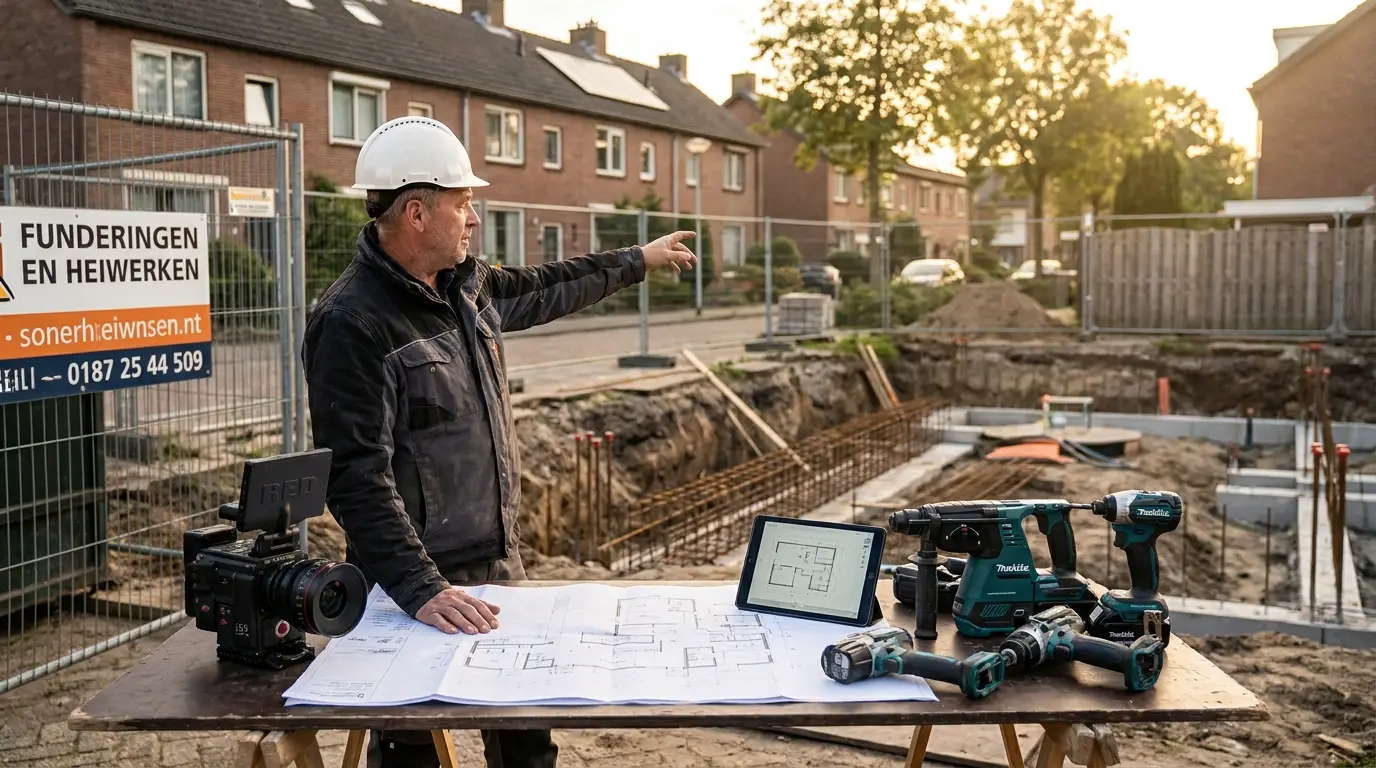
Cost of foundations and pile driving: everything you need to know
Foundations and pile driving are essential for new construction, additions, and foundation repair. The cost depends on the type of foundation, the soil type, the number of piles, and how accessible the building site is. Based on Google price research, we give you an honest and up-to-date overview.
In this article
- ›Average cost of foundations and pile driving
- ›Prices by type of foundation
- ›Material and labor costs
- ›Hire a contractor or do it yourself?
- ›How does the foundation process work?
- ›Money-saving tips
- ›Frequently asked questions
Need a contractor for this?
Describe your job and get quotes from contractors near you.
average price
€15,000
foundation including pile driving
average hourly rate
€65
contractor hourly rate (€55–80/hour)
turnaround time
3–10 days
depending on scope
€ Average price by type
| Foundation / pile driving type | Range | Average price |
|---|---|---|
| Pile driving per pile (new construction)precast concrete pile, including driving and boring | €500 – €1,200 | €850avg.incl. installation |
| Complete home foundation (most popular)pile driving + concrete slab + reinforcement, average row house | €7,500 – €20,000 | €13,000avg.incl. installation |
| Foundation repair (partial)local repair, limited number of piles replaced | €5,000 – €15,000 | €9,000avg.incl. installation |
| Foundation repair (complete)full foundation replacement for an existing home | €15,000 – €50,000 | €28,000avg.incl. installation |
| Foundation for an addition or extensionstrip foundation or footings including concrete slab | €3,000 – €10,000 | €6,000avg.incl. installation |
Prices are estimates based on Google price research; final costs depend on soil type, accessibility, and number of piles. Based on Google price research.
Material and labor costs
General contractor hourly rate averages €60–80/hour. Pile driving is usually quoted as a day rate including equipment.
Hiring a contractor vs. doing it yourself
| Job | Do it yourself | Via a contractor | Savings doing it yourself |
|---|---|---|---|
| Driving pilesdriving precast concrete piles or screw piles into the ground down to the load-bearing layer | Not recommendedRequires a specialized pile driving rig, knowledge of soil mechanics, and a certified foundation company; heavy machinery can't be rented by private individuals | €500–€1,200 per pile | No legal savings possible |
| Foundation repair on an existing homereplacing or reinforcing a rotted or settled foundation | Not recommendedStructural work on an existing building; requires a building permit, structural calculations, and a licensed foundation company: mistakes lead to instability or cracking | €700–€1,500/m² | No recommended savings |
| Earthwork and manual excavationdigging by hand around the foundation or in narrow strips | With experienceLimited manual digging (shovel and wheelbarrow) is doable for motivated DIYers; mechanical digging with a mini excavator requires a driver's license and experience | €800–€2,500 | up to €600 |
| Footing foundation for a small additionpouring concrete footings for a light extension or garden shed on stable sandy soil | With experienceOnly feasible on proven load-bearing sandy soil, for structures without load-bearing walls; have a structural engineer confirm the soil conditions first | €1,500–€4,000 | up to €1,200 |
| Foundation inspectionvisual inspection of the crawl space and foundation for cracks or rot | FeasibleThe owner can inspect the crawl space with a flashlight; for a binding report, you need a building surveyor or foundation expert | €300–€900 | up to €400 |
Foundations and pile driving are among the heaviest and most risk-sensitive work in construction. Both pile driving and foundation repair are structural interventions that require a permit, meaning a building permit and structural calculations by a licensed structural engineer are mandatory. A mistake in the pile plan (piles that are too short, the wrong pile density, or insufficient reinforcement) can lead to uneven settlement, cracks in walls, and in the worst case instability of the home. That's why you should always hire a licensed foundation company or a certified building contractor. What a DIYer can do: carry out a visual inspection of the crawl space (look for cracks, damp spots, or loose concrete), dig out a small patch of ground by hand for a utility line or drainage pipe, and pour simple concrete footings for a light garden shed or shed on proven stable sandy soil. For everything else (as soon as load-bearing structures, piles, or repairing an existing foundation are involved), a contractor isn't just recommended but legally required.
The full process step by step
Soil investigation and soil test report
A geotechnical consultant carries out a cone penetration test: a steel probe is pushed into the ground at a constant speed while resistance values are measured. This determines at what depth the load-bearing sand layer begins and how long the piles need to be. Without this report, a reliable foundation calculation isn't possible.
1–3 days
Structural calculations and permit application
A structural engineer translates the soil test report into a pile plan: the number of piles, the dimensions, the pile diameter, and the reinforcement requirements for the concrete slab. Based on this plan, the general contractor submits a building permit application to the municipality. This is mandatory for both new construction and foundation repair.
2–8 weeks (permit)
Site preparation and excavation
The building site is cleared: utilities are located and rerouted if necessary, access for the pile driving rig is set up, and the ground is excavated to the required depth. For foundation repair, the crawl space is also cleared and the old foundation exposed.
0.5–2 days
Pile driving
The pile driving rig drives precast concrete piles or screw piles down to the load-bearing layer. The drop hammer or hydraulic jack works systematically through the pile plan. On average, 8 to 15 piles are completed per day. After each pile, the final depth is recorded and compared with the soil test report.
1–3 days
Pouring the concrete slab and reinforcement
A reinforced concrete pile-supported slab is placed on top of the installed piles. The rebar installer places the steel mesh or bars according to the structural drawing. Then the concrete is poured and finished. The slab distributes the load of the structure evenly across all piles.
1–2 days + 3–7 days curing time
Inspection and handover
The structural engineer or the municipal building inspector checks whether the pile depths, pile spacing, and reinforcement match the approved drawings. After written approval, the superstructure can be built. The general contractor hands over the final measurements of all pile depths as part of the handover package.
0.5–1 day
6 smart money-saving tips
Frequently asked questions
What do foundations and pile driving cost on average?
On average €15,000 for a complete foundation with pile driving for a home. The range runs from €5,000 for a small addition to €50,000 for a complete foundation repair on an existing home.
How long do foundations and pile driving take?
Driving the piles takes 1 to 3 days. The complete foundation, including the concrete slab and curing time, takes 5 to 10 workdays on average. For foundation repair with a preliminary investigation, the total lead time can be 2 to 4 weeks.
Do I need a permit for foundation work?
Most foundation work and pile driving requires a building permit. This certainly applies to repairing an existing foundation or to new construction. Your general contractor usually arranges this as part of the job.
Can I do foundation work myself?
No. Foundations and pile driving require specialized knowledge, heavy machinery, and an understanding of soil mechanics. This isn't suitable for DIYers. Always hire a licensed foundation company or a certified building contractor.
What affects the price of pile driving the most?
The soil type (peat, clay, or sand), the number and length of the piles needed, the accessibility of the building site, and the type of pile (precast concrete or screw pile) largely determine the final cost.
What's the difference between piles and a footing foundation?
Piles are driven into the ground down to a load-bearing layer and are suitable for soft soil (peat or clay). A footing foundation consists of concrete blocks on the ground and is used on load-bearing, stable soil. Footing foundations are cheaper, but they can't always be used.
Related jobs
Ready to have your foundation built or repaired?
Describe your job and receive quotes from verified foundation contractors near you.
Within 24 hours
response from a contractor
Verified
all contractors checked
Competitive price
compare quotes