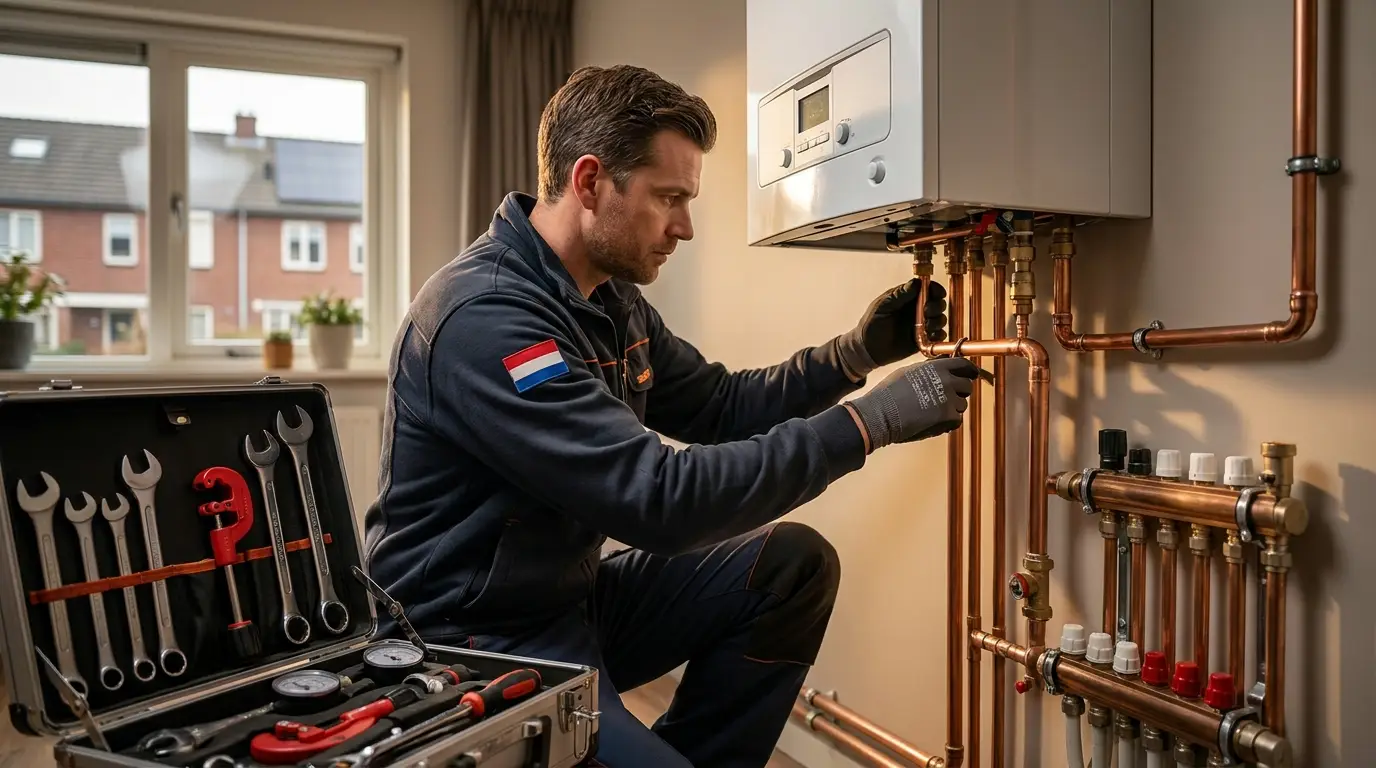
Cost of installing or replacing a gas line: everything you need to know
Installing or replacing a gas line is custom work: the length of the line, the type of home, and accessibility largely determine the price. On average, you'll pay between €450 and €2,000 for a complete gas installation or replacement, including materials and labor. A licensed plumber is required: you must never do gas work yourself.
In this article
- ›What does it cost to install or replace a gas line?
- ›Prices by type of job
- ›Material and labor costs
- ›Hiring a contractor vs. doing it yourself
- ›How does the process work?
- ›Money-saving tips
- ›Frequently asked questions
Need a contractor for this?
Describe your job and get quotes from contractors near you.
average price
€1,100
gas line up to 15 meters, incl. materials and labor
average hourly rate
€65
licensed gas fitter (€55–75/hour)
turnaround time
1–2 days
depending on scope and complexity
€ Average price by type
| Type of gas line job | Range | Average price |
|---|---|---|
| Small adjustment or repairmoving or replacing 1 connection, max. 5 meters | €250 – €600 | €400avg.incl. installation |
| New connection or extensioninstalling 5–15 meters of extra indoor gas line | €450 – €1,100 | €750avg.incl. installation |
| Partial replacement (most popular)replacement per floor or per room, 10–20 meters | €800 – €1,800 | €1,200avg.incl. installation |
| Full replacement, entire homeall gas lines replaced, incl. main shutoff valve and connection points | €1,500 – €3,500 | €2,500avg.incl. installation |
| Outdoor line to outbuilding or yardunderground or aboveground connection, 10–30 meters | €600 – €2,000 | €1,100avg.incl. installation |
Prices are estimates based on Google price research and include materials and labor; demolition and repair are charged separately. Based on Google price research.
Material and labor costs
Licensed gas fitter (plumber) hourly rate averages €55–75/hour. A pressure test and safety inspection are required after all gas work.
Hiring a contractor vs. doing it yourself
| Job | Do it yourself | Via a contractor | Savings doing it yourself |
|---|---|---|---|
| Installing or fully replacing a gas linerunning a new route or replacing existing indoor lines | Not recommendedLegally reserved for NEN 7244 certified plumbers | €450–€3,500 | No legal savings possible |
| Replacing a gas valve or main shutoff valveswapping an existing shutoff valve or main valve on the gas line | Not recommendedCounts as licensed gas work, even small adjustments | €150–€350 | No legal savings possible |
| Demolition and preparing pipe channelscutting channels in walls or floors for the pipe route | DoableYou can do this yourself: always discuss the route with the plumber first | €0 (yourself) vs. €150–€400 | up to €400 |
| Repair work after the pipingfilling channels, plastering, or tiling once the line is installed | With experienceSimple plastering or tiling is doable with some skill | €0 (yourself) vs. €100–€400 | up to €400 |
| Requesting and comparing quotesposting your job for free; plumbers show interest and you choose who to talk to | DoableAlways do this: price differences of up to 20–25% between plumbers are normal | Free via VakmanBaas | up to €300 |
In the Netherlands, gas work is legally reserved exclusively for NEN 7244 certified plumbers. This applies without exception: from a new gas line to replacing a shutoff valve or extending an existing route. Tinkering with gas lines yourself isn't just prohibited, it also voids your homeowners insurance and can leave you with major personal liability in case of damage or fire. What you can do yourself: the preparatory demolition (cutting channels, drilling holes) and the repair work afterward (plastering, tiling). Always discuss this with the plumber in advance so the route is mapped out correctly and your preparation fits their working method. That way, you save €150–€800 without doing a single bit of gas work yourself.
The full process step by step
On-site inspection and measuring
The licensed plumber looks at the existing gas installation, determines the desired pipe route, and measures the total length. They also assess the condition of the main shutoff valve, existing connection points, and the pipe diameter needed for the consumption of the connected appliances.
30–60 min
Quote and coordination
Based on the inspection, you'll receive an itemized quote covering materials, labor, the pressure test, and any demolition. Once you agree, a workday is scheduled. For larger projects, the plumber also coordinates with the grid operator or (for rental homes) the landlord.
1–3 days
Shutting off the gas supply and demolition
The gas fitter safely shuts off the gas supply at the main shutoff valve. Next, the channels are cut and pass-through holes are drilled. You can prepare this part yourself to save on installation costs, provided the plumber has mapped out the route in advance.
1–3 hours
Installing or replacing the gas line
The new line, copper or flexible stainless steel, is laid piece by piece, connected with approved fittings and shutoff valves, and secured along the route. The gas fitter works in accordance with NEN 7244 and makes all couplings leak-free using the correct soldering or press method.
3–8 hours
Pressure test and safety inspection
After the piping work, a legally mandatory pressure test is required: the installation is pressurized to detect leaks. This is followed by a safety inspection of the entire gas installation. Only after approval is the gas turned back on.
1–2 hours
Installation report and handover
The plumber prepares an installation report in accordance with NEN 7244. This document proves the work was done professionally and is required when selling the home. You'll also receive the warranty documentation for the materials.
15–30 min
Wall and floor repair
Pipe channels are filled and walls or floors are repaired. You can do this repair work yourself or schedule it later with a separate contractor. The plumber cleans up their work area, and the home is immediately livable again.
1–4 hours (or yourself)
6 smart money-saving tips
Frequently asked questions
What does it cost on average to install or replace a gas line?
On average, you'll pay €1,100 for a mid-sized gas line job. The range runs from €250 (small repair) to €3,500 (full replacement of the entire home). Factors include length, material type, complexity, and the amount of demolition work.
How long does it take to install or replace a gas line?
An average job takes 1 to 2 workdays. Simple adjustments are sometimes done the same day. Fully replacing all gas lines in an older home can take 2 to 3 days.
Do I need a permit for a new gas line?
Indoor work usually doesn't require a building permit. The work must, however, be done by an NEN 7244 certified plumber (certified under NEN 7244, the Dutch standard for gas installations). Afterward, a mandatory pressure test and safety inspection always take place.
Can I install or repair a gas line myself?
No. By law, gas work may only be done by a licensed plumber. Tinkering with gas lines yourself is dangerous and prohibited. Your regional grid operator and your insurer also require a professional installation.
What does a gas line cost per meter?
Indoors, a gas line costs on average €25 to €50 per meter including labor. Outdoors (e.g., to a shed), you'll pay €20 to €45 per meter. The material itself costs €3 to €12 per meter, depending on whether it's copper or flexible stainless steel.
When is it wise to have gas lines replaced?
Lead or zinc gas lines (from before 1970) are outdated and need to be replaced. Replacement or adjustment is also needed during renovations, with a persistent gas smell, a new central heating boiler, or an expansion of the gas lines in your home.
Related jobs
Ready to have your gas line installed or replaced?
Describe your job for free. Checked plumbers near you respond, and you choose who to continue with.
Within 24 hours
response from a contractor
Verified
all contractors checked
Competitive price
compare quotes