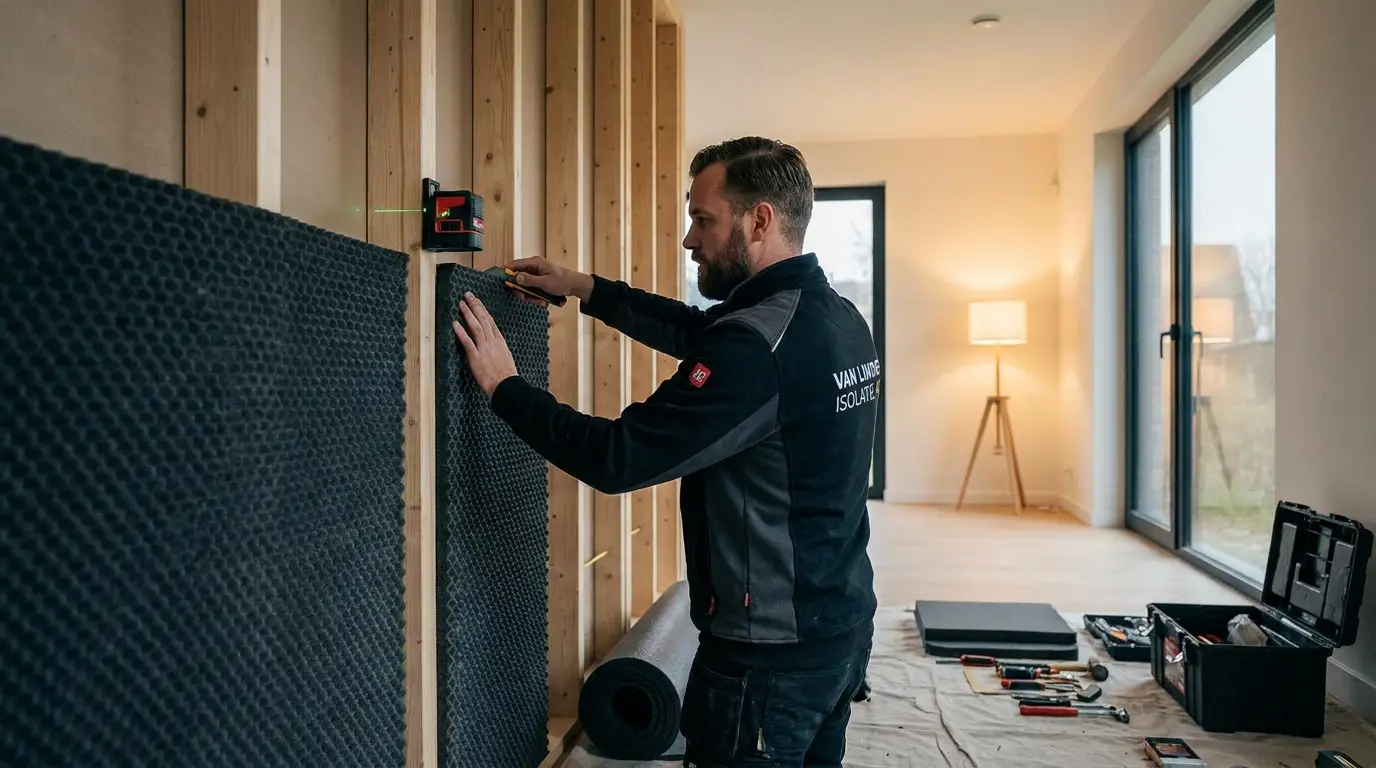
Cost of sound and vibration insulation for your home: everything you need to know
Noise from neighbors, traffic, or vibrations from a railway can seriously spoil the enjoyment of your home. With the right sound and vibration insulation, you can lower the noise level considerably. The cost depends on which surfaces you want to insulate, the type of noise (airborne or impact noise), and the floor area of your home.
In this article
- ›What does sound and vibration insulation cost?
- ›Prices by type of insulation
- ›Material and labor costs
- ›Hire a contractor or do it yourself?
- ›How does the process work?
- ›Money-saving tips
- ›Frequently asked questions
Need a contractor for this?
Describe your job and get quotes from contractors near you.
average price
€2,800
average for 1 room (approx. 20 m²)
average hourly rate
€55
contractor hourly rate (€45–65/hour)
turnaround time
1–3 days
depending on scope
€ Average price by type
| Insulation type | Range | Average price |
|---|---|---|
| Floor insulation (impact noise)floating floor or vibration isolation mat, approx. 20 m² | €600 – €1,200 | €900avg.incl. installation |
| Wall insulation (1 wall, most popular)furred-out wall with acoustic insulation, approx. 12 m² | €800 – €1,800 | €1,300avg.incl. installation |
| Ceiling insulation (1 room)dropped ceiling or acoustic ceiling tiles, approx. 20 m² | €900 – €1,800 | €1,350avg.incl. installation |
| Wall + ceiling combinationcomplete acoustic treatment of 1 room | €1,800 – €3,500 | €2,600avg.incl. installation |
| Complete room (floor + wall + ceiling)maximum sound and vibration insulation, approx. 20 m² | €2,800 – €5,500 | €4,000avg.incl. installation |
Prices include materials and installation; areas that differ from the 20 m² standard are charged proportionally. Based on Google price research.
Material and labor costs
Acoustic contractor (general contractor/insulation installer) hourly rate averages €45–€65/hour. Complex vibration isolation with system floors can run up to €75/hour.
Hiring a contractor vs. doing it yourself
| Job | Do it yourself | Via a contractor | Savings doing it yourself |
|---|---|---|---|
| Gluing acoustic wall panelsApplying decorative foam panels or fleece-faced boards to an existing wall for sound absorption | DoableNo construction knowledge needed; panels are glued or nailed to the existing surface | €150–€400 | up to €400 |
| Laying a vibration isolation mat under flooringLaying a loose rubber or foam mat under laminate, hardwood, or tile to reduce impact noise | DoableFollow the manufacturer's instructions carefully; pay attention to seam overlap and the connection to the baseboard | €200–€600 | up to €350 |
| Acoustically insulating a furred-out wallMetal or wood stud framing with Rockwool acoustic insulation and double drywall for a party wall | With experienceGaps at the connections (floor, ceiling, side walls) are critical; one small gap halves the sound reduction | €600–€1,400 | up to €700 |
| Installing a floating screed floorAcoustically decoupled concrete or anhydrite screed on a vibration isolation layer for maximum impact noise reduction | Not recommendedMistakes in the decoupling or expansion joint lead to flanking (sound bridges), settling, or moisture problems | €800–€2,000 | No recommended savings |
| Dropped ceiling with acoustic insulation boardsHanging a complete suspended ceiling system with sound-dampening mineral wool tiles against noise from above | Not recommendedStructural fastening and acoustic decoupling from the existing ceiling require expertise; incorrect installation leads to vibration transfer | €900–€1,800 | No recommended savings |
Sound and vibration insulation follows an iron rule: the weakest point determines the overall result. Gluing acoustic wall panels or laying a loose floor mat are jobs you can do yourself without special knowledge, and they already noticeably improve airborne noise or light footstep noise. But as soon as you need a furred-out wall, a floating floor, or a dropped ceiling, an insulation contractor is essential. These applications require precise connections to all surrounding structures: a gap of just 1 mm can halve the sound reduction. In addition, with floating floors the perimeter expansion joint must be done correctly; a missing or too narrow joint causes flanking: vibrations that still come through via the walls. No specific certifications are legally required for this work, but a contractor with proven acoustic project experience and knowledge of NEN standards (Dutch building standards, NEN 1070 for airborne sound insulation) gives you the most confidence in the desired end result.
The full process step by step
Inspection and noise source analysis
The insulation contractor visits your home and determines the type of noise problem: airborne noise (voices, music, traffic) or impact noise (footsteps, vibrations from rail or equipment). They may measure the background noise level and examine which building elements transmit the noise: wall, floor, ceiling, or a combination.
1–2 hours
Advice and quote
Based on the inspection, the contractor proposes an approach: which surfaces will be insulated, which material (Rockwool, resilient mat, acoustic drywall), and which construction method (furred-out wall, floating floor, dropped ceiling). You receive an itemized quote with material types, prices per m², and labor hours.
2–5 business days
Preparing the room
Furniture is moved or covered. Existing flooring, baseboards, or wall finishes are removed as needed. The substrate is checked for flatness, moisture, and existing structural connections that could form acoustic bridges.
2–4 hours
Installing the insulation assembly
The insulation assembly is installed with vibration decoupling: the framing or support structure is fastened without rigid contact with the existing structure, insulation is inserted and covered with drywall or another facing layer. All connections to walls, floor, and ceiling are sealed with acoustic caulk to prevent sound leaks.
1–3 days
Finishing and caulking
Baseboards are reinstalled or replaced. All seams, cable holes, and connection points are caulked. The contractor visually checks for missing seals and loose parts that could resonate or transmit vibrations.
2–4 hours
Inspection and handover
After completion, the contractor systematically checks the work for gaps and unexpected contact points (flanking). For larger jobs or homes near a railway or highway, a follow-up visit is scheduled to measure the achieved sound reduction in dB.
1–2 hours
6 smart money-saving tips
Frequently asked questions
What does sound and vibration insulation cost on average?
On average €2,800 to insulate one room. Range: €600 (floor mat only) to €5,500 (complete room with floor, wall, and ceiling).
How long does it take to install soundproofing?
For one wall or ceiling, a contractor needs 1 day. A complete room (floor, wall, and ceiling) usually takes 2 to 3 workdays.
Do I need a permit for soundproofing?
Interior soundproofing almost never requires a permit. Only for changes to the facade, historic buildings, or structural work might you need an omgevingsvergunning (a Dutch building permit).
Can I install soundproofing myself?
Simple products such as acoustic wall panels or floor mats can be installed without a contractor. For a structural approach (floating floor, furred-out wall), having it done professionally is strongly recommended for the best result.
What works better: soundproofing the wall or the ceiling?
That depends on the noise source. Noise from neighbors above (footsteps) is tackled through the ceiling. Noise through the party wall is solved with wall insulation. Combining both gives the most sound reduction.
Are there subsidies for soundproofing?
For homes near busy roads or railways, municipalities sometimes offer subsidies through the Meerjarenprogramma Geluidsanering (MJPG, a Dutch multi-year noise abatement program). Ask your municipality whether you qualify.
Related jobs
Ready to have your home insulated against noise and vibration?
Describe your job and receive quotes from verified insulation contractors near you.
Within 24 hours
response from a contractor
Verified
all contractors checked
Competitive price
compare quotes