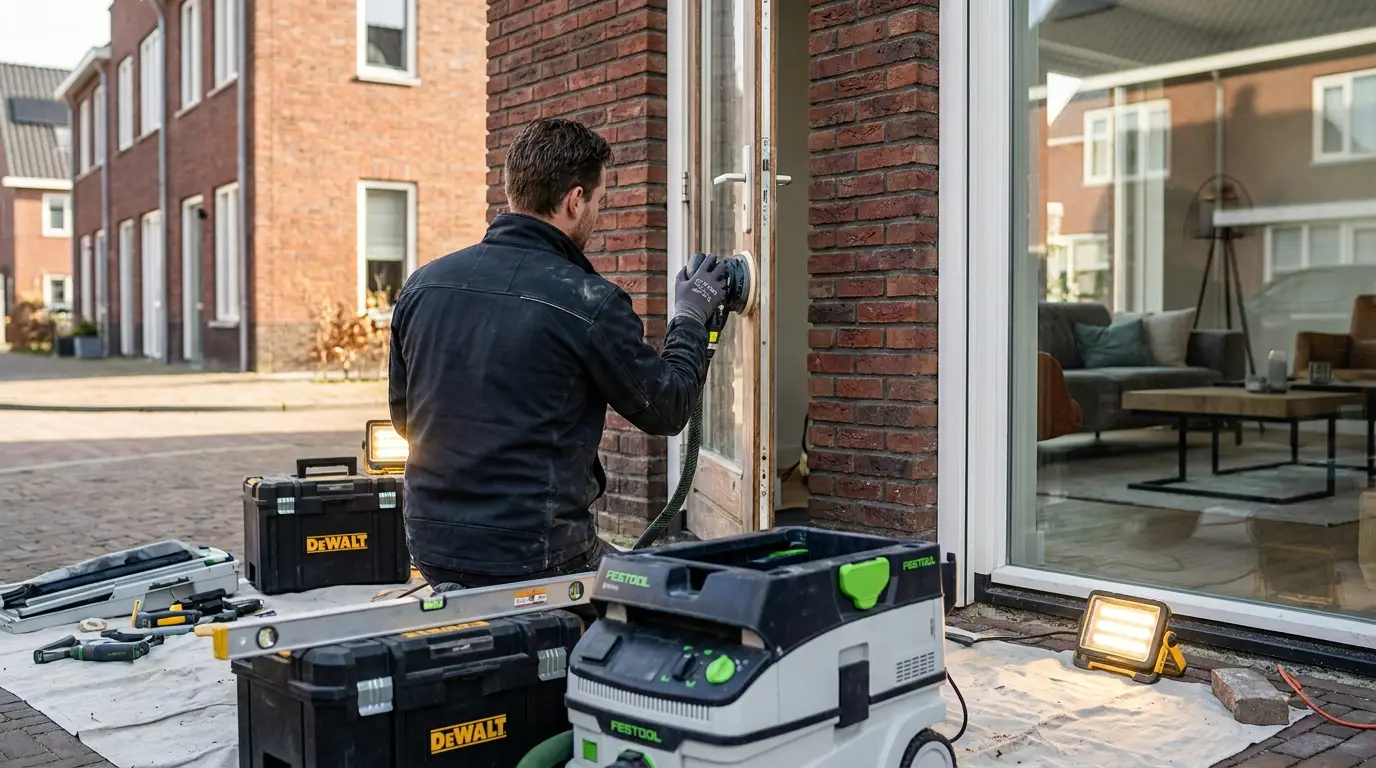
Cost of facade repair or treatment: everything you need to know
Facade repair or treatment covers everything from small pointing repairs and facade cleaning to full water-repellent sealing or repainting of the exterior wall. The cost depends heavily on the facade area, the condition of the brickwork, and the type of treatment. A row house with a facade of 50–60 m² costs on average between €1,500 and €7,500 all-in.
In this article
- ›What does facade repair or treatment cost?
- ›Prices by type of treatment
- ›Material and labor costs
- ›Hiring a contractor vs. doing it yourself
- ›How does a facade treatment work?
- ›Money-saving tips
- ›Frequently asked questions
Need a contractor for this?
Describe your job and get quotes from contractors near you.
average price
€2,800
facade cleaning + pointing, row house
average hourly rate
€35
contractor hourly rate (€25–50/hour)
turnaround time
1–4 days
depending on scope
€ Average price by type
| Type of facade treatment | Range | Average price |
|---|---|---|
| Facade cleaningpressure washing or chemical cleaning per m² | €300 – €900 | €550avg.incl. labor |
| Partial pointing repairlocal raking out and repointing | €600 – €1,800 | €1,100avg.incl. labor |
| Facade repair + pointing (most popular)cleaning, pointing repair, and sealing, row house | €1,500 – €4,000 | €2,800avg.incl. labor |
| Full facade repointingraking out and fully repointing 50–60 m² | €2,500 – €5,500 | €3,800avg.incl. labor |
| Complete facade renovationrepair, pointing, sealing, and painting | €4,000 – €8,000 | €5,500avg.incl. labor |
Prices include labor and standard materials for a row house with approx. 50–60 m² of facade area; large facades or special brickwork (large handmade bricks; raised, knife-trimmed joints) cost more. Based on Google price research.
Material and labor costs
Bricklayer/facade contractor hourly rate on average €35–€50/hour. Scaffolding costs are budgeted separately; for accessible facades, an aerial lift can be cheaper than scaffolding.
Hiring a contractor vs. doing it yourself
| Job | Do it yourself | Via a contractor | Savings doing it yourself |
|---|---|---|---|
| Ground-floor facade cleaningapplying algae remover and rinsing with a pressure washer on reachable areas | DoableEasy to do on the ground floor with rental equipment; don't set the pressure too high (max. 80–100 bar) to keep the joints intact | €60–€150 | up to €400 |
| Local pointing repairraking out one or more damaged joints and filling them with fresh mortar | With experienceThe wrong pointing mortar or raking out too deep causes cracking; only do this if you know which mortar type matches the existing brickwork | €30–€80 | up to €350 |
| Applying facade sealerspraying or rolling a water-repellent sealer onto the brickwork | With experienceThe sealer must be applied to a completely dry, clean facade; too thin a coat or the wrong product gives no effect or only a temporary one | €150–€350 | up to €600 |
| Full facade repointingraking out and repointing the entire facade area (50–60 m²) | Not recommendedRequires a special joint raking machine, solid knowledge of mortar mixes, and several workdays; mistakes draw moisture straight into the wall | €250–€500 | No recommended savings |
| Complete facade renovationcombination of crack repair, pointing, cleaning, sealing, and possibly painting | Not recommendedRequires coordinating several trades, scaffolding, and a warranty on the whole job; mistakes in one step undermine all other treatments | €500–€1,000 | No recommended savings |
Facade work has a clear dividing line: cleaning on the ground floor and applying water-repellent sealer are things you can do yourself with the right rental equipment, as long as the facade is dry and reachable. As soon as you need to go up a ladder (for higher parts of the facade, cracks in the brickwork, or eroded joints), a contractor becomes essential. Mistakes in pointing draw moisture straight into the cavity wall or interior walls, which can lead to mold and structural damage that costs ten times as much to repair. A certified facade contractor has the right joint raking machine and expert knowledge of mortar mixes (not too hard, not too soft), and gives a written warranty on the result. For work at height, a certified scaffolding builder or aerial lift operator is also legally required on commercial jobs.
The full process step by step
Inspection and damage map
The facade contractor checks the facade from top to bottom and maps all damaged areas: eroded joints, cracks in the brickwork, damp spots, and biological growth (algae, moss). Based on this, they determine which treatments are needed and draw up a detailed quote.
30–60 min
Setting up scaffolding or an aerial lift
For facades higher than about 3 meters, single scaffolding is set up along the front facade. For hard-to-reach locations or short jobs, an aerial lift is used. The scaffolding is firmly anchored and fitted with guardrails in line with safety standards.
2–4 hours
Facade cleaning
The facade is cleaned with a pressure washer (60–100 bar) combined with a biological or chemical cleaning agent. Stubborn layers of algae and moss first get time for the agent to work before they're rinsed off. The facade then has to dry completely before the next step.
3–8 hours
Pointing repair
Damaged joints are mechanically raked out to a depth of at least 1.5–2 cm without damaging the brickwork. Then the right pointing mortar, matched to the color, hardness, and historical profile of the existing work, is applied and finished into an even, watertight joint profile.
1–3 days
Crack repair and local brickwork
Small cracks are sealed with elastic sealant or a suitable injection resin. Larger damage where bricks are cracked or missing is locally rebuilt with matching bricks and mortar. This work requires dry conditions and a nighttime temperature above 5°C.
1–4 hours
Applying the sealer
After complete drying (at least 24–48 hours after pointing), a water-based water-repellent sealer is applied in two crosswise coats. The sealer soaks into the brickwork and creates an invisible, water-repellent barrier without blocking the facade's ability to breathe.
2–4 hours
Final walkthrough and taking down the scaffolding
The contractor inspects the end result together with the resident, takes photos for the completion records, and discusses the warranty period (usually 5–10 years on pointing and sealing). Then the scaffolding is properly taken down and the site is cleaned up.
1–2 hours
6 smart money-saving tips
Frequently asked questions
What does facade repair or treatment cost on average?
On average €2,800 for a complete treatment of a row house. Range: €300 for cleaning only up to €8,000 for a full facade renovation.
How long does facade repair or treatment take?
Cleaning takes 1 day, partial pointing repair 1–2 days, and a complete renovation 3–5 workdays, depending on the area and drying time.
Do I need a permit for facade repair?
Normally not. Repairs and cleaning count as maintenance and don't require a permit. For structural facade cladding or scaffolding that stays up longer than 6 weeks, it's wise to check with the municipality.
Can I repair my facade myself?
Simple cleaning with a pressure washer is something you can do yourself, but pointing repair and sealing require expertise. Mistakes quickly lead to moisture problems and higher repair costs.
How often should I have my facade treated?
Water-repellent sealing usually lasts 8–12 years. Pointing has a lifespan of 20–30 years. Facade cleaning makes sense every 5–10 years or as soon as algae and staining become visible.
What does pointing cost per m²?
Pointing (raking out and repointing) costs on average €35–€55 per m², including labor and materials. Special pointing such as raised, knife-trimmed joints costs up to €100 per m².
Related jobs
Ready to have your facade expertly repaired or treated?
Describe your job and get quotes from verified facade contractors near you.
Within 24 hours
response from a contractor
Verified
all contractors checked
Competitive price
compare quotes