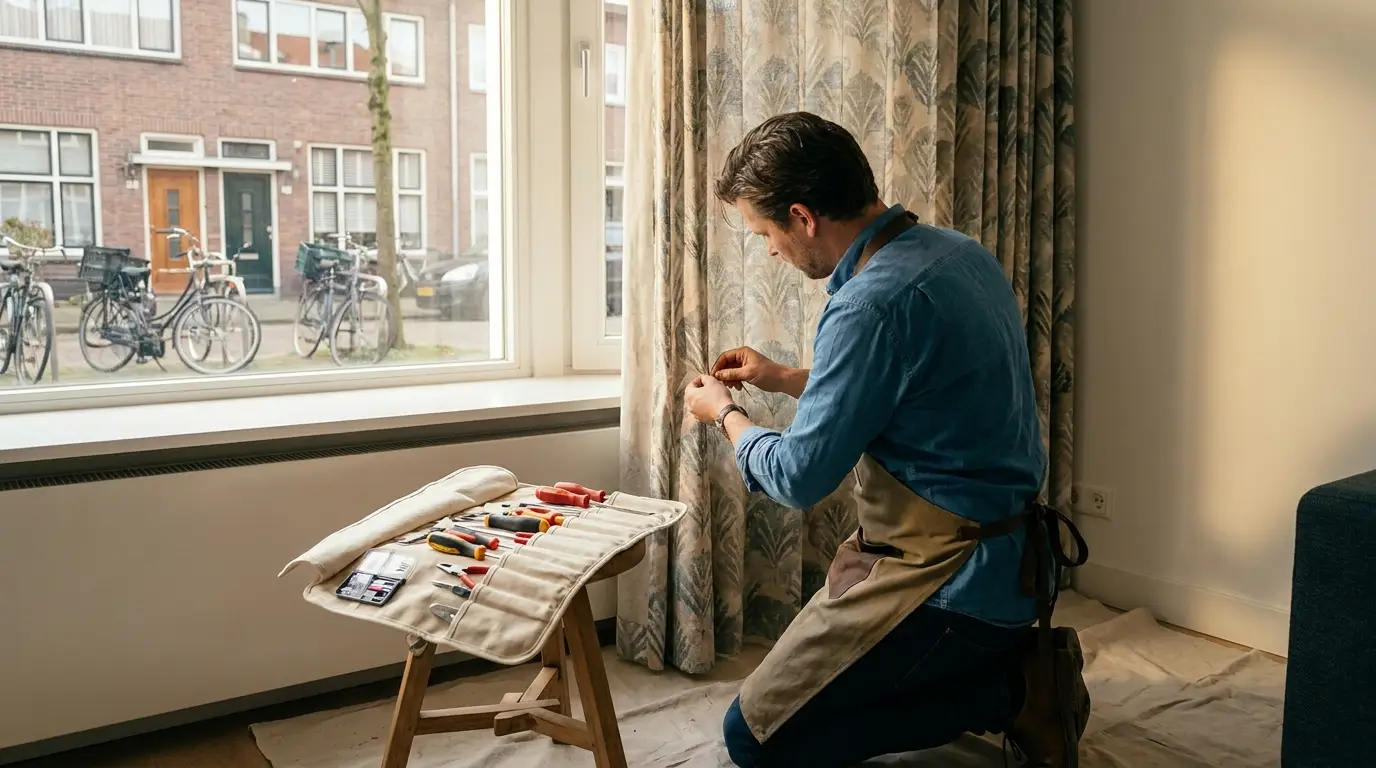
Cost of altering or making curtains: everything you need to know
Altering or shortening curtains is a handy way to give existing curtains a new life or make them fit a different room. The cost depends on the alteration you want (shortening, narrowing, re-hemming, or adding a new pleat) and the type of fabric. A seamstress or curtain maker usually finishes the job within one to three hours, depending on the number of curtains and the complexity.
In this article
- ›What does altering curtains cost on average?
- ›Prices by type of alteration
- ›Material and labor costs
- ›Hire a seamstress or do it yourself?
- ›How altering curtains works
- ›Money-saving tips for curtain work
- ›Frequently asked questions
Need a contractor for this?
Describe your job and get quotes from contractors near you.
average price
€45
per curtain including labor
average hourly rate
€40
seamstress hourly rate (€30–55/hour)
turnaround time
1–3 days
depending on number of curtains and alteration
€ Average price by type
| Alteration type | Range | Average price |
|---|---|---|
| Shortening curtains (blind hem)adjusting the length without lining, blind hem at the bottom | €15 – €35 | €25avg.incl. labor |
| Shortening lined curtains (most popular)adjusting the length including lining, neat finish | €30 – €65 | €48avg.incl. labor |
| Narrowing curtainsadjusting the width to a narrower window or frame | €25 – €55 | €40avg.incl. labor |
| Adding a new pleat or hooksgiving existing curtains a different pleat style or new hooks | €35 – €80 | €55avg.incl. labor |
| Custom-made curtains (per meter of fabric)completely new curtain including sewing, excluding fabric costs | €37 – €95 | €60avg.incl. labor |
| Altering a set of curtains (2 pieces)combined price for a set of two curtains, same alteration | €40 – €120 | €80avg.incl. labor |
Prices per curtain including labor, excluding any fabric costs for new sewing; a workshop minimum may apply. Based on Google price research.
Material and labor costs
Seamstress/curtain maker hourly rate averages €30–55/hour. Heavy fabrics (velour, blackout) take 20–30% more sewing time.
Hiring a contractor vs. doing it yourself
| Job | Do it yourself | Via a contractor | Savings doing it yourself |
|---|---|---|---|
| Shortening a curtain (light fabric, no lining)adjusting the length with a straight blind hem at the bottom | DoableVery doable with a sewing machine and basic sewing skills; leave enough hem allowance | €15–€35 at a seamstress | up to €30 |
| Shortening a lined curtainadjusting the length with the outer fabric and lining handled separately | With experienceLining and outer fabric must be shortened separately and then neatly matched; if they don't match, the curtain hangs crooked | €30–€65 at a seamstress | up to €50 |
| Narrowing curtainsreducing the width so the curtain fits a narrower window or frame | With experiencePleat density has to be recalculated; without the correct pleat stitch, the curtain hangs flat instead of folded | €25–€55 at a seamstress | up to €40 |
| Adding a new pleat style (goblet, pencil, wave)working a completely new pleat structure into an existing curtain | Not recommendedRequires a specific presser foot, pleat tape, and knowledge of pleat density; a mistake is visible and hard to fix | €35–€80 at a seamstress | No recommended savings |
| Sewing custom curtainsmaking a new curtain from loose fabric including finishing and hooks | Not recommendedRequires pattern knowledge, pleat tape, experience with heavy or delicate fabrics, and the right sewing machine settings; mistakes waste expensive fabric | €37–€95/meter at a seamstress | No recommended savings |
A seamstress or curtain maker is essential once curtains have a lining, are made of heavy or delicate fabrics (velour, velvet, blackout fabric, silk), or when the pleat style needs to change. With lined curtains, the outer fabric and lining must be shortened separately and then precisely matched; the slightest deviation makes the curtain hang crooked. Adding a new pleat (goblet pleat, pencil pleat, or wave) also requires a special presser foot, and the pleat density has to be recalculated for each curtain. A mistake on expensive fabric can rarely be undone. For simple straight polyester or linen curtains without lining, the trade-off is different: if you own a sewing machine and have basic sewing skills, you can shorten them yourself and save €15–€30 per curtain. Always leave at least 3–5 cm of hem allowance: curtains shrink slightly when washed, and a hem that's too short can't be fixed. If you're unsure about the fabric composition or the result you want, dropping them off at a seamstress is still the safest choice.
The full process step by step
Take measurements and decide on the alteration
Measure the desired final size of the curtain: the height from rail to floor minus the desired clearance (usually 1–2 cm), and the width of the window frame plus the desired overlap on each side. Also note the current curtain measurements and the fabric type. The more precise the information you provide, the less chance of misunderstandings.
15–30 minutes
Drop off the curtains and discuss the price
Take the curtains to the workshop or arrange a home visit. Include a clear note with the desired final measurements and alteration. Ask for a price estimate on the spot before you leave the curtains, and discuss the turnaround time as well. Check whether a minimum rate or a surcharge for heavy fabric applies.
15–30 minutes
Pre-treatment and marking
The seamstress steams or irons the curtains if needed, so the fabric settles and any shrinkage is visible before sewing begins. The alteration lines are then marked precisely with chalk or pins, including the required hem allowance of 3–5 cm.
15–30 minutes per curtain
Sewing
When shortening, the bottom is cut along the marked line, folded over, and stitched. With lined curtains, the outer fabric and lining are handled separately and then joined. When narrowing, the sides are taken in and the pleat density is recalculated. For a new pleat style, the pleat tape is replaced and the hooks are reset.
1–3 hours per curtain
Finishing and quality check
After sewing, the curtains are steamed or ironed and checked while hanging for equal length, a straight hem, and neat pleats. The seamstress measures both curtains of a set side by side to make sure they're identical. Any small corrections are made on the spot.
15–30 minutes
Pick up and hang
Pick up the curtains at the workshop or receive them at home. Hang them on the rails right away and check the drop from inside the room: are the bottoms even, do the pleats hang symmetrically, and is the distance to the floor correct? If something isn't right, get in touch the same day: small corrections are usually fixed free of charge.
15–30 minutes
6 smart money-saving tips
Frequently asked questions
What does altering curtains cost on average?
On average €25–€65 per curtain. Simple shortening without lining starts at around €15–€35. Shortening a complete set of two lined curtains usually costs €60–€120. More complex alterations, such as adding a new pleat, cost €35–€80 per curtain.
How long does altering curtains take?
A simple alteration like shortening takes 30 to 60 minutes per curtain. More complex jobs take 1 to 2 hours each. Turnaround when you drop them off at a workshop is usually 1 to 3 business days.
Do I drop the curtains off at the seamstress, or does she come to my home?
Most seamstresses work in a workshop or from home; you drop the curtains off there. Some contractors also come to your home and take down the curtains on site. A home visit usually comes with a trip charge of €15–€30.
Can I shorten curtains myself?
With simple linen or polyester curtains without lining, it's doable with a sewing machine and basic skills. For lined curtains, delicate fabrics, or special pleats, a seamstress is strongly recommended to avoid damage or warping.
Does altering curtains get more expensive as the fabric gets heavier?
Yes. Heavy curtain fabrics such as velour, velvet, or blackout fabric take more sewing time and a sturdier needle. Expect 20 to 30 percent higher costs compared to light fabrics.
What's the difference between shortening and narrowing curtains?
Shortening means adjusting the length of the curtain (raising the bottom). Narrowing means reducing the width (taking in the sides). Narrowing is often a bit more work because the pleat density has to be recalculated and reset.
Related jobs
Ready to have your curtains altered?
Describe your job and get quotes from verified seamstresses and curtain makers near you.
Within 24 hours
response from a contractor
Verified
all contractors checked
Competitive price
compare quotes