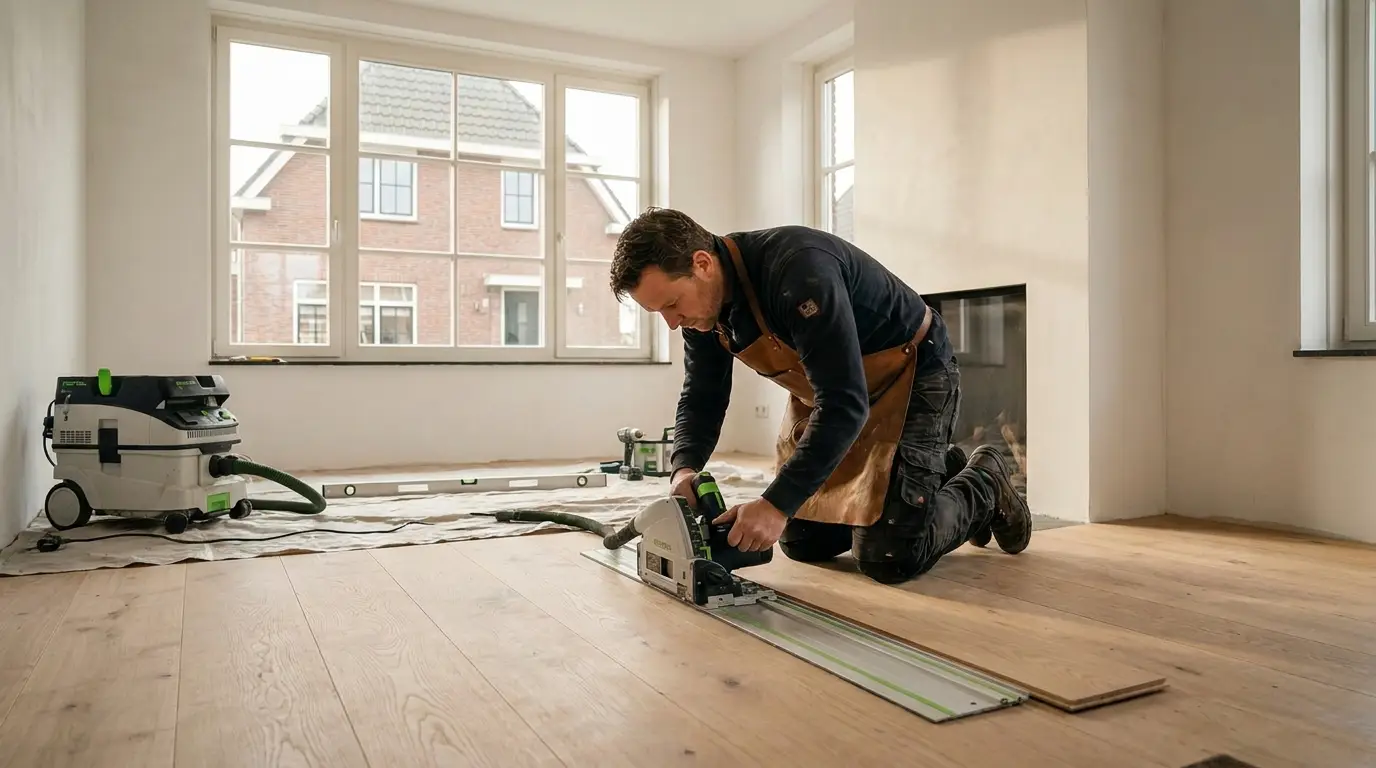
Cost of installing a hardwood or parquet floor: everything you need to know
A hardwood or parquet floor adds warmth and character to any room, but the price varies widely by wood species, laying pattern, and installation method. For an average living room of 25 m², expect a total price between €1,500 and €4,000, including materials and labor. Choosing solid parquet, engineered parquet, or a herringbone pattern largely determines your final budget.
In this article
- ›What does it cost to install a hardwood or parquet floor?
- ›Price overview by type of parquet
- ›Material and labor costs
- ›Hiring a contractor vs. doing it yourself
- ›How does the installation process work?
- ›Money-saving tips for a hardwood floor
- ›Frequently asked questions
Need a contractor for this?
Describe your job and get quotes from contractors near you.
average price
€2,500
for a living room of approx. 25 m²
average hourly rate
€38
floor installer (€25–50/hour)
turnaround time
1–3 days
depending on area and pattern
€ Average price by type
| Type of parquet floor | Range | Average price |
|---|---|---|
| Engineered parquet, floatingclick-lock or floating engineered parquet, quick to install, suitable for most subfloors | €1,000 – €2,200 | €1,600avg.incl. installation |
| Engineered parquet, glued down (most popular)firmly glued down, less noise, suitable for radiant floor heating | €1,500 – €3,000 | €2,200avg.incl. installation |
| Solid parquet, straight patternall wood, long-lasting and refinishable, classic look | €2,000 – €4,000 | €3,000avg.incl. installation |
| Herringbone parquetdiagonal laying pattern, timeless and decorative, requires more labor and material | €2,500 – €5,500 | €4,000avg.incl. installation |
| Chevronclean V-pattern, high-end look, a lot of waste and more labor hours | €3,500 – €7,000 | €5,000avg.incl. installation |
Prices include materials, underlayment, and labor for a room of approx. 25 m²; herringbone and chevron cost 30–60% more due to extra working time and cutting waste. Based on Google price research.
Material and labor costs
Floor installer hourly rate on average €25–€50/hour. Many contractors charge a per-m² rate of €15–€35 for labor only; for small rooms (< 15 m²), a minimum charge often applies.
Hiring a contractor vs. doing it yourself
| Job | Do it yourself | Via a contractor | Savings doing it yourself |
|---|---|---|---|
| Installing click-lock or floating engineered parquetLaying straight planks on a flat, dry subfloor without glue | DoableVery doable for a DIYer with a pull saw, rubber mallet, and spacers | €600–€1,200 | up to €400 |
| Installing glued-down engineered parquetGluing parquet with parquet adhesive to concrete or an existing subfloor | With experienceRequires knowledge of the adhesive's open and working time; mistakes are almost impossible to correct | €1,500–€3,000 | up to €600 |
| Solid parquet, nailed or gluedNailing or gluing solid planks to a wood subfloor | Not recommendedA nail gun, moisture testing, and knowledge of wood movement are essential; mistakes lead to cupping or squeaking | €2,000–€4,000 | No recommended savings |
| Installing a herringbone or chevron patternPrecisely aligning diagonal parquet pieces on a center line | Not recommendedEvery millimeter of deviation shows across the whole floor; cutting waste rises to 20% with inexperienced installation | €2,500–€5,500 | No recommended savings |
| Leveling the subfloor for parquetEvening out height differences up to 2 mm with leveling compound | With experienceThe water ratio is critical; compound applied too thick shrinks and cracks, making the parquet squeak later | €100–€400 | up to €200 |
A professional floor installer is essential for glued-down or nailed solid parquet, complex patterns such as herringbone or chevron, or a subfloor with damp or uneven spots. Solid wood is highly sensitive to moisture and temperature changes: too much moisture in the subfloor (more than 2.5% CM for concrete) inevitably leads to cupping or loosening. Contractors measure this with a CM meter before they start and know which adhesive is suitable for radiant floor heating. DIYers can install floating click-lock parquet or engineered parquet themselves, as long as the subfloor is already flat and dry. Basic tools (a miter saw, rubber mallet, clamps, and spacers) can be rented at the hardware store. Allow for 8–10% extra material for cutting waste, and always leave an expansion gap of at least 10 mm around the room.
The full process step by step
Measuring, moisture testing, and quote
The floor installer measures the room, checks the flatness of the subfloor with a straightedge (maximum deviation 2 mm per 2 m), and measures the moisture content of the concrete floor with a CM meter. Based on the type of parquet, the desired laying pattern, and the condition of the subfloor, you receive an itemized quote.
45–90 min
Choosing and ordering materials
You choose the type of parquet (solid, engineered, or a decorative pattern) and the finish: oiled, lacquered, smoked, or brushed. The material is ordered with 8–10% extra for cutting waste (15–20% for herringbone). With radiant floor heating, the wood species determines the maximum thickness and choice of adhesive.
1–5 business days delivery time
Acclimating the wood
The unopened parquet packs are placed in the room so the wood can adjust to the local temperature and humidity for 24 to 48 hours. Don't skip this: wood that comes in too cold or too dry shrinks after installation and develops gaps between the planks.
24–48 hours
Subfloor preparation
The subfloor is cleaned, leveled with leveling compound, and if needed treated with a primer for the parquet adhesive. On a wood subfloor, loose boards are screwed down. Moisture problems are dealt with now, not later.
2–4 hours
Installing the parquet floor
With the floating method, an underlayment film or acoustic underlay is rolled out and the planks are clicked or glued together. With glue-down installation, the floor installer spreads parquet adhesive with a notched trowel and presses the planks down one by one. Patterns such as herringbone start from a center line. An expansion gap of 10–15 mm is left around the room.
1–3 workdays
Baseboards, thresholds, and final finish
Baseboards are cut to size and attached so they cover the expansion gap without pinning the floor down. Transitions to tile, thresholds, or other floor types are finished with a matching transition strip. On oiled floors, the contractor applies a maintenance oil as the final coat.
2–4 hours
Handover and care instructions
The floor is swept clean and inspected for holes, gaps, or damage. The contractor explains how to care for the floor: cleaning with a dry mop, touching up with the right floor oil or lacquer, and keeping indoor humidity at the recommended level (40–60%) to prevent shrinking and swelling.
30–45 min
6 smart money-saving tips
Frequently asked questions
What does it cost on average to install a hardwood or parquet floor?
On average €50–€120 per m², including materials and labor. For a 25 m² living room, expect €1,500–€4,000 in total. Herringbone and chevron cost 30–60% more than a straight pattern.
How long does it take to install a parquet floor?
A straight pattern in a 25 m² room is done in 1 workday. Complex patterns such as herringbone or chevron take 2 to 3 days. With radiant floor heating, the wood must acclimate (24–48 hours).
Do I need a permit for a hardwood floor?
No, you don't need a permit for a hardwood floor in an existing home. In an apartment with a VvE (the homeowners association of an apartment building), extra rules on sound insulation sometimes apply; check the building's bylaws.
Can I install a hardwood floor myself?
Click-lock parquet and floating engineered parquet are easy to install yourself with basic tools. Glued-down solid parquet is harder and requires professional gluing techniques and surface preparation. A poor subfloor or the wrong adhesive leads to squeaking, cracking, or loosening.
What does a floor installer charge per hour?
A floor installer's hourly rate is on average between €25 and €50 per hour. For a 25 m² job, you typically pay €400–€1,000 in labor costs. Many floor installers also charge a per-m² rate of €15–€35 for labor only.
Is a hardwood floor suitable over radiant floor heating?
Yes, but not all wood species are equally suitable. Choose engineered parquet or stable solid wood with a maximum thickness of 15 mm. The floor must acclimate for 24–48 hours, and the radiant floor heating is turned on gradually after installation.
Related jobs
Ready to have your parquet floor professionally installed?
Describe your job and receive quotes from verified floor installers near you.
Within 24 hours
response from a contractor
Verified
all contractors checked
Competitive price
compare quotes