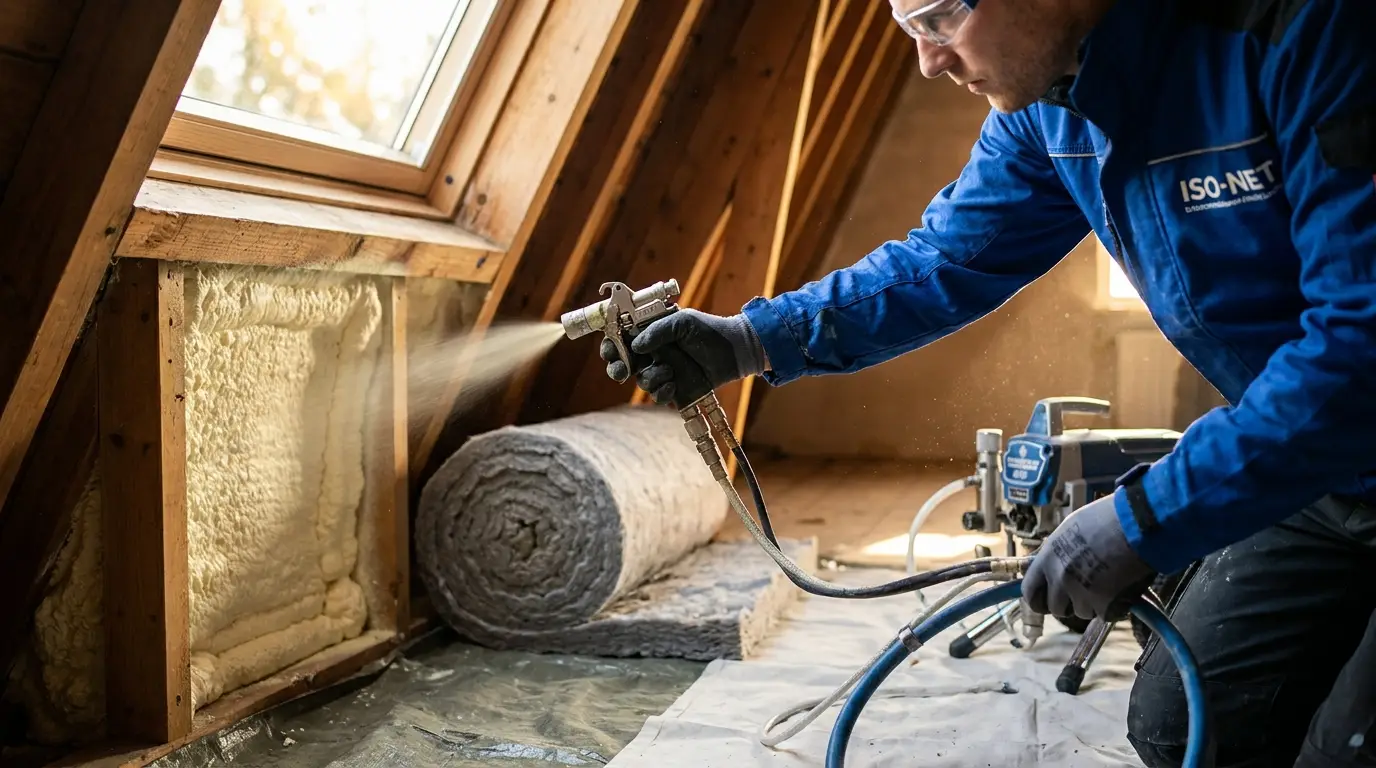
Cost of installing insulation: everything you need to know
Installing insulation is one of the smartest investments you can make in your home: you lower your energy bill and make your home more comfortable. The cost depends heavily on the type of insulation (cavity wall insulation, roof insulation, floor insulation, or exterior wall insulation) and the area that needs to be treated. With an ISDE (a Dutch government subsidy for sustainable energy) subsidy, you can get a good share of the cost back.
In this article
- ›How much does installing insulation cost?
- ›Prices by type of insulation
- ›Material and labor costs
- ›Hire a contractor or do it yourself?
- ›Step by step: how does it work?
- ›ISDE subsidy and money-saving tips
- ›Frequently asked questions
Need a contractor for this?
Describe your job and get quotes from contractors near you.
average price
€5,000
average job (materials + labor)
average hourly rate
€45
contractor hourly rate (€40–55/hour)
turnaround time
1–3 days
depending on type and area
€ Average price by type
| Insulation type | Range | Average price |
|---|---|---|
| Cavity wall insulation€20–€30 per m² including materials and labor | €2,000 – €5,000 | €3,200avg.incl. installation |
| Floor insulation (most popular)€25–€40 per m², crawl space or concrete floor | €2,500 – €6,000 | €3,800avg.incl. installation |
| Roof insulation (pitched roof)€20–€50 per m², insulating from the inside | €3,000 – €7,000 | €4,800avg.incl. installation |
| Roof insulation (flat roof)€40–€60 per m², warm roof from the outside | €4,000 – €9,000 | €6,000avg.incl. installation |
| Exterior wall insulation (outside)€55–€80 per m², facade + finish | €6,000 – €15,000 | €9,000avg.incl. installation |
Prices include materials and labor; exterior wall insulation often requires scaffolding, which increases the cost. Based on Google price research.
Material and labor costs
Insulation contractor hourly rate averages €40–55/hour. Cavity wall insulation requires a BRL 2202 certified company to apply for the ISDE subsidy.
Hiring a contractor vs. doing it yourself
| Job | Do it yourself | Via a contractor | Savings doing it yourself |
|---|---|---|---|
| Crawl space floor insulationInstalling insulation boards or foil under the ground floor | DoablePhysically demanding because of the low crawl space, but technically doable without specialized training | €600–€1,400 | up to €1,000 |
| Attic floor insulationLaying mineral wool rolls or EPS boards on a flat attic floor | DoableEasy to access through the attic hatch; materials widely available at home improvement stores | €500–€1,200 | up to €900 |
| Cavity wall insulationBlowing in EPS beads or PUR foam through holes drilled in the exterior wall | Not recommendedRequires certified blowing equipment and the BRL 2202 quality mark; no certificate means no ISDE subsidy | €2,000–€5,000 | No recommended savings |
| Pitched roof insulation (inside)Installing insulation boards or spray PUR between or under the rafters | With experienceTechnically doable for DIYers with carpentry experience; installing the vapor barrier correctly is critical to prevent condensation problems | €2,000–€4,500 | up to €1,500 |
| Exterior wall insulation (outside)Gluing insulation boards to the exterior wall and finishing them with a reinforcement layer and finish plaster | Not recommendedRequires scaffolding, specialized adhesive and skim coat bonding, and a flat finish layer; mistakes lead to moisture infiltration and mold in the wall cavity | €6,000–€15,000 | No recommended savings |
Cavity wall insulation and exterior wall insulation are reserved for certified insulation contractors. Cavity wall insulation requires a BRL 2202 certified company (certified under the Dutch quality standard for cavity wall insulation): without this certificate, you lose your right to the ISDE subsidy, and a moisture-free result isn't covered by a warranty. Exterior wall insulation also calls for scaffolding, specific bonding mortar, and a finished plaster layer: mistakes are hard to fix without redoing the entire exterior finish. For floor insulation in the crawl space and insulation on a flat attic floor, you can get to work yourself just fine: the materials are widely available and the technique can be learned with a good guide. Keep in mind: as soon as you do the labor yourself, you lose the right to the ISDE subsidy for that specific measure. So always weigh the savings on labor costs (usually €400–€900) against the missed subsidy before you decide.
The full process step by step
Home inspection and custom quote
The insulation contractor comes by to inspect your home: they measure the areas to be insulated, assess the cavity width (for cavity wall insulation), check access to the crawl space or attic, and determine which insulation material is most suitable. You receive an itemized quote with the expected Rc value and a calculation of the ISDE subsidy you can expect.
1–2 hours
Apply for the ISDE subsidy before work starts
For the ISDE subsidy, the application must be submitted to RVO.nl before the work begins: you can't apply afterward. The insulation contractor can arrange this for you, or you receive a detailed description of the work to submit it yourself. After approval (usually within a few business days), the job can be scheduled.
1–3 business days
Preparation and material delivery
Insulation material, blowing equipment, vapor barrier, and the necessary fasteners are delivered. For cavity wall insulation, the drill holes are marked on the facade; for exterior wall insulation, the scaffolding is put up. The work area is shielded to limit disruption and dust.
Half a day
Installing the insulation material
The actual insulation work is carried out: for cavity wall insulation, EPS beads or PUR foam are blown in through drilled holes and the holes are sealed; for floor insulation, boards or foil are fastened in the crawl space or on the concrete floor; for roof insulation, boards or mineral wool are installed and covered with a vapor barrier; for exterior wall insulation, insulation boards are glued, anchored, and finished with reinforcement mesh and finish plaster.
1–3 days
Quality check and handover
After installation, the insulation contractor checks the airtightness of the joints, the blowing holes are neatly sealed, and any scaffolding is removed. You receive a completion report with the measured Rc values, the material used, and the number of m² installed: this report is required for the final subsidy application.
1–2 hours
Final subsidy settlement with RVO
With the completion report and the invoice, you (or the insulation contractor on your behalf) submit the final ISDE application to RVO.nl. After approval, the subsidy amount is deposited into your account within eight weeks. Keep all documents carefully: RVO may ask for additional proof on a random basis.
4–8 weeks
6 smart money-saving tips
Frequently asked questions
How much does installing insulation cost on average?
On average €5,000 for a standard insulation job. The range runs from €2,000 (cavity wall insulation in a row house) to €15,000 (insulating an entire semi-detached house).
How long does installing insulation take?
Cavity wall insulation usually takes one day. Floor insulation takes one to two days. Roof insulation takes one to three days, depending on the area and accessibility. Exterior wall insulation can take a week or longer.
Do I need a permit for insulation?
You don't need a permit for insulation on the inside (cavity wall, floor, inside of the roof). Exterior wall insulation on the outside sometimes requires a building permit, especially in a protected historic district or on historic buildings. Check this with your municipality in advance.
Can I install insulation myself?
Floor insulation in the crawl space and laying insulation boards in the attic are relatively easy to do yourself. Cavity wall insulation, however, requires certified equipment and a licensed contractor: this is also required to receive the ISDE subsidy.
What subsidies are available for insulation?
Through the ISDE program, you receive per m²: €3–6 for cavity wall insulation, €4–8 for roof insulation, and €5–9 for floor insulation. If you combine two or more measures at the same time, the amounts double. You apply via RVO.nl (the Netherlands Enterprise Agency).
What is the payback period for insulation?
Cavity wall insulation pays for itself in 3–5 years on average. Roof insulation has a payback period of 5–10 years. Floor insulation sits in between at 4–7 years. With a subsidy, it's shorter.
Related jobs
Ready to have your home properly insulated?
Describe your job and receive quotes from verified insulation contractors near you.
Within 24 hours
response from a contractor
Verified
all contractors checked
Competitive price
compare quotes