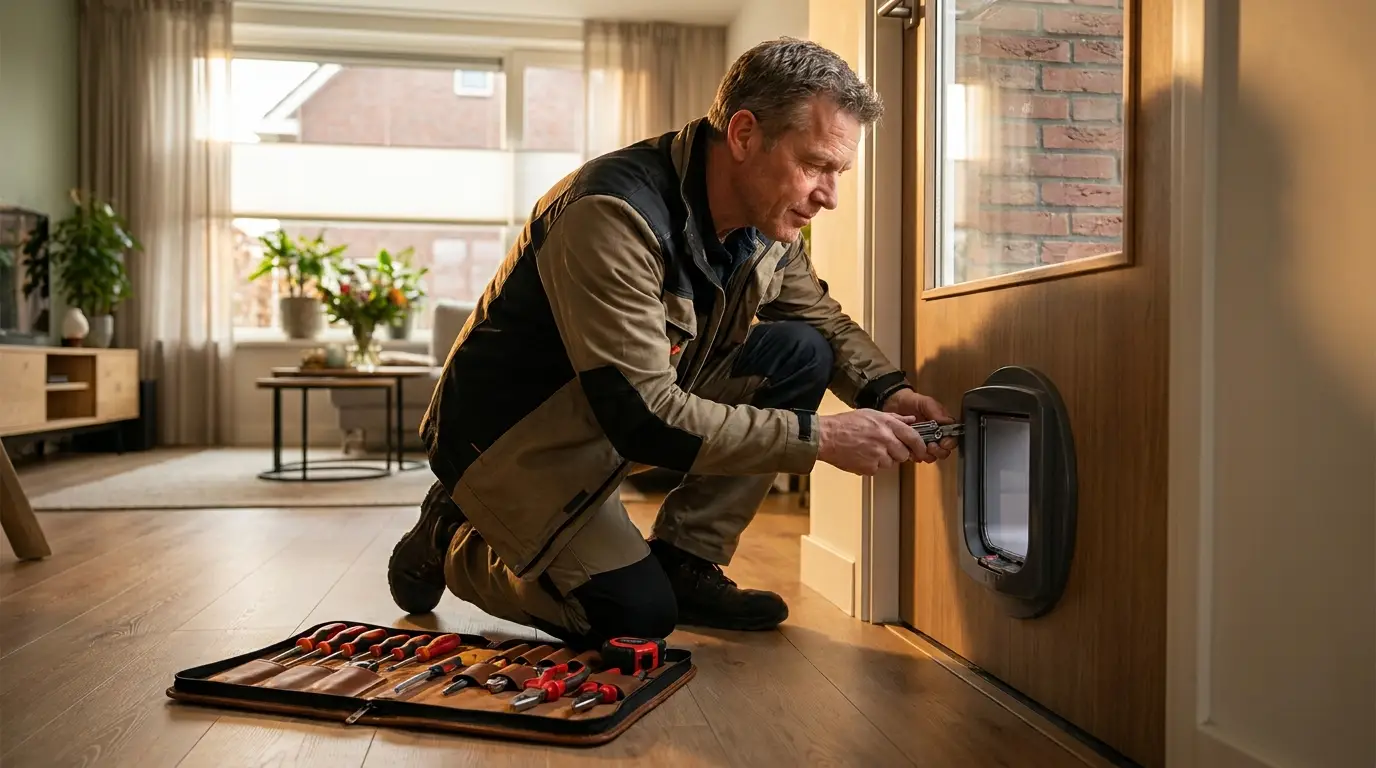
Cost of installing or removing a cat flap: everything you need to know
Having a cat flap installed in a wooden door, PVC door, or wall is a small but handy home improvement. The price depends heavily on the material and the type of flap. Read here what you pay on average, which factors determine the cost, and when hiring a contractor is a smart move.
In this article
- ›Average cost of installing a cat flap
- ›Prices by door or wall type
- ›Material and labor costs
- ›Install it yourself or hire a contractor?
- ›How does installation work step by step?
- ›Money-saving tips for your cat flap
- ›Frequently asked questions
Need a contractor for this?
Describe your job and get quotes from contractors near you.
average price
€200
installation incl. labor (excl. flap)
average hourly rate
€45
contractor hourly rate (€40–55/hour)
turnaround time
1–2 days
depending on surface
€ Average price by type
| Door type or surface | Range | Average price |
|---|---|---|
| Wooden doorstandard cutting and mounting in a solid or composite wooden door | €80 – €150 | €115avg.incl. installation |
| PVC door (most popular)routing and installing in a PVC door, including sealing | €130 – €250 | €190avg.incl. installation |
| Glass door or panelnew glass pane with a pre-cut hole or replaced glass section | €200 – €350 | €275avg.incl. installation |
| Wall (brick or sand-lime brick)drilling through the wall, building or insulating a tunnel, finishing the frame | €285 – €450 | €370avg.incl. installation |
| Removing a cat flap and repairingremove the flap, fill the hole, and repair the door or wall | €100 – €300 | €200avg.incl. labor |
Prices are estimates and exclude the cat flap itself; the cost of the flap (€15–€120) comes on top of this. Based on Google price research.
Material and labor costs
Carpenter hourly rate averages €40–€55/hour. Glass panels sometimes require a specialized glazier, which can push the rate up to €65/hour.
Hiring a contractor vs. doing it yourself
| Job | Do it yourself | Via a contractor | Savings doing it yourself |
|---|---|---|---|
| Cat flap in a wooden interior doorCut the hole with a paper template and jigsaw, screw the frame in place | DoableEasy with the included template and a jigsaw for someone with basic experience | €15–€60 (flap only) | save up to €90 |
| Cat flap in a PVC exterior doorRouting the PVC, fitting the frame, and sealing all around with caulk | With experiencePVC can crack with the wrong tools; a poor seal leads to drafts and moisture problems | €50–€130 (flap + caulk) | save up to €120 |
| Cat flap in a glass door or side panelCutting the glass or replacing it with a custom-cut panel with a pre-cut hole | Not recommendedCutting glass is specialist work; breakage leads to high repair costs and safety risks | €200–€350 (contractor) | No recommended savings |
| Cat flap through an exterior wall (brick or sand-lime brick)Core drilling through the wall, fitting and insulating the tunnel sleeve, finishing the outer frame | Not recommendedRisk of cracks in the masonry, a tunnel that doesn't match the wall thickness, and drafts from poor insulation | €285–€450 (contractor) | No recommended savings |
| Removing a cat flap and repairing the holeRemove the flap, fill the hole with wood filler or plaster, paint or wallpaper | With experienceDoable in a wooden door with filler and sandpaper; plastering a wall takes more skill | €20–€80 (materials) | save up to €200 |
For a cat flap in an ordinary wooden interior door, installing it yourself is a realistic option: the included paper template and a jigsaw are enough. Once it's a PVC exterior door, a glass panel, or a wall installation, the situation changes significantly. PVC doors require a router and specific drill speeds to prevent cracking; glass doors are handled only by a glazier or specialized carpenter, because incorrect glass cutting immediately leads to dangerous shards and an expensive replacement. For a wall installation, a core drill is required and the tunnel must match the wall thickness exactly: too short and condensation forms in the tunnel, too loose and the flap wobbles and leaks. A contractor usually offers a warranty on the seal; if you install it yourself, you bear the risk of drafts and moisture damage.
The full process step by step
Site check and advice
The carpenter inspects the door or wall and measures the material thickness. They check for obstacles such as lock bolt positions, reinforcement stiles in a PVC door, or pipes behind the wall. Based on this, they recommend the right type of flap and the best installation height for an average house cat (bottom of the flap about 15–20 cm above the floor).
15–30 min
Measuring and marking
The cutout is marked precisely with a pencil and the included template. For a wall installation, both the inside and outside are marked, and the tunnel depth is calculated based on the wall thickness, including insulation and finish layer.
10–20 min
Sawing, routing, or drilling
In a wooden door, the hole is cut with a jigsaw. In a PVC door, the opening is routed so the flap frame fits snugly without stressing the plastic. In a wall, a core drill of the right diameter is used to drill through. For a glass door or side panel, the glass is replaced entirely by a glazier who supplies the new custom-sized panel with a pre-cut hole.
30–90 min
Installing and sealing the cat flap
The flap frame is set into the hole and secured with the included screws. The seams around the frame are then sealed with silicone caulk to prevent air and moisture from getting in. For a wall flap, the plastic or aluminum tunnel sleeve is attached and insulated on the inside to prevent condensation.
20–45 min
Programming and testing
For a microchip or magnetic flap, the cat's chip is registered in the flap mechanism and its operation is checked. For a standard swing flap, the flap is tested for smooth movement and inspected for gaps. The seal is checked for drafts visually and by hand.
10–20 min
Finishing and handover
Any saw marks or damaged paint are touched up. The contractor removes debris and leftover caulk and leaves the work area clean. They show you how to operate the flap and reset it if needed, and tell you the warranty period on the seal.
10–20 min
6 smart money-saving tips
Frequently asked questions
How much does it cost to install a cat flap on average?
On average, you pay €80–€350 for installation, depending on the material. In a wooden or PVC door, that's €80–€250 in labor. Installation in a wall can run up to €285–€450 including repair work.
How long does it take to install a cat flap?
In a wooden or PVC door, it takes 1 to 2 hours. In a wall or glass panel, a contractor charges 2 to 4 hours. Removing a flap and filling the hole usually takes 1 to 3 hours, depending on the material.
Do I need a permit for a cat flap?
No, in the vast majority of cases no permit is required. For a historic building or a building in a protected historic district, check with the municipality. In an apartment with a VvE (the homeowners association of an apartment building), permission from the VvE is sometimes required.
Can I install a cat flap myself?
In a wooden door, you can easily do this yourself with a jigsaw and the included template. In a PVC door, glass panel, or wall, a contractor's skill is recommended to prevent breakage or drafts and leaks. A contractor works faster and usually offers a warranty on the installation.
Which type of cat flap is best?
For exterior doors, a microchip or magnetic flap is recommended: only your own cat can get in. A standard swing flap is cheaper but also lets in other animals and drafts. Wall flaps offer extra insulation thanks to a tunnel, but are more expensive to install.
How much does it cost to remove a cat flap?
Removing the flap and repairing the hole costs €100–€300 on average, depending on the material of the door or wall. In a wooden door, the hole is filled and painted over; in concrete or brick, more repair work is needed.
Related jobs
Ready to have your cat flap installed?
Describe your job and receive quotes from verified carpenters near you.
Within 24 hours
response from a contractor
Verified
all contractors checked
Competitive price
compare quotes