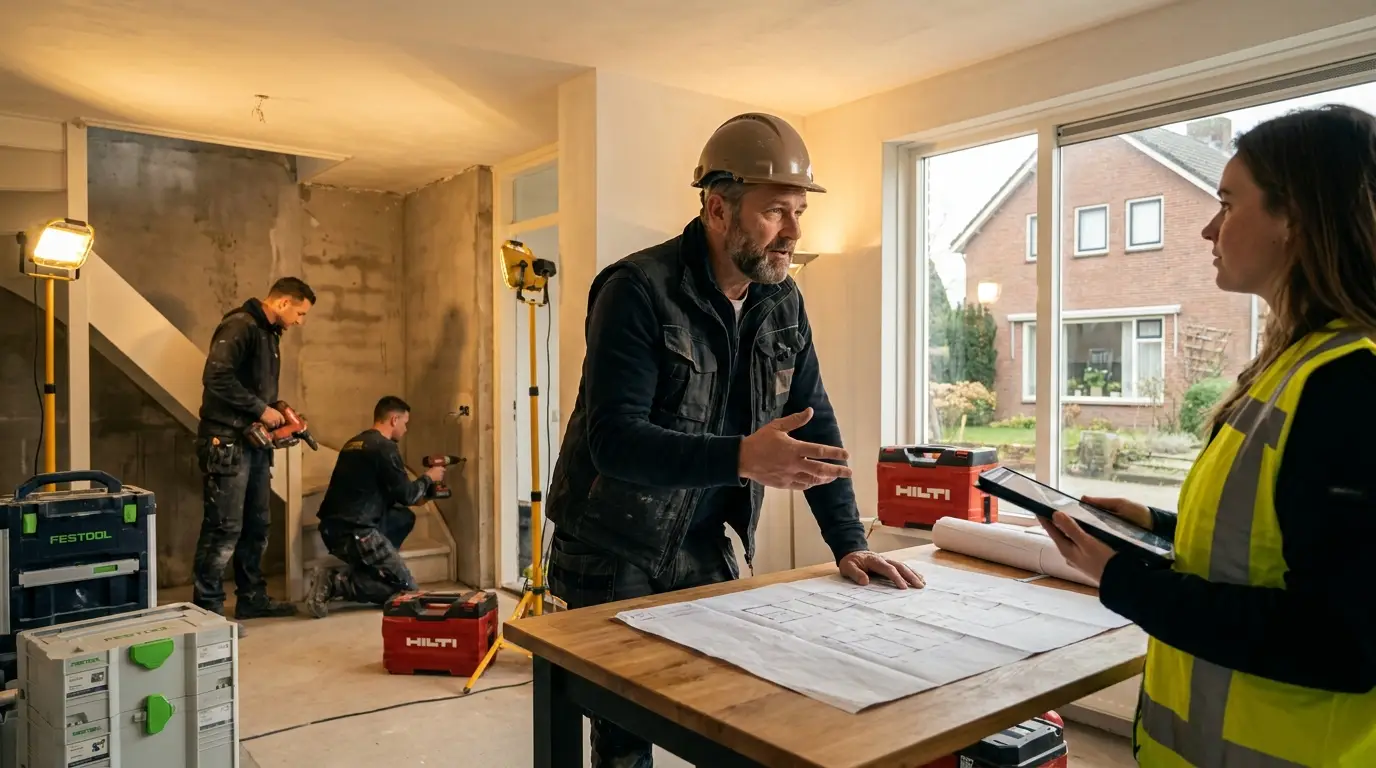
Cost of building or renovating a basement: everything you need to know
Building or renovating a basement is a major renovation that involves excavation, foundation modifications, and waterproofing. Costs vary widely: a simple basement renovation that tackles moisture can easily cost several thousand euros, while a completely new basement under an existing home quickly runs €30,000 to €65,000. What you pay exactly depends on the floor area, soil type, finish, and the condition of the existing foundation.
In this article
- ›What does building or renovating a basement cost?
- ›Prices by type of basement
- ›Material and labor costs
- ›Hiring a contractor vs. doing it yourself
- ›Basement project step by step
- ›Money-saving tips
- ›Frequently asked questions
Need a contractor for this?
Describe your job and get quotes from contractors near you.
average price
€35,000
new basement under existing home (approx. 20 m²)
average hourly rate
€55
contractor hourly rate (€45–70/hour)
turnaround time
4–12 weeks
depending on type and scope
€ Average price by type
| Type of basement or renovation | Range | Average price |
|---|---|---|
| Basement renovation (moisture & finishing)moisture control, sealing, and basic finishing of existing basement | €3,500 – €12,000 | €7,000avg.incl. labor |
| New basement in new construction (most popular)basement built along with new construction or an addition, approx. 20 m² | €15,000 – €35,000 | €22,000avg.incl. installation |
| Digging a basement under an existing homeunderpinned construction including excavation, foundation, and waterproofing | €30,000 – €65,000 | €45,000avg.incl. installation |
| Installing a precast concrete basementfactory-made concrete basement unit set into the ground, faster construction | €18,000 – €40,000 | €28,000avg.incl. installation |
| Converting a basement into living spaceinsulation, ventilation, electrical, and finishing the floor and walls | €8,000 – €20,000 | €13,000avg.incl. installation |
Prices are estimates; soil type, groundwater level, and foundation construction can significantly affect the actual costs. Based on Google price research.
Material and labor costs
Average general contractor/construction worker hourly rate: €45–70/hour. Specialized excavation or pile driving is usually quoted as a day rate or unit price.
Hiring a contractor vs. doing it yourself
| Job | Do it yourself | Via a contractor | Savings doing it yourself |
|---|---|---|---|
| Finishing basement walls (plaster or drywall)Finishing already watertight, dry basement walls with drywall or a plaster coat | FeasibleStandard do-it-yourself job; no special permit or heavy equipment needed as long as the wall is already watertight and dry | €300–€800 materials (yourself) vs. €1,000–€2,500 contractor | up to €1,700 |
| Applying interior moisture sealingCement-based sealing mortar or crystalline coating on existing basement walls | With experienceSurface preparation is crucial: mistakes lead to recurring leaks. You need to know how to choose the product and apply it | €400–€1,200 materials (yourself) vs. €1,500–€4,000 contractor | up to €2,800 |
| Insulating the basement (walls and floor)Applying insulation boards or spray foam to basement walls and floor | With experienceInstalling insulation boards is feasible; properly handling ventilation connections and vapor retarder film takes know-how to prevent condensation problems | €600–€1,800 materials (yourself) vs. €2,000–€5,000 contractor | up to €3,200 |
| Excavation and digging out a basement underneathDigging under the existing foundation in phases, removing soil by crane and truck | Not recommendedRequires heavy equipment, knowledge of foundation engineering, and a building permit. A mistake can cause structural damage to the building | €8,000–€20,000 (always a contractor) | No recommended savings |
| Exterior foundation waterproofingExcavating all around, applying bitumen or bentonite membrane, laying drainage mat and pipe | Not recommendedComplex excavation next to the foundation carries a risk of collapse. Improperly applied waterproofing leads to structural moisture damage that only shows years later | €5,000–€15,000 (always a contractor) | No recommended savings |
For a basement project, there's a hard line between what you can do yourself and what absolutely requires a contractor. Excavation, foundation support, and exterior waterproofing are never suitable for DIYers: mistakes immediately cause structural damage to your home that can cost tens of thousands of euros to repair. Building a new basement also always requires a building permit and a structural calculation by a licensed structural engineer: nobody can 'skip' this. What you can do yourself is limited to the finishing phase: plastering walls or covering them with drywall, installing insulation boards on already sealed walls, and doing painting or tile work. Realistically, that saves you €1,000 to €4,000 on the total project cost without risking the safety or watertightness of the structure.
The full process step by step
Research, architectural sketch, and permit application
Decide on the type of basement project (renovation, including it in new construction, or digging underneath). Have a building consultant or structural engineer assess feasibility based on the current foundation, soil type, and groundwater level. Then submit the building permit application to the municipality: expect two to eight weeks for approval.
2–8 weeks
Soil survey and structural calculation
Every new basement requires a soil survey (determining bearing capacity and groundwater level) and a structural calculation. Based on this, the structural engineer determines the basement wall thickness, foundation method, and waterproofing strategy. This report is also required for the permit application.
1–2 weeks
Requesting quotes and selecting a general contractor
Request at least three quotes from general contractors with proven experience in basement projects. Compare not only the price, but also the foundation support method used, the warranty period on the waterproofing, and references from similar projects in the same soil type.
1–2 weeks
Excavation and foundation support
The general contractor excavates the soil in phases; when building underneath, always in small sections to prevent cracks in the foundation. The foundation is temporarily supported with shores or concrete blocks. Excavated soil is hauled away by truck right away.
1–4 weeks
Basement construction: formwork, concrete, and waterproofing
Formwork is set up and concrete is poured for the basement floor, walls, and ceiling (or a precast concrete basement is lifted into place). After curing comes the waterproofing: exterior bitumen or bentonite membrane, drainage mat, drainage pipe, and possibly a sump pit with a pump system for groundwater drainage.
2–4 weeks
Finishing: insulation, ventilation, and installations
After sealing, insulation boards are installed on the walls and floor. Mechanical ventilation is required in a basement used as living space. When converting to living space, electrical, lighting, and possibly heating or radiant floor heating are installed as well. This is the phase where DIYers can step in.
1–3 weeks
Inspection, handover, and warranty documentation
Have the waterproofing and structure checked by an independent building inspector before handover. Check that all permit conditions have been met and request the warranty documentation for the waterproofing: good general contractors offer at least a ten-year warranty on the watertight shell.
2–5 days
6 smart money-saving tips
Frequently asked questions
What does building or renovating a basement cost on average?
A basement renovation costs an average of €3,500–€12,000. A new basement in new construction costs €15,000–€35,000. Building underneath an existing house is the most expensive: an average of €30,000–€65,000 depending on soil type and scope.
How long does it take to build a basement?
A basement renovation takes 1 to 3 weeks. A completely new basement under an existing home usually takes 6 to 12 weeks, including excavation, formwork, pouring, and curing the concrete.
Do I need a permit for a basement?
Yes, almost always. Digging a new basement or doing a major renovation requires a building permit. A soil survey and structural calculation are often needed as well. Apply early with your municipality.
Can I build a basement myself?
Smaller jobs, such as applying a sealing layer or finishing walls, can sometimes be done yourself, but excavation, foundation work, and waterproofing require specialized contractors and professional equipment. Doing it yourself is only possible to a limited extent here and is risky.
What are the main causes of high basement costs?
The biggest cost items are excavation (digging out and removing soil), foundation modifications, formwork and poured concrete, and waterproofing. For an existing house, there are also costs for temporarily supporting the foundation.
Is a basement a good investment?
A basement increases your home's value, but the payback period is long. In new construction, adding a basement is relatively inexpensive. Building underneath an existing home is costly, and the return depends heavily on the housing market and location.
Related jobs
Ready to build or renovate your basement?
Describe your job and get quotes from verified general contractors near you.
Within 24 hours
response from a contractor
Verified
all contractors checked
Competitive price
compare quotes