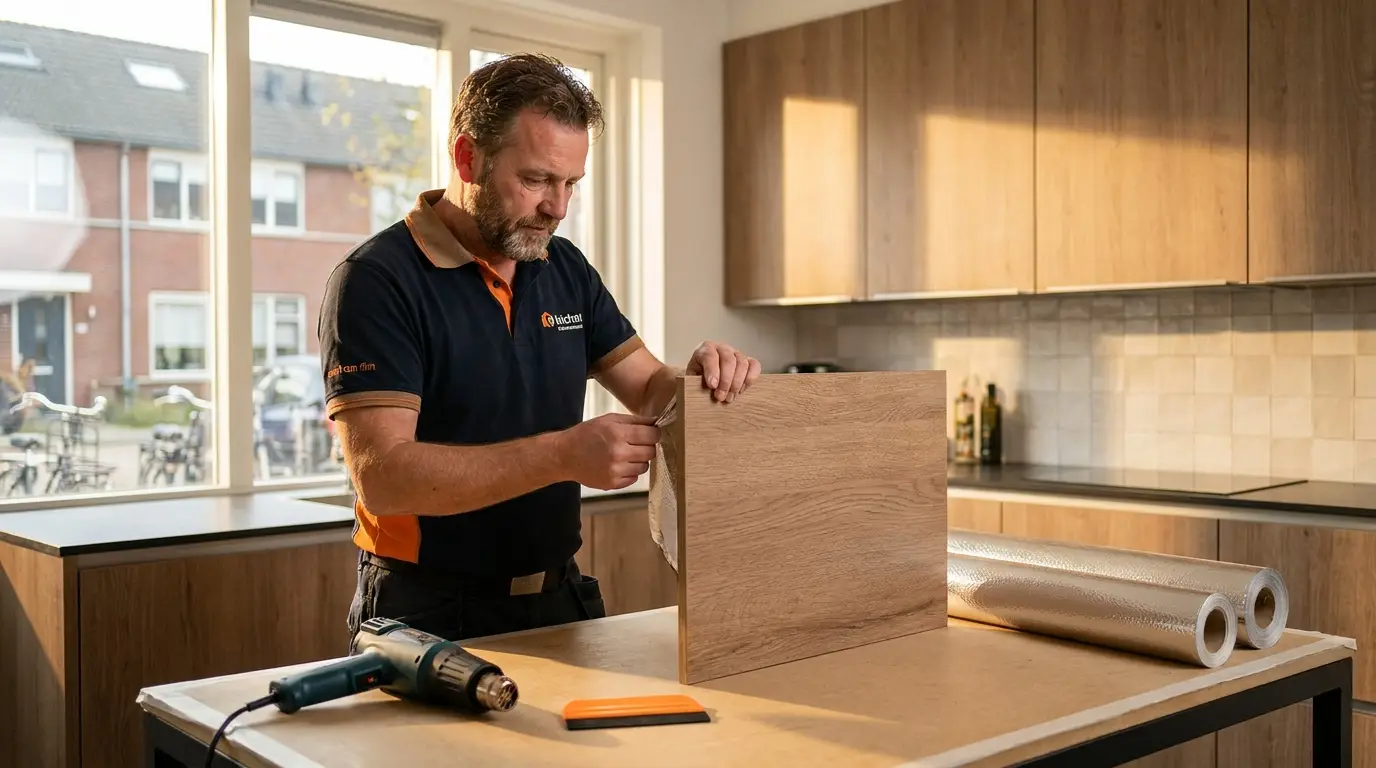
Cost of wrapping a kitchen or applying vinyl film: everything you need to know
Wrapping your kitchen or applying vinyl film is a popular way to give your kitchen a fresh look without remodeling. The cost depends on the number of cabinet fronts, the quality of the film, and whether you hire a contractor. In this overview, you'll find current prices, a clear cost breakdown, and practical tips to save money wisely.
In this article
- ›What does kitchen wrapping cost on average?
- ›Price overview by kitchen type
- ›What determines the cost?
- ›Hiring a contractor vs. doing it yourself
- ›How does kitchen wrapping work step by step?
- ›Money-saving tips for kitchen wrapping
- ›Frequently asked questions
Need a contractor for this?
Describe your job and get quotes from contractors near you.
average price
€1,500
full kitchen wrap, materials + labor included
average hourly rate
€50
contractor hourly rate (€40–60/hour)
turnaround time
1–3 days
depending on scope and number of fronts
€ Average price by type
| Kitchen type or scope | Range | Average price |
|---|---|---|
| Partial wrap (a few fronts)5–10 cabinet doors or drawers, one color of matte film | €300 – €700 | €500avg.incl. labor |
| Full wrap, small kitchen (most popular)10–15 fronts, materials and labor included | €700 – €1,500 | €1,100avg.incl. labor |
| Full wrap, medium kitchen15–25 fronts, including side panels and hood | €1,200 – €2,500 | €1,800avg.incl. labor |
| Full wrap, large kitchen25+ fronts, panels, backsplash, and hood | €2,000 – €4,000 | €3,000avg.incl. labor |
| Premium film or special finishWood look, marble look, or carbon finish, large kitchen | €2,500 – €5,000 | €3,500avg.incl. labor |
Prices include standard matte or gloss film and labor; premium films such as wood look or marble look cost 20–40% more. Based on Google price research.
Material and labor costs
Kitchen wrap contractors charge an average hourly rate of €40–60/hour. Highly complex pieces (curved fronts, grooved wood) can go up to €65/hour.
Hiring a contractor vs. doing it yourself
| Job | Do it yourself | Via a contractor | Savings doing it yourself |
|---|---|---|---|
| Wrapping flat cabinet doorsSimple rectangular MDF fronts without routing or relief | DoableVery doable with a squeegee and patience; use air-release film and work from the center outward to prevent air bubbles | €150–€400 | up to €250 |
| Wrapping drawer fronts and narrow profilesLow, wide drawer fronts with corners and possibly handles | With experienceRequires precise cutting; mistakes in the corners are clearly visible, and fixing them means a new piece of film | €200–€500 | up to €200 |
| Wrapping the hood, side panels, and backsplashLarge continuous surfaces with inside corners and joints to the fronts | With experienceCreases and air bubbles form easily on large surfaces; professional tools (heat gun, long squeegee) make the difference | €300–€700 | up to €300 |
| Applying premium or textured filmWood look, marble look, or carbon with a continuous directional pattern across multiple fronts | Not recommendedThe pattern must line up to the millimeter across adjacent fronts; one miscut piece of expensive film easily wastes €30–€80 in material | €600–€1,500 | No recommended savings |
| Wrapping fronts with routed profiles or decorative moldingKitchen doors with routed frames, decorative grooves, or raised moldings | Not recommendedThe film has to be pressed into the grooves using a relief cut; too much tension causes tears, too little causes air pockets along the edge | €400–€900 | No recommended savings |
Wrapping flat MDF fronts is the only part of the job where doing it yourself gives you a realistic chance of an acceptable result, provided you carefully degrease the fronts, use solid film, and take the time to smooth out air bubbles inch by inch. As soon as textured film (wood look, marble look), routed profiles, or large continuous panels are involved, a contractor is essential. Kitchen wrap contractors work with professional squeegees, heat guns, and cutting templates that allow precise custom work. There's no certification requirement specific to wrapping, but a specialized contractor has proven experience with film brands such as 3M, Avery, or Orajet and can offer a workmanship warranty, something that doesn't apply when you do it yourself.
The full process step by step
Consultation and on-site measurement
The contractor inspects all parts to be wrapped: fronts, drawers, side panels, hood, and any backsplash. They note the exact number, measure the dimensions, and assess the condition of the surface (painted MDF, particleboard, HPL). Based on this, the amount of film needed is calculated, including a margin for waste and cutting.
30–60 min
Removing fronts, drawers, and handles
All cabinet doors and drawer fronts are unscrewed and numbered or marked so each piece goes back in the right place. Handles and hinges are removed. Ideally, fronts are worked on lying flat for a better result.
30–90 min
Cleaning and surface preparation
Each front is thoroughly degreased with isopropyl alcohol or a special film cleaner. Film doesn't adhere well to grease residue, soap film, and cooking fumes. Small damage is filled and sanded smooth. The contractor checks that the surface is dry, clean, and dust-free before the film is applied.
45–90 min
Cutting and applying the film
The film is cut to size for each front with 2–3 cm of overhang all around. The backing is removed step by step while the contractor applies the film with a squeegee from the center outward. With textured film (wood look, marble look), the pattern is first aligned across all adjacent fronts. Corners and edges are cut, folded over, and finished tightly with a heat gun.
4–8 hours (full kitchen)
Wrapping the hood, side panels, and backsplash
After the fronts, the fixed parts are wrapped: side panels, upper hood, and any visible backsplash. Joints with already wrapped fronts are finished seamlessly. At inside corners, the film is cut and overlapped for a watertight seal.
1–3 hours
Reinstallation and final inspection
Fronts and drawers are put back in their original positions. Hinges are adjusted so doors hang straight and close evenly. Handles are installed. The contractor checks all seams, corners, and transitions for air bubbles or loose edges and secures them.
1–2 hours
6 smart money-saving tips
Frequently asked questions
What does kitchen wrapping cost on average?
On average €1,500 for a standard kitchen, including film and labor. Range: €300 for a few fronts up to €5,000 for a large kitchen with premium film.
How long does it take to wrap a kitchen?
It takes 1 to 3 days, depending on the number of fronts and the complexity. A contractor wraps 8 to 15 fronts per day on average.
Do I need a permit to wrap my kitchen?
No, wrapping a kitchen or applying vinyl film is a cosmetic change that doesn't require a permit. You can start right away.
Can I wrap my kitchen myself?
You can for simple flat doors. Watch out for air bubbles and tight corners. You can buy film for €10–€30 per m² at a home improvement store. For a flawless result, hiring a contractor is recommended.
What's the difference between wrapping and buying new doors?
New doors easily cost €2,000–€5,000 for a complete set, while wrapping is half to three-quarters cheaper. Wrapping is reversible; new doors are a permanent choice.
How long does the film last?
Quality film lasts 5 to 10 years with normal use. Avoid prolonged contact with steam, grease, or abrasive cleaners to extend its lifespan.
Related jobs
Ready to have your kitchen wrapped?
Describe your job and receive quotes from verified kitchen contractors near you.
Within 24 hours
response from a contractor
Verified
all contractors checked
Competitive price
compare quotes