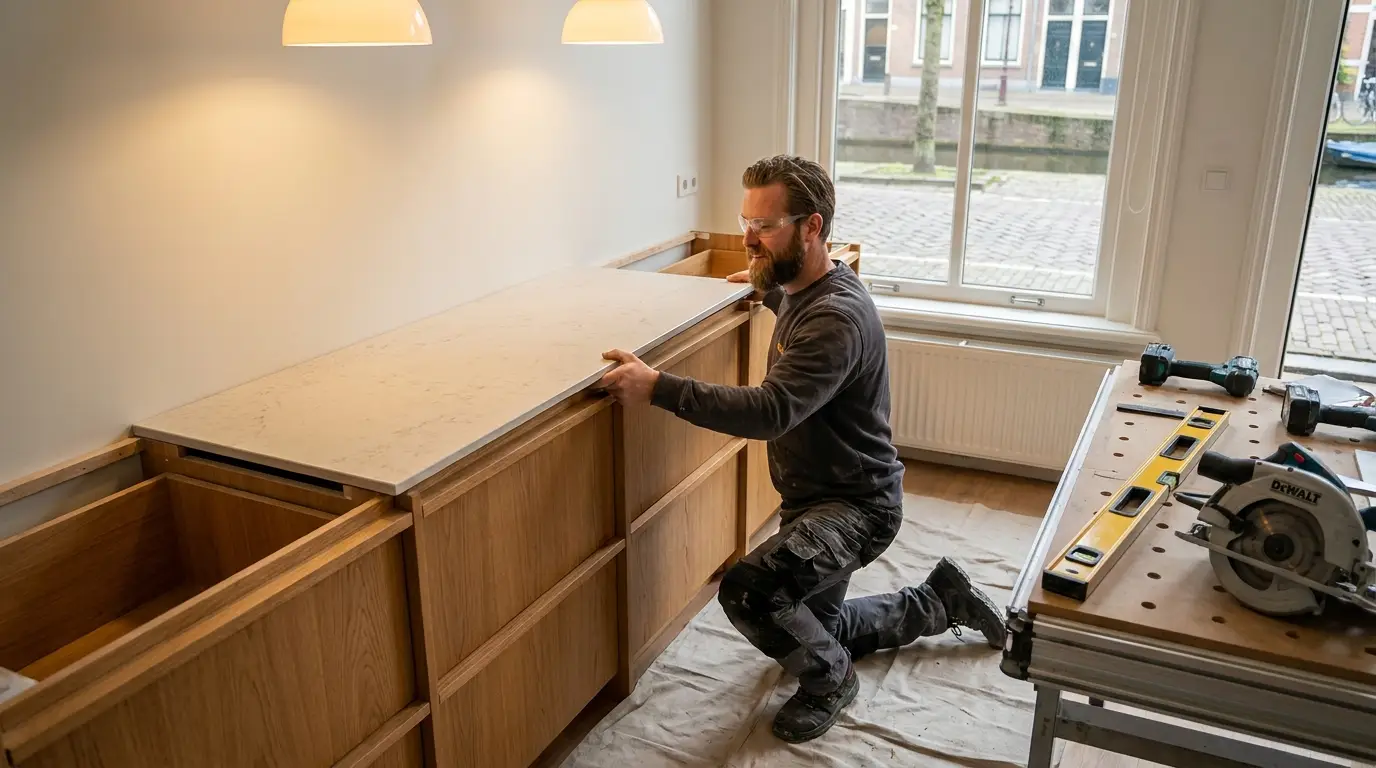
Cost of installing or replacing a countertop: everything you need to know
A new countertop instantly gives your kitchen a fresh look. The cost depends heavily on the material you choose, from affordable laminate to luxury granite or quartz composite, and on the size of the countertop. Read here what you can expect in material and installation costs and which choices affect the price the most.
In this article
- ›What does it cost to install or replace a countertop?
- ›Prices by material type
- ›Material and labor cost breakdown
- ›Hire a contractor or do it yourself?
- ›How does installation work step by step?
- ›Handy money-saving tips
- ›Frequently asked questions
Need a contractor for this?
Describe your job and get quotes from contractors near you.
average price
€950
material + installation (standard laminate countertop)
average hourly rate
€48
contractor hourly rate (€45–55/hour)
turnaround time
1–2 days
depending on material and scope
€ Average price by type
| Countertop type | Range | Average price |
|---|---|---|
| Laminate (HPL)Most affordable choice, many color and wood patterns available | €250 – €800 | €500avg.incl. installation |
| Solid-core / compact laminate (most popular)Sturdy, water-resistant, and easy to maintain | €450 – €1,200 | €800avg.incl. installation |
| Wood (solid or bamboo)Warm look, needs periodic oiling | €600 – €1,500 | €1,000avg.incl. installation |
| Granite or slateDurable and unique, heavy material: expert installation required | €900 – €2,500 | €1,600avg.incl. installation |
| Composite / quartzScratch-resistant, hygienic, and non-porous, premium segment | €1,200 – €3,500 | €2,200avg.incl. installation |
Prices include installation for a standard countertop of approx. 2.5 linear meters; cutouts for a sink or cooktop may involve extra costs. Based on Google price research.
Material and labor costs
Carpenter/kitchen contractor hourly rate averages €45–55/hour. Prices for heavy natural stone (granite, quartz) may be higher due to specialized tools.
Hiring a contractor vs. doing it yourself
| Job | Do it yourself | Via a contractor | Savings doing it yourself |
|---|---|---|---|
| Installing a laminate countertop (straight, no cutouts)Standard straight countertop on base cabinets, no openings needed | DoableWith a power saw and precise measuring, a handy person can do this | €90–€200 | up to €200 |
| Cutout for sink or cooktopPrecision routing in the countertop for an undermount or drop-in sink or induction cooktop | With experienceRequires a router guide or jigsaw; one wrong cut and the countertop is unusable | €60–€150 | up to €150 |
| Corner joint and custom workJoining two countertops seamlessly in an L- or U-shaped kitchen | Not recommendedRequires accuracy to half a millimeter; a poor joint leaves a visible gap or crack | €100–€250 | No recommended savings |
| Installing a granite or composite countertopInstalling a heavy stone or quartz countertop, including silicone sealing | Not recommendedThe countertop weighs 40–80 kg, can break if poorly supported, and requires special lifting equipment | €150–€350 | No recommended savings |
| Applying silicone caulk and sealingMaking the seam between the countertop and the tiled backsplash watertight | DoableWith a caulking gun and masking tape, you can easily do this yourself; remove the old caulk thoroughly first | €20–€60 | up to €60 |
A straight laminate countertop without cutouts is realistically doable for a handy DIYer, provided you have a fine-tooth saw or circular saw and enough time for measuring. Applying the silicone seal afterward is also easy to do yourself. As soon as cutouts are needed for a built-in sink, induction cooktop, or faucet hole (or when you choose a heavy material such as granite, slate, or composite), a specialized carpenter or kitchen installer is essential. Granite and composite weigh up to 80 kg per linear meter and can break if poorly supported; a wrong cut or loose countertop can permanently damage the base cabinets and lead to moisture problems in the long run. No legal certifications are required to install a countertop, but the work is beyond the skills of the average handy person once precision and heavy materials come into play.
The full process step by step
Measuring and confirming the material
The kitchen contractor carefully measures the entire countertop area: length, width, corners, and the exact position of the sink, faucet, and cooktop. A deviation of half a centimeter is already too much here. The material and color are finalized, and any custom drawings are sent to the supplier or manufacturer.
30–60 min
Removing the old countertop
The sink and cooktop are disconnected. The water supply and drain are shut off. The old countertop is unscrewed from the base cabinets and carefully removed. Any old silicone caulk and adhesive residue is removed from the backsplash and cabinet edge.
30–60 min
Cutting the new countertop to size
The new countertop is cut to the measured dimensions. In an L- or U-shaped kitchen, the corner joints are routed at a precise angle so the countertops will join seamlessly. Cut edges are finished right away to prevent chipping.
30–90 min
Routing cutouts for built-in appliances
Using a plunge router or jigsaw, the openings for the built-in sink, cooktop, and faucet are cut. With laminate and solid-core laminate, the cut edges are then sealed with an edge profile or strip to keep moisture out. With stone, the edges are ground and polished.
30–60 min
Placing and leveling the countertop
The countertop is placed on the base cabinets and checked with a level. Any height differences are corrected with shims or by adjusting the cabinet legs. The countertop is then screwed in from below at the corners and along the center support.
30–60 min
Reinstalling the sink, faucet, and cooktop
The sink is glued in or mounted with clips, and the faucet is connected to the water supply. The cooktop is put back. The contractor immediately checks for leaks on the water side and tests the drain.
30–60 min
Sealing and final inspection
The seam between the countertop and the tiled backsplash is masked off and filled with kitchen silicone caulk. After curing (at least 24 hours), the seam is watertight. The contractor checks all connections, removes the masking tape, and cleans the surface.
20–40 min
6 smart money-saving tips
Frequently asked questions
What does replacing a countertop cost on average?
On average, you'll pay €450–€2,500 including installation. Laminate starts at around €250, while granite or composite can run up to €3,500 for a complete kitchen layout.
How long does it take to install a countertop?
Installation takes 1 to 4 hours on average. With complex cutouts, corner joints, or heavy natural stone, it can take half a day to a full day.
Which material is the easiest to maintain?
Composite and quartz need the least maintenance: non-porous, scratch-resistant, and easy to clean. Wood needs periodic treatment with oil or wax.
Can I install a countertop myself?
You can install a laminate countertop yourself if you're handy, but cutouts for the sink or cooktop require precision and specific tools. Stone and composite are too heavy and fragile: always have a contractor do this.
Do I need a permit?
No. Replacing a countertop is a cosmetic change and counts as regular maintenance. No building permit is required.
What does it cost if I also want to replace the sink?
A new sink including installation costs an extra €150–€400 on average. Have this done at the same time as the countertop to avoid paying labor costs twice.
Related jobs
Ready to have your countertop installed or replaced?
Describe your job and get quotes from verified kitchen contractors and carpenters near you.
Within 24 hours
response from a contractor
Verified
all contractors checked
Competitive price
compare quotes