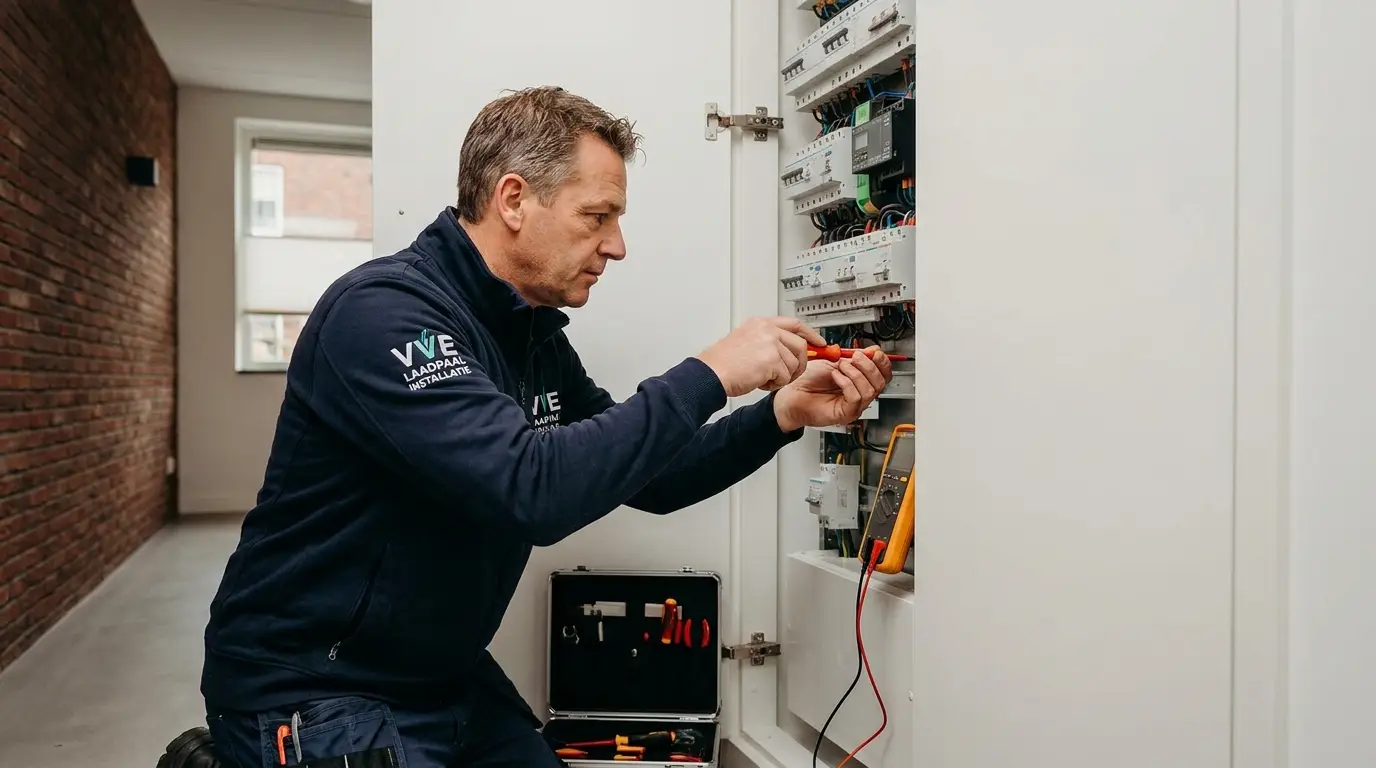
Cost of an EV charger for a business, VvE, or charging hub: everything you need to know
An EV charger for a business, VvE (the homeowners association of an apartment building), or charging hub is an investment that varies widely based on the number of charging points, the cabling needed, power capacity, and any grid connection upgrade. For a single business EV charger, you'll quickly pay €1,500 to €3,000, while a complete charging hub with multiple AC charging points can run to €40,000 or more. Subsidies such as SPRILA (a Dutch subsidy for private charging infrastructure) can cover a large share of the cost.
In this article
- ›What does an EV charger for a business or VvE cost?
- ›Price overview by installation type
- ›Material and labor cost breakdown
- ›Subsidies: SPRILA, SVVE, and tax benefits
- ›Hire a contractor or do it yourself?
- ›Step-by-step plan: from quote to connection
- ›Money-saving tips for businesses and VvEs
Need a contractor for this?
Describe your job and get quotes from contractors near you.
average price
€2,200
EV charger incl. installation (per point)
average hourly rate
€65
electrician hourly rate (€55–75/hour)
turnaround time
1–5 days
depending on scope and grid upgrade
€ Average price by type
| EV charger installation type | Range | Average price |
|---|---|---|
| Single business EV charger (1 charging point, AC 11 kW)Ideal for 1–2 electric cars on business premises or a VvE parking lot | €1,000 – €2,500 | €1,700avg.incl. installation |
| Dual business EV charger (2 charging points, AC 22 kW), most popularStandard solution for small businesses and VvEs; one installation, two charging points | €1,500 – €3,500 | €2,500avg.incl. installation |
| Charging station with 5–10 AC charging points (charging cluster)Suitable for larger VvEs, vehicle fleets, or small charging hubs | €8,000 – €20,000 | €14,000avg.incl. installation |
| Charging hub with 10+ AC charging points and load managementBusiness parks, offices, or parking lots; incl. distribution panel and cabling | €15,000 – €40,000 | €27,000avg.incl. installation |
| DC fast charger for a business or charging hub (50–150 kW)Fast charging for fleets or public use; higher purchase and grid costs | €20,000 – €60,000 | €35,000avg.incl. installation |
Prices include standard installation; grid connection upgrades, excavation, and load management software are quoted separately and can significantly raise the total price. Based on Google price research.
Material and labor costs
Electrician hourly rate averages €55–75/hour. Business installations generally require a certified installation company (NEN 1010).
Hiring a contractor vs. doing it yourself
| Job | Do it yourself | Via a contractor | Savings doing it yourself |
|---|---|---|---|
| Mechanically mounting the EV charger on a wall or postPhysically attaching the charger housing at the desired location | FeasibleOnly the mechanical mounting without cabling is doable for a handy DIYer; the electrical connection must be done separately by an electrician | €50–€150 | up to €100 |
| Running cabling and making the electrical connectionInstalling the circuit from the meter cabinet or distribution panel to the charging point | Not recommendedLegally required to be done by a certified installation company (NEN 1010); without a licensed electrician, the warranty is void and the SPRILA subsidy isn't paid out | €260–€750 | No legal savings possible |
| Submitting the SPRILA subsidy application through RVOOnline application through the subsidy portal of the Netherlands Enterprise Agency | FeasibleThe form at rvo.nl/sprila is easy to access; a business or VvE board member can fill it in themselves in about an hour | €0 (your own time) | up to €1,250 per charging point |
| Requesting a grid connection upgrade from the grid operatorFormal request to expand the electrical connection | With experienceThe business or VvE can submit the request itself; the technical work is handled entirely by the grid operator and requires no expertise from the applicant | €2,000–€15,000 (grid operator) | No recommended savings |
| Configuring load management softwareSetting up smart power management through the charge point operator's back-office portal | With experienceSimple settings (max power per point, schedules) can be handled yourself through the supplier portal; complex OCPP integrations or linking to an energy management system require technical knowledge | €0–€200 | up to €15,000 |
For a business EV charger installation for a business or VvE, the electrical connection is always reserved for a certified installation company. This is legally anchored in NEN 1010 (the Dutch standard for electrical installations) and is also a strict condition for the SPRILA subsidy payout and the validity of the manufacturer's warranty. No licensed electrician means no subsidy and no valid warranty. What businesses and VvE board members can handle themselves: the mechanical mounting of the charger housing, the subsidy application through the RVO portal, submitting the grid upgrade request to the grid operator, and setting up basic functions in the load management software. VvEs must also arrange formal approval in advance through a members' meeting: without a two-thirds majority, the installation legally can't go ahead.
The full process step by step
Needs assessment and site survey
Map out the number of charging points needed based on the current and expected vehicle fleet or EV adoption within the VvE. Measure the distance from the meter cabinet (where the electricity meter and the breaker panel are) or distribution panel to the planned charging location, and check the available electrical connection capacity. VvEs also arrange formal approval through a members' meeting in this phase.
1–2 weeks
Request quotes from certified electricians
Request at least three quotes from installation companies that are NEN 1010 certified and experienced with business charging installations. Have the grid upgrade, excavation, hardware, and management software itemized separately so you can compare offers fairly. Check whether the quote includes an electrical inspection report.
1–2 weeks
Submit the subsidy application before work starts
Submit the SPRILA application through the RVO portal before the electrician starts. VvEs can also apply for the SVVE subsidy (a Dutch subsidy for VvEs) for professional charging advice or basic charging infrastructure. Keep the confirmation safe: it's required for the final settlement.
2–4 weeks (RVO processing time)
Request a grid connection upgrade if necessary
If the total charging capacity exceeds the current grid connection, you or the electrician on your behalf request an upgrade from the grid operator. This process is completely separate from the electrician and is carried out by the grid operator itself. Expect a lead time of 4 to 26 weeks.
4–26 weeks (grid operator)
Installation, cabling, and connection
The EV charger installer places the chargers, runs cabling from the distribution panel to each charging point, installs any extra circuits, and connects everything according to NEN 1010. For larger charging hubs, cable trays, excavation, and an extra distribution panel are also installed.
1–5 days
Electrical inspection and inspection report
After the installation, the electrician performs an electrical inspection in accordance with NEN 1010. The inspection report is required for the SPRILA subsidy payout and to activate the manufacturer's warranty. Make sure you receive this report before handover.
A few hours (same day)
Commissioning, load management, and test charging
The electrician activates the chargers through the operator's back-office portal. Set up load management based on the available connection capacity and the expected usage pattern. Test each charging point individually with an EV before handover.
Half a day
6 smart money-saving tips
Frequently asked questions
What does an EV charger for a business or VvE cost on average?
On average €2,200 per charging point, including installation. Range: €1,000 (simple single charger) to €60,000+ (DC fast charger or complete charging hub). A dual AC charger for a VvE or small business typically costs €1,500–€3,500.
How long does it take to install a business EV charger?
A single installation is done in 1 day. A charging cluster or charging hub with excavation and a grid connection upgrade can take 3 to 5 days, not counting the lead time at the regional grid operator, which can run to several weeks.
Is my business eligible for a subsidy for EV chargers?
Yes. Through SPRILA (Subsidieregeling Private Laadinfrastructuur), you can receive a subsidy as a business or VvE. Apply through RVO (the Netherlands Enterprise Agency).
Do I need a permit for an EV charger or charging hub?
On your own private property, a permit usually isn't required. For excavation, public land, or major changes to the electrical system, a permit may be required. Check with your municipality or through the Omgevingsloket (the Dutch online permit portal).
What's the difference between AC and DC charging for businesses?
AC charging (11–22 kW) suits office parking and VvEs where cars are parked for hours. DC fast charging (50–150 kW) charges in 20–45 minutes and makes sense for logistics, fleet management, or public use. DC costs 5–10× more to purchase.
Can I deduct the cost of a business EV charger from my taxes?
Yes. Business EV chargers are business assets and fully deductible as business expenses. You may also qualify for the MIA/Vamil scheme (Dutch environmental investment tax deduction), which lowers the net investment further.
Related jobs
Ready to have EV chargers installed for your business or VvE?
Describe your job and receive quotes from verified EV charger installers near you.
Within 24 hours
response from a contractor
Verified
all contractors checked
Competitive price
compare quotes