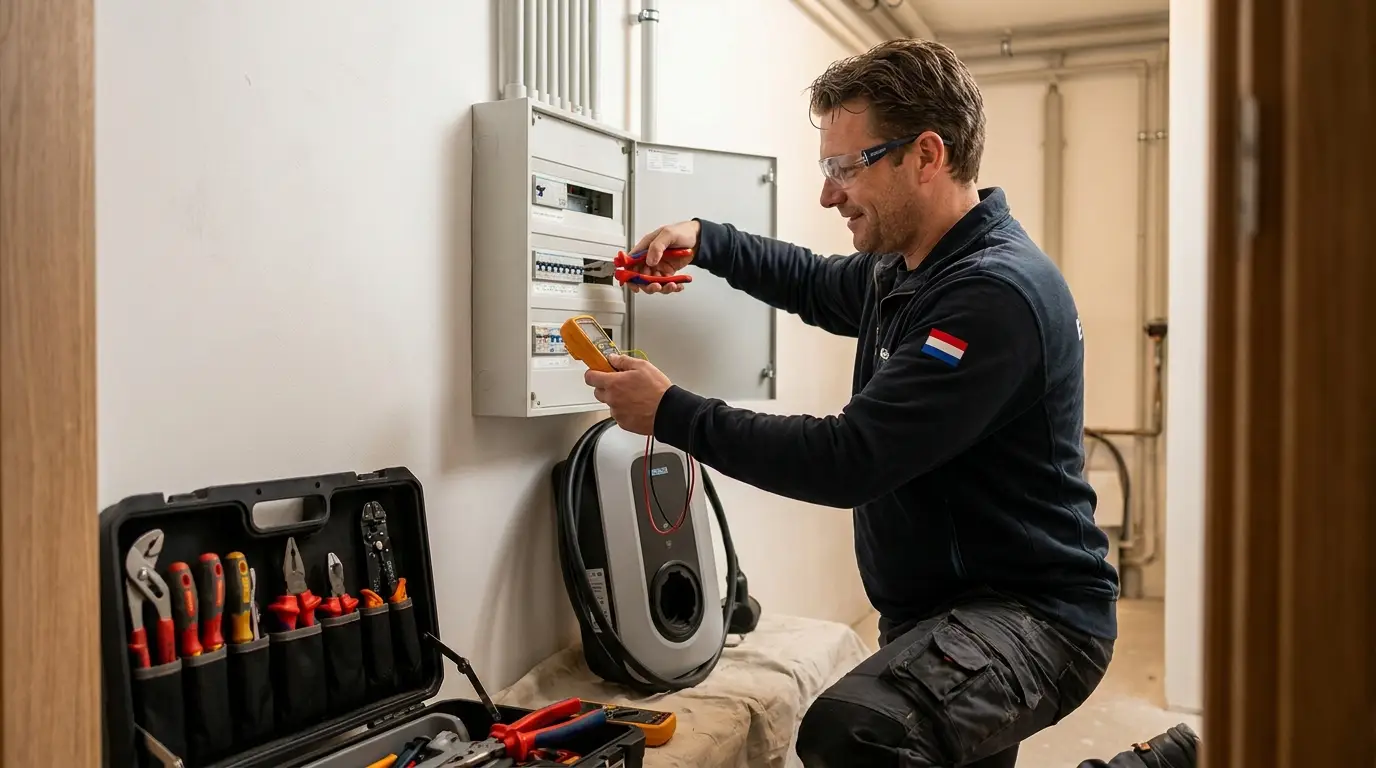
Cost of replacing or upgrading an EV charger: everything you need to know
Replacing or upgrading an EV charger in the Netherlands costs on average between €600 and €2,500, depending on the new model, the installation work required, and any changes to the meter cabinet (where the electricity meter and the breaker panel are). If you switch from a single-phase to a three-phase EV charger or add smart charging, you pay more but benefit from faster charging and lower energy costs over time.
In this article
- ›What does replacing an EV charger cost?
- ›Prices by type of EV charger
- ›Material and labor costs
- ›Hire an electrician or do it yourself?
- ›Step-by-step process
- ›Money-saving tips
- ›Frequently asked questions
Need a contractor for this?
Describe your job and get quotes from contractors near you.
average price
€1,200
EV charger replacement incl. installation
average hourly rate
€85
electrician hourly rate (€75–110/hour)
turnaround time
1–2 days
depending on scope
€ Average price by type
| Replacement / upgrade type | Range | Average price |
|---|---|---|
| Like-for-like replacement (1-phase, 3.7 kW)same connection reused, only a new charging unit | €600 – €1,100 | €800avg.incl. installation |
| Upgrade to 1-phase 7.4 kW (most popular)faster home charging, minor meter cabinet change | €800 – €1,600 | €1,200avg.incl. installation |
| Upgrade to 3-phase 11 kWthree-phase connection required, type B RCBO | €1,200 – €2,500 | €1,800avg.incl. installation |
| Upgrade to 3-phase 22 kWmaximum home charging speed, connection upgrade often needed | €2,000 – €4,500 | €3,000avg.incl. installation |
| Smart EV charger with dynamic load balancinglink with solar panels or energy management system | €1,500 – €3,500 | €2,500avg.incl. installation |
Prices include VAT and standard installation costs; changes to the grid connection by the grid operator are not included. Based on Google price research.
Material and labor costs
Electrician hourly rate averages €75–110/hour. Includes NEN 1010 inspection; travel costs may be charged separately.
Hiring a contractor vs. doing it yourself
| Job | Do it yourself | Via a contractor | Savings doing it yourself |
|---|---|---|---|
| Removing the existing EV chargerShutting off power, disconnecting from the breaker panel, and removing the old unit | Not recommendedWork on the fixed electrical system is legally reserved for licensed electricians (NEN 1010) | €50–150 | No legal savings possible |
| Connecting the new EV charger to the breaker panelConnecting the cabling, installing the RCBO, and commissioning | Not recommendedRequires a licensed electrician; without a NEN 1010 certificate of compliance the installation is uninsured and the grid operator may refuse the connection | €150–400 | No legal savings possible |
| Selecting an EV charger and comparing quotesReviewing specs, comparing brands, checking subsidy eligibility | DoableBeing well prepared saves the electrician's advisory hours: use RVO's SEEH product list as a guide | €0 | up to €150 |
| Submitting the SEEH subsidy application to RVOFilling out an online form with the invoice and a photo of the installed EV charger | DoableThe application is easy to do yourself after installation; make sure the electrician is licensed and listed on the invoice | €0 | up to €500 |
| Preparing the cable route (digging or chasing)Digging a trench for an outdoor cable or cutting a chase for an indoor route | With experienceYou may do the digging or chasing yourself, as long as the electrician connects the cable. Discuss this in advance to protect the warranty | €80–250 | up to €200 |
Connections to the fixed electrical system fall under the NEN 1010 standard and are legally reserved for licensed electricians with a valid certificate. Connecting an EV charger yourself, even if it's 'just a plug in the panel', isn't allowed and has serious consequences: your homeowners insurance won't cover damage resulting from a non-certified installation, and when you sell your home, the buyer may demand a certificate of compliance you don't have. What you can do yourself: choose the right EV charger based on your EV's charging speed and driving habits, compare quotes through platforms like VakmanBaas, prepare the cable route (digging, cutting chases) to reduce labor costs, and afterward submit the SEEH subsidy application yourself through RVO.nl. That combination can lower the total cost by €200–700 without any safety or legal risk.
The full process step by step
Intake and site assessment
The EV charger installer reviews the existing charger type, the gauge and length of the current wiring, the free space in the breaker panel, and the grid connection capacity (1- or 3-phase, maximum load). Based on this, they determine which upgrade is technically feasible without the grid operator having to upgrade the connection.
30–60 min
Quote, subsidy check, and scheduling
You receive an itemized quote with unit costs, estimated labor hours, and any extra costs for a type B RCBO (a combined breaker and residual current device, the European counterpart of a GFCI), a new cable route, or a breaker panel circuit. The installer checks whether the chosen model is on RVO's SEEH product list, so you know for sure the subsidy applies before you buy anything.
1–2 days
Removing the old EV charger
The relevant circuit in the breaker panel is switched off and locked out. The EV charger is disconnected from the wiring and lifted off the wall or post. The electrician inspects the connection points, mounting points, and cable sheath for wear or corrosion: any damage determines whether the existing cable can be reused.
30–60 min
Installing the new EV charger
The new unit is mounted and the wiring connected: for a power upgrade, the cable gauge is checked for adequacy (at least 6 mm² for 32 A). For a three-phase upgrade, the electrician installs a type B RCBO in the breaker panel; a type AC is expressly not allowed for EV chargers. After connection, the breaker panel is checked for phase balancing.
1–4 hours
Inspection and NEN 1010 certificate of compliance
The entire installation is tested: grounding resistance, residual current, voltage drop over the cable length, and actual charging power. For smart EV chargers, the app link, the dynamic charging profile, and any P1 integration with the energy management system or solar panels are configured. The installer then issues the mandatory NEN 1010 certificate of compliance.
30–60 min
Instructions and handover
The installer explains how the new EV charger works: how to start and stop charging sessions, how to set up the app for home rate optimization, and what to do if an error message appears. You receive the invoice with all the details needed for the subsidy application.
15–30 min
Submitting the subsidy application to RVO
With the invoice, the certificate of compliance, and a photo of the installed EV charger, you submit the SEEH subsidy application yourself through the RVO.nl portal. Make sure you have the contractor's licensed installer number at hand: it's a required field on the form.
15–30 min (yourself)
6 smart money-saving tips
Frequently asked questions
What does replacing an EV charger cost on average?
On average €1,200, including a new EV charger and installation by a licensed electrician. Range: €600 for a simple like-for-like replacement up to €4,500 for an upgrade to a 22 kW three-phase EV charger with meter cabinet modifications.
How long does it take to replace an EV charger?
A standard like-for-like replacement takes 2–3 hours. An upgrade to three-phase with meter cabinet work and a new cable route takes 4–8 hours, sometimes spread over two days if the regional grid operator has to upgrade the connection.
Do I need a permit to replace my EV charger?
On your own property, you usually don't need a permit. If you live in a protected historic district or a historic building, or if the charger is in a public space, a permit may be required. Check this with your municipality.
Can I replace an EV charger myself?
No, that's not allowed. Connections to the fixed electrical system must be made by a licensed electrician. If you do it yourself, the warranty is void and the installation won't comply with NEN 1010 (the Dutch electrical installation standard), which can cause problems in case of damage or when you sell your home.
When is my EV charger due for replacement?
The technical lifespan of an EV charger is on average 7–10 years with normal use. Heavy use (daily charging, outdoor placement) can shorten this to 5–7 years. Signs that it needs replacing: charging errors, slow communication, outdated software without updates, or too little power for your new EV.
Is there a subsidy for a new EV charger?
Private individuals who own their home can apply for a subsidy through the SEEH scheme from RVO (the Netherlands Enterprise Agency), provided the electrician is licensed and the EV charger meets the technical requirements. Some energy suppliers and municipalities offer additional discounts. Check the current amounts and conditions at RVO.nl.
Related jobs
Ready to have your EV charger replaced or upgraded?
Describe your job and receive quotes from verified EV charger installers near you.
Within 24 hours
response from a contractor
Verified
all contractors checked
Competitive price
compare quotes