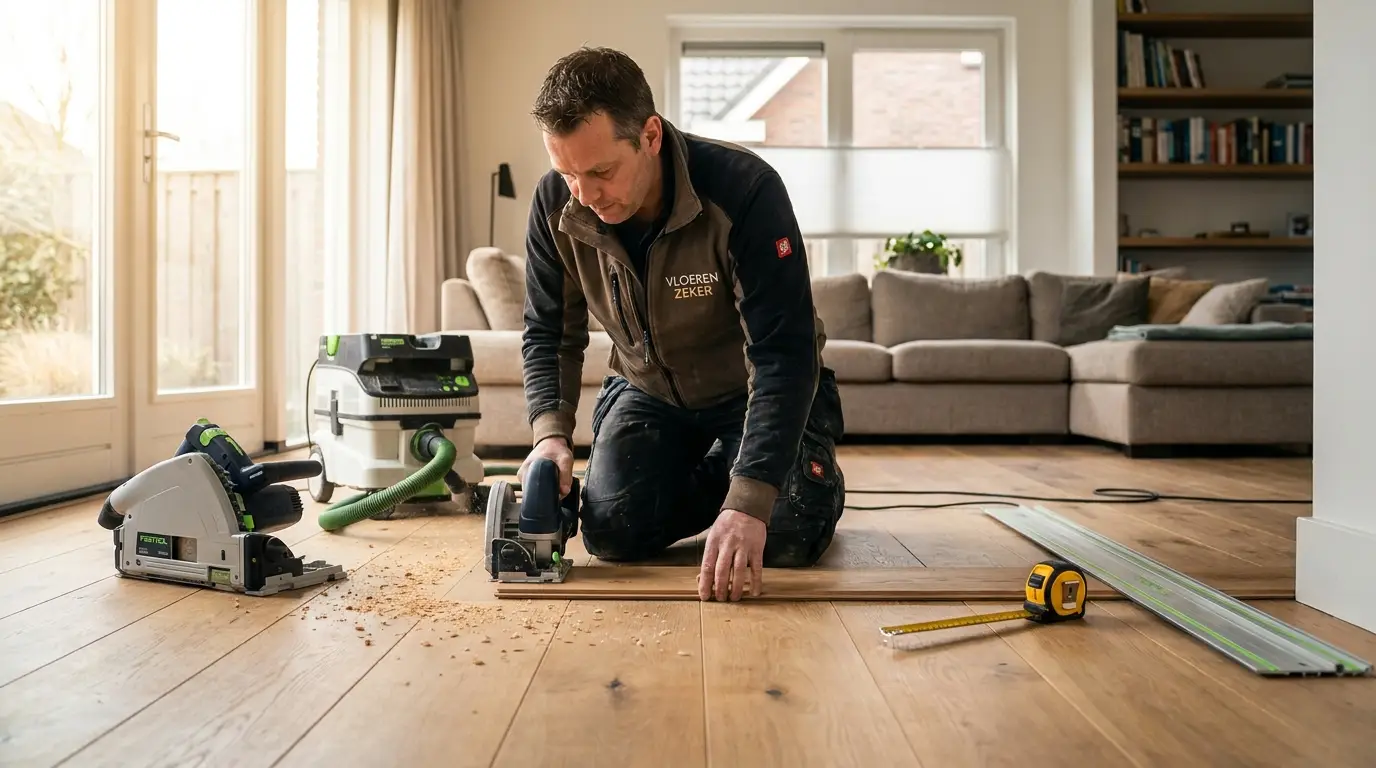
Cost of installing a laminate or hardwood floor: everything you need to know
A new floor instantly gives your home a fresh look. Whether you choose affordable laminate or a durable hardwood parquet floor, the total price depends on the floor area, the type of flooring you choose, and the condition of the subfloor. On average, the all-in cost for a 30 m² living room is between €800 and €4,500.
In this article
- ›What does installing a laminate or hardwood floor cost?
- ›Prices by flooring type
- ›Material and labor costs
- ›Hiring a contractor vs. doing it yourself
- ›How does the installation process work?
- ›Money-saving tips
- ›Frequently asked questions
Need a contractor for this?
Describe your job and get quotes from contractors near you.
average price
€1,800
incl. material, underlayment, and baseboards (30 m²)
average hourly rate
€45
contractor hourly rate (€35–60/hour)
turnaround time
1–3 days
depending on area and flooring type
€ Average price by type
| Flooring type | Range | Average price |
|---|---|---|
| Laminate (entry level)8 mm thick, click-lock system, AC3 wear layer, suitable for living rooms and bedrooms | €600 – €1,100 | €850avg.incl. installation |
| Laminate (mid-range, most popular)10–12 mm, waterproof, AC4 wear layer, including underlayment and baseboards for ~30 m² | €1,000 – €1,800 | €1,400avg.incl. installation |
| Laminate (premium)12 mm extra quiet, wood look with V4 bevel, AC5, ideal for busy rooms | €1,600 – €2,500 | €2,050avg.incl. installation |
| Solid hardwood floorSolid oak or pine parquet, sanded and lacquered, for 30 m² | €2,200 – €4,000 | €3,100avg.incl. installation |
| Engineered hardwood floor (multi-ply)Composite hardwood top layer on HDF/plywood, stable, also works with radiant floor heating | €1,800 – €3,500 | €2,650avg.incl. installation |
Prices are all-in estimates for about 30 m², including material, underlayment, and baseboards; custom work and leveling are charged separately. Based on Google price research.
Material and labor costs
Carpenter/flooring installer hourly rate averages €35–60/hour. Prices per m² vary widely by region; in the Randstad, rates are usually 10–20% higher.
Hiring a contractor vs. doing it yourself
| Job | Do it yourself | Via a contractor | Savings doing it yourself |
|---|---|---|---|
| Installing laminate (click-lock, straight room)Clicking planks together on a flat, dry subfloor without major obstacles | DoableWith a laminate saw, pull bar, and spacers, you can easily do it yourself; instructional videos are enough preparation | €270–€450 | up to €450 |
| Leveling the subfloor with self-leveling compoundSmoothing out unevenness in a concrete or wood subfloor | With experienceSelf-leveling compound sets quickly and is unforgiving; a layer that's too thick or too thin leads to creaking or bumpy planks and loss of the warranty on the floor | €100–€400 | up to €300 |
| Installing and gluing a solid hardwood parquet floorGluing planks to a concrete floor, including acclimation and finishing | Not recommendedIncorrect gluing technique or the wrong acclimation time causes cupping or shrinkage gaps; the damage can hardly be repaired without replacing the entire floor | €750–€1,050 | No recommended savings |
| Sanding and lacquering or oiling a hardwood floorFinishing an existing or newly installed hardwood floor with a floor sander | Not recommendedRental sanders are heavy and unforgiving; sanding too deep permanently damages the top layer; contractors do this in multiple passes with the right grit sizes | €300–€700 | No recommended savings |
| Installing baseboards and cutting cornersCutting baseboards to size and attaching them along the entire edge of the room | DoableWith a miter saw or rented saw, inside and outside corners are easy to make; attaching with adhesive or clips is a beginner job | €80–€150 | up to €120 |
Installing laminate is one of the few flooring jobs where a motivated DIYer can really save on labor costs. The click-lock system needs no glue or special training, but it does require a strictly flat subfloor and correct expansion gaps along all walls. As soon as the room has a bay window, stairwell, or radiator pipe, the difficulty quickly increases. For engineered and especially solid hardwood parquet, a contractor is almost always the better choice. The planks need to acclimate in the room for 24 to 48 hours, the gluing technique has to be matched to each wood species, and a mistake in the installation direction or moisture barrier can hardly be fixed without buying the entire floor again. Always ask the flooring installer to provide a written workmanship warranty.
The full process step by step
Inspection, measuring, and material advice
The flooring installer checks the flatness of the subfloor with a level or straightedge (standard: maximum 3 mm height difference per 2 meters). They measure the room, determine the installation direction, and advise on the right flooring type, the underlayment thickness, and whether leveling is needed. You receive an itemized quote.
30–60 min
Removing the existing floor
Carpet, felt, old laminate, or loose tiles are removed and hauled away. Glued-down material takes more time and tools. The subfloor is then swept thoroughly and checked for loose nails, water damage, or rot.
1–3 hours
Leveling and drying the subfloor
Unevenness is filled with self-leveling compound or leveling mortar. On concrete subfloors, a moisture barrier (PE sheeting or an integrated underlayment) is applied. The flooring installer waits until the compound has had the required drying time before continuing.
2–8 hours (incl. drying time of the compound)
Rolling out the underlayment and installing the planks
The felt underlay or sound-dampening layer is rolled out snugly. The first row of laminate or hardwood planks is laid with an expansion gap of at least 10 mm along the wall. Row by row, the planks are pressed into the click-lock system; with solid parquet, they're glued or nailed to the subfloor.
4–8 hours (30 m²)
Cutting around obstacles and transitions
Cutouts for radiator pipes, door frames, stair treads, and transitions to tile floors or other flooring types are cut precisely to size. Transition strips are attached at doorways. This is the most time-consuming part in rooms with many transitions.
1–3 hours
Installing baseboards and finishing
New baseboards are cut to size with miter cuts at inside and outside corners, glued or clipped in place, hiding the expansion gap. Transitions at doors get a matching T-molding or reducer strip.
1–2 hours
Handover and inspection
The flooring installer walks through the room with you, checking for creaking planks, visible gaps, damaged corners, and correctly attached baseboards. Make sure you're there so any comments are resolved right away and recorded in writing.
15–30 min
6 smart money-saving tips
Frequently asked questions
What does it cost on average to install a laminate or hardwood floor?
On average, you'll pay €1,400 to €1,800 all-in for a 30 m² living room with laminate (mid-range). For a hardwood parquet floor, it can go up to €2,650–€3,100. The range across all types is €600 to €4,000.
How long does it take to install a floor?
An average living room of 20–40 m² is usually done within 1 day. With larger areas, extra leveling work, or solid hardwood floors that need to be sanded and lacquered, it can take 2 to 3 days.
Do I need a permit?
No, you don't need a permit to replace a floor. If you live in an apartment, check the rules of the VvE (the homeowners association of an apartment building): some VvEs require a minimum level of sound insulation (Rc value) to limit noise for the neighbors.
Can I install laminate myself?
Laminate is relatively easy to install yourself thanks to the click-lock system. You save the labor costs (€9–€15 per m²), but a perfect subfloor and straight walls are essential. For hardwood parquet floors, professional installation is almost always recommended because of the precision and finish required.
What does a flooring installer charge per hour?
A professional flooring installer in the Netherlands charges €35 to €60 per hour on average. In the Randstad, rates are often 10–20% higher. Many contractors also work with a price per m²: €9–€15 per m² for laminate and €25–€35 per m² for parquet.
What does leveling the subfloor cost?
If the existing subfloor isn't flat, it has to be leveled first. This costs an extra €10–€15 per m² on average and is necessary for a good end result, especially with thin laminate floors.
Related jobs
Ready to have your floor installed by a skilled contractor?
Describe your job and receive quotes from verified flooring installers near you.
Within 24 hours
response from a contractor
Verified
all contractors checked
Competitive price
compare quotes