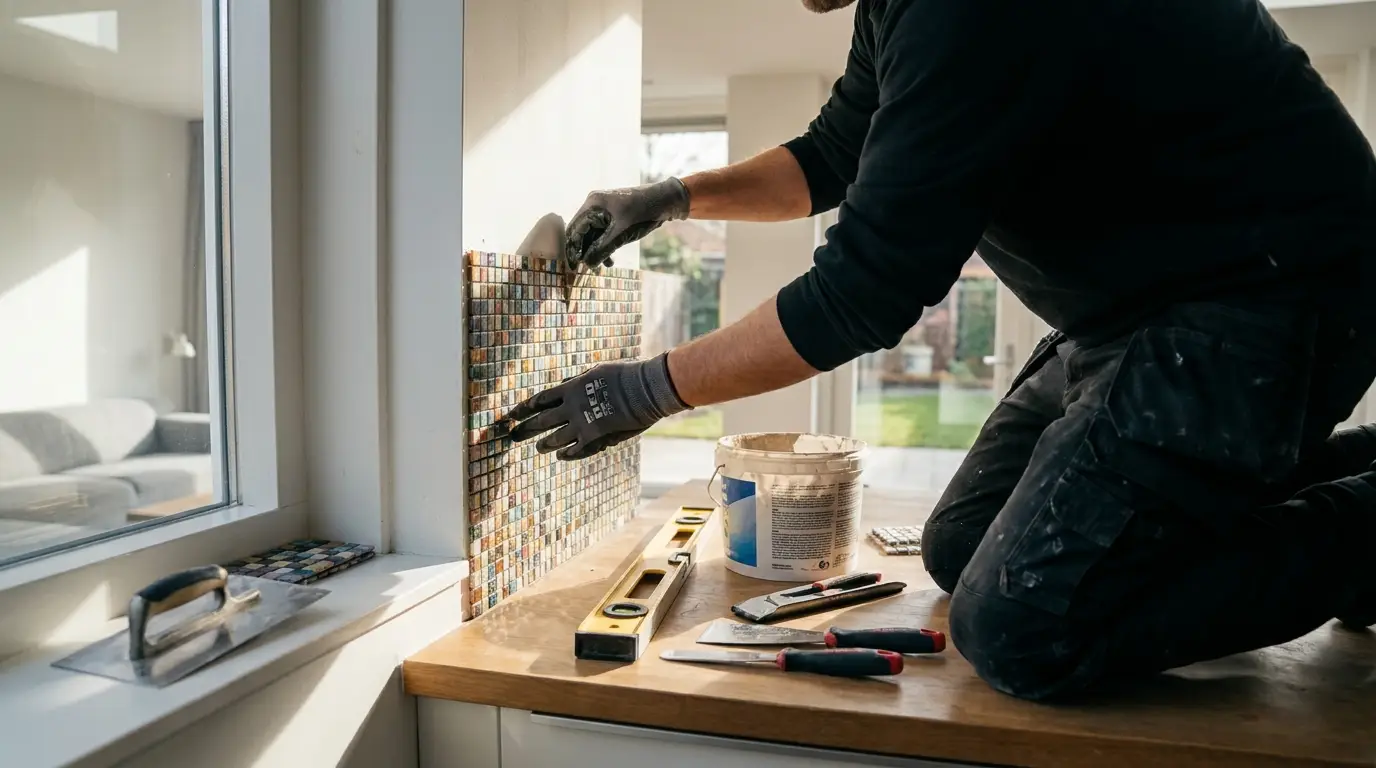
Cost of installing mosaic or decorative tiles: everything you need to know
Mosaic and decorative tiles give a room a unique, luxurious look, but installing them is labor-intensive and takes real skill. The cost depends heavily on the size, the pattern, and the complexity of the work. On this page, you'll find a clear overview of what to expect.
In this article
- ›What does installing mosaic or decorative tiles cost?
- ›Prices by type of application
- ›Material and labor costs
- ›Hire a contractor or do it yourself?
- ›How does the process work?
- ›Money-saving tips
- ›Frequently asked questions
Need a contractor for this?
Describe your job and get quotes from contractors near you.
average price
€1,800
average total price including labor and materials
average hourly rate
€45
contractor hourly rate (€35–55/hour)
turnaround time
1–3 days
depending on area and complexity
€ Average price by type
| Type of mosaic or decorative tile work | Range | Average price |
|---|---|---|
| Small accent wall or nichee.g., shower niche or small kitchen strip up to 3 m² | €400 – €900 | €650avg.incl. installation |
| Mosaic kitchen backsplash (most popular)standard backsplash 5–8 m², simple pattern | €800 – €2,000 | €1,400avg.incl. installation |
| Complete shower areaentire shower surround in mosaic or decorative tile | €1,500 – €3,500 | €2,500avg.incl. installation |
| Floor with decorative patterne.g., herringbone, patchwork, or geometric pattern, per 10 m² | €1,200 – €3,000 | €2,000avg.incl. installation |
| Pool or outdoor mosaicwater-resistant mosaic for outdoors or pool edge | €2,500 – €6,000 | €4,000avg.incl. installation |
Prices include labor and exclude VAT; small-format mosaic (< 5 cm) is on average 20–30% more expensive to install because of the extra work time. Based on Google price research.
Material and labor costs
Tile setter hourly rate averages €35–€55/hour. Because it's more labor-intensive, mosaic work usually takes more hours per m² than standard tile work.
Hiring a contractor vs. doing it yourself
| Job | Do it yourself | Via a contractor | Savings doing it yourself |
|---|---|---|---|
| Small dry accent wall (< 2 m²)e.g., simple mosaic sheet as a decorative kitchen strip or niche on a dry wall | With experienceDoable with patience; grouting small gaps takes precision | €100–€300 | save up to €250 |
| Mosaic kitchen backsplash (5–8 m²)laying sheets straight on a flat, dry substrate | With experienceVisible mistakes in the sheets or grout lines are hard to fix | €350–€700 | save up to €600 |
| Complete shower area in mosaicincluding waterproofing, membrane layer, and moisture-resistant grout | Not recommendedWatertightness requires professional work; leaks behind tiles cause structural damage | €700–€1,400 | risk of leaks outweighs the savings |
| Decorative floor pattern (herringbone, geometric)exact pattern alignment from wall to wall, cutting around obstacles | Not recommendedAlignment errors grow visibly across the entire surface and can't be corrected | €500–€1,100 | repair costs exceed the savings |
| Outdoor mosaic or pool edgefrost-resistant mosaic with outdoor adhesive, special grout, and substrate treatment | Not recommendedThe wrong adhesive or grout leads to frost damage after the very first winter | €1,000–€2,200 | No recommended savings |
Mosaic and decorative tile work in dry rooms with small areas (< 3 m²) is doable for a DIYer who's patient and willing to practice grouting. As soon as wet areas such as showers or bathrooms are involved, a certified tile setter is essential: the waterproofing layer must be applied professionally, and the adhesive and grout must be suitable for constant exposure to moisture. Mistakes here lead to mold and structural damage behind the finish. The same goes for decorative floor patterns: herringbone, geometric patterns, and patchwork layouts require precise alignment that a contractor guarantees with a level and tape measure. For outdoor applications (garden wall, pool edge, patio accent), frost-resistant materials and special outdoor adhesive are also required: knowledge that only an experienced tile setter can reliably apply.
The full process step by step
Assess and prepare the substrate
The tile setter inspects the substrate for flatness, stability, and moisture permeability. Loose plaster is removed, and unevenness greater than 3 mm is leveled with a leveling compound. Without a flat substrate, mosaic sheets can show bumps that ruin the final result.
30–90 min
Apply waterproofing (wet areas)
In showers, bathrooms, and other wet zones, an elastic waterproofing membrane is applied to the wall and floor joints. This membrane dries completely before tiling begins: skipping it is the most common cause of leaks behind mosaic tiles.
1–3 hours (+ 12–24 hours curing)
Lay out the pattern and set the starting point
The contractor determines the visual center of the wall or floor and marks horizontal and vertical guidelines with a level and chalk line. For decorative patterns such as herringbone or geometric tiles, the layout is first dry-fitted to minimize cut pieces at the edges and center the pattern symmetrically.
30–60 min
Apply adhesive and set mosaic sheets
A flexible tile adhesive is spread evenly with a notched trowel. Mosaic sheets are laid section by section, pressed with a flat cork block or sponge, and adjusted right away before the adhesive sets. Around fixtures, outlets, and corners, tiles are cut to size with a tile cutter or angle grinder.
3–14 hours (depending on area and size)
Wait for curing
After installation, the tile setter lets the adhesive cure for at least 24 hours, longer at lower temperatures or with thick adhesive layers. There's no cutting corners here: grouting too early causes movement in the sheet and crumbling grout.
24 hours waiting time
Grouting
The small gaps in the mosaic are filled with a fine grout, matched to the desired color and joint width (often 1–2 mm). The grout is worked in diagonally with a grout float, and excess is wiped off immediately with a damp sponge. In wet areas, an epoxy or flexible grout is used.
2–5 hours
Finishing, caulk, and final inspection
Once fully dry, grout residue is removed with a floor pad, and adjoining surfaces (for example, where tile meets a frame or tub) are sealed with silicone caulk. The tile setter checks for hollow tiles by tapping, loose corners, and uneven grout surfaces: only then is the work handed over.
1–2 hours
6 smart money-saving tips
Frequently asked questions
What does installing mosaic or decorative tiles cost on average?
On average €1,800 for a standard job such as a kitchen backsplash or shower niche. The range runs from €400 for a small accent wall to more than €6,000 for a large outdoor application or pool.
How long does installing mosaic tiles take?
An average job of 5–10 m² takes 1 to 3 days. Larger areas, complex patterns, or extra prep work (leveling, waterproofing) take more time.
What determines the price of mosaic work?
The main factors are the area, the complexity of the pattern, the quality of the tiles, and whether the substrate needs to be prepped. Finer mosaics (smaller sizes) take more work and are therefore more expensive to install.
Do I need a permit?
No, you don't need a permit to install mosaic or decorative tiles. It's an interior job that doesn't affect the load-bearing structure of the home.
Can I install mosaic tiles myself?
You can, but mosaic work takes patience and precision, especially with sheets that need to be laid straight and grouting in small gaps. A professional tile setter delivers a neater and more durable result.
What's the price difference between indoor and outdoor mosaic?
Outdoor mosaic is considerably more expensive: the tiles must be frost-resistant, the adhesive and grout must be suitable for outdoor use, and the substrate needs more preparation. Expect €60–€120 per m² extra compared to indoor mosaic.
Related jobs
Ready to have your mosaic or decorative tiles installed?
Describe your job and get quotes from verified tile setters near you.
Within 24 hours
response from a contractor
Verified
all contractors checked
Competitive price
compare quotes