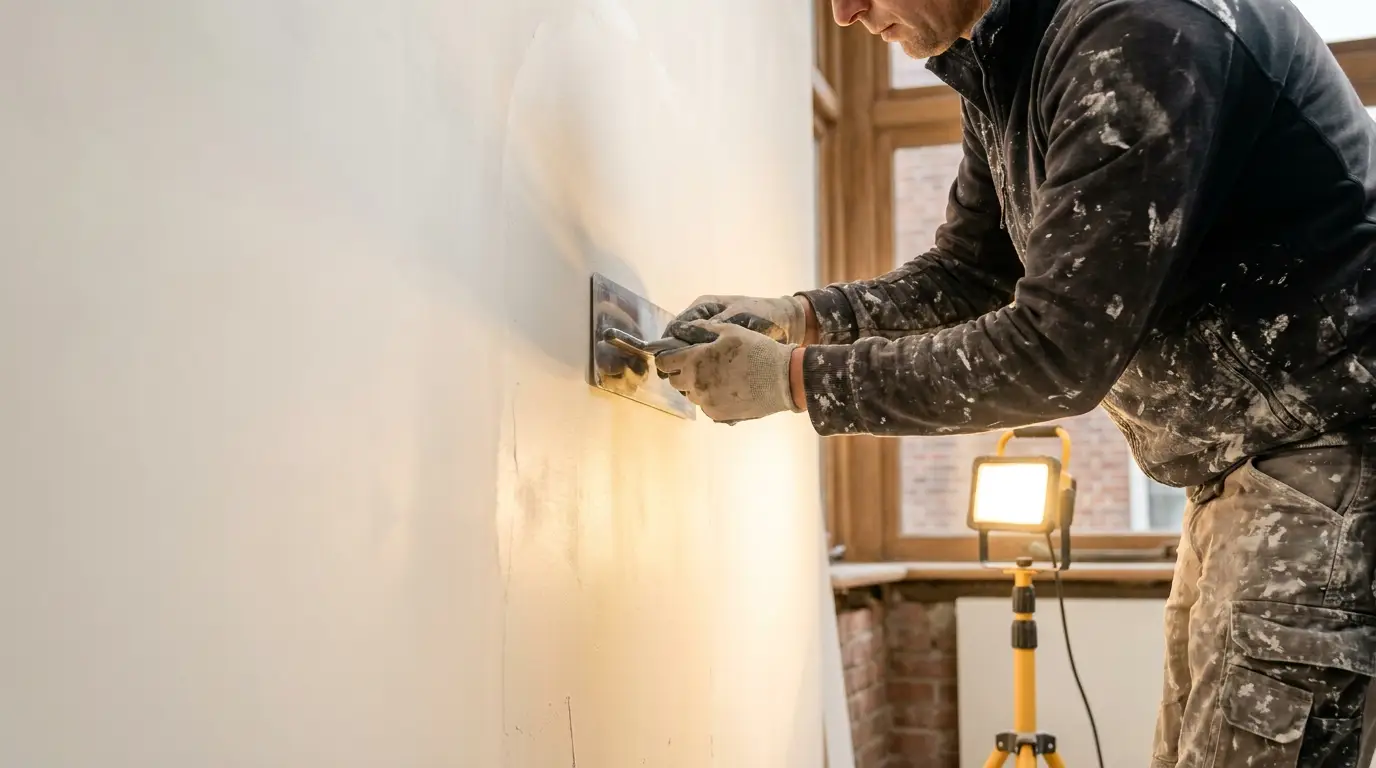
Cost of skim coating a wall for wallpaper or paint: everything you need to know
Skim coating a wall gives you a smooth, even surface that's ready for wallpaper or paint. The total cost depends on the size of the job, the condition of the existing surface, and the level of finish you want. In this overview, you'll find current prices per m², per room, and per situation, based on Google price research.
In this article
- ›How much does skim coating a wall cost?
- ›Prices by room type
- ›Material and labor costs
- ›Hire a contractor or do it yourself?
- ›How does the plastering process work?
- ›Money-saving tips for skim coating
- ›Frequently asked questions
Need a contractor for this?
Describe your job and get quotes from contractors near you.
average price
€900
average room incl. labor & materials
average hourly rate
€42
contractor hourly rate (€30–55/hour)
turnaround time
1–3 days
depending on scope and drying time
€ Average price by type
| Plastering job type | Range | Average price |
|---|---|---|
| Skim coating an accent wallone wall approx. 10–15 m², wallpaper-ready finish | €150 – €375 | €250avg.incl. labor |
| Skim coating a bedroomapprox. 35–45 m² of wall surface, wallpaper-ready | €525 – €1,125 | €750avg.incl. labor |
| Skim coating a living room (most popular)approx. 50–70 m² of wall surface, paint-ready or wallpaper-ready | €750 – €1,750 | €1,100avg.incl. labor |
| Living room with a damaged or rough surfaceextra prep work needed, fully paint-ready | €1,000 – €2,500 | €1,600avg.incl. labor |
| Skim coating a whole house (4–6 rooms)complete package including prep and finishing, all walls | €2,500 – €6,500 | €4,200avg.incl. labor |
Prices are estimates for a wallpaper-ready or paint-ready finish including materials and labor; rough or damaged surfaces increase the cost. Based on Google price research.
Material and labor costs
Plasterer hourly rate averages €30–55/hour excl. VAT. Many plasterers use a price per m² in addition to an hourly rate.
Hiring a contractor vs. doing it yourself
| Job | Do it yourself | Via a contractor | Savings doing it yourself |
|---|---|---|---|
| Filling and smoothing a small crack or damagespot repair on an existing wall, area smaller than 0.5 m² | DoableManageable with ready-mixed repair filler and some patience; respecting the drying time is the key thing | €10–30 | up to €80 |
| Plastering an accent wall wallpaper-readyone wall approx. 10–15 m², surface in reasonable condition | With experienceGypsum plaster dries quickly and needs a steady hand; practice on a wall that's out of sight before you start on the living room | €50–120 | up to €250 |
| Plastering a whole room paint-readyultra-smooth finish for painting, no visible seams or uneven areas allowed | Not recommendedPaint-ready requires professional troweling technique; even small ridges or uneven spots show up right after painting and are then costly to fix | €150–350 | No recommended savings |
| Leveling walls with old wallpaper or limewash before plasteringthorough prep: removing, bonding, leveling | Not recommendedNot fully removing old layers or using the wrong primer causes the new plaster to come loose: often only visible weeks after it's applied | €80–200 | No recommended savings |
| Skim coating a whole house (multiple rooms)complete package, including prep and finishing on all wall surfaces | Not recommendedThe combination of scope, time pressure, and the uniformity you want puts this out of reach for most DIYers; a plasterer works as part of a crew and covers more meters in one day than an amateur does in a week | €500–1,200 | No recommended savings |
Small spot repairs (sealing a crack, filling a nail hole) are easy for most DIYers to do themselves with ready-mixed repair filler. Once it comes to fully leveling a wall for wallpaper or paint, it gets harder: gypsum plaster has an open time of just 20–30 minutes and requires a fast, fluid technique to avoid uneven spots and ridges. For a wallpaper-ready finish, plastering yourself is doable with some practice; for a paint-ready finish, where paint magnifies every imperfection, a professional plasterer is practically essential. There are no legal requirements or mandatory certifications for plastering interior walls, but a recognized plasterer has a sharp steel trowel, a stainless steel trowel set, and the right primer for every surface, which makes the difference between a result that lasts ten years and plasterwork that starts cracking after a year.
The full process step by step
Inspection and surface prep
The plasterer checks the wall for loose or hollow plaster, cracks, lime residue, and old wallpaper. Anything loose is chipped away, cracks are opened with a V-cut and filled, and the surface is primed or pre-wetted, depending on its porosity, so the new plaster bonds and doesn't dry too fast.
1–3 hours
Applying the plaster coat
Using a stainless steel trowel, finishing plaster (gypsum) is applied in an even 2–4 mm coat. The contractor works from top to bottom and from corner to corner to get a continuous surface without a visible lap line.
2–6 hours per room
Smoothing and finishing
As soon as the plaster starts to set, but before it's fully dry, it's troweled smooth with a clean stainless steel trowel. For a wallpaper-ready finish, one smoothing pass is enough; for a paint-ready finish, the plasterer makes several passes with increasing pressure until the surface is glass-smooth.
1–3 hours
Checking for flatness
After the last smoothing pass, the plasterer holds a long straightedge (1.5–2 m) diagonally against the wall to find high and low spots. Small deviations are touched up right away while the plaster is still workable.
15–30 min
Monitoring drying time
Gypsum plaster needs at least 24–72 hours to dry completely, depending on coat thickness, temperature, and ventilation. Freshly plastered walls are light gray; fully dry plaster is an even white. Heating can speed up drying, but avoiding drafts prevents small cracks from uneven drying.
1–3 days
Handover and final check
After drying, the plasterer inspects the wall again with a straightedge and raking light. Small imperfections are fixed with fine filler or an extra pass of the trowel. The protective plastic and drop cloths are removed from the work area and the room is handed over broom-clean.
30–60 min
6 smart money-saving tips
Frequently asked questions
How much does skim coating a wall cost on average?
On average, you'll pay €15 to €25 per m² for skim coating, including labor and materials. For a typical living room with approx. 60 m² of wall surface, that comes to €900 to €1,500. A full accent wall starts at €150.
How long does it take to skim coat a room?
The plastering itself takes 1 to 2 workdays. After that, you need at least 1 to 3 days of drying time before you can paint or hang wallpaper. So the total turnaround time is 2 to 5 days.
What's a plasterer's hourly rate?
A professional plasterer charges an average of €30 to €55 per hour excluding VAT. Many plasterers also use a price per m² of €10 to €25 per m², depending on the level of finish and the condition of the surface.
Do I need a permit for skim coating?
No, you don't need a permit to skim coat interior walls. It's purely interior work with no structural impact on the home.
Can I skim coat a wall myself?
Plastering yourself is technically possible, but it takes practice. Gypsum plaster dries quickly and has to be applied quickly and evenly for a smooth result. For a paint-ready finish, where the surface has to be perfectly flat for paint, having a professional do the work is strongly recommended.
What's the cost difference between wallpaper-ready and paint-ready?
Paint-ready plastering costs approx. €5 to €8 per m² more than wallpaper-ready, because it requires an extra, finer finishing coat. For a 60 m² room, that quickly adds up to €300 to €480.
Related jobs
Ready to have your walls skim coated?
Describe your job and get quotes from verified plasterers near you.
Within 24 hours
response from a contractor
Verified
all contractors checked
Competitive price
compare quotes