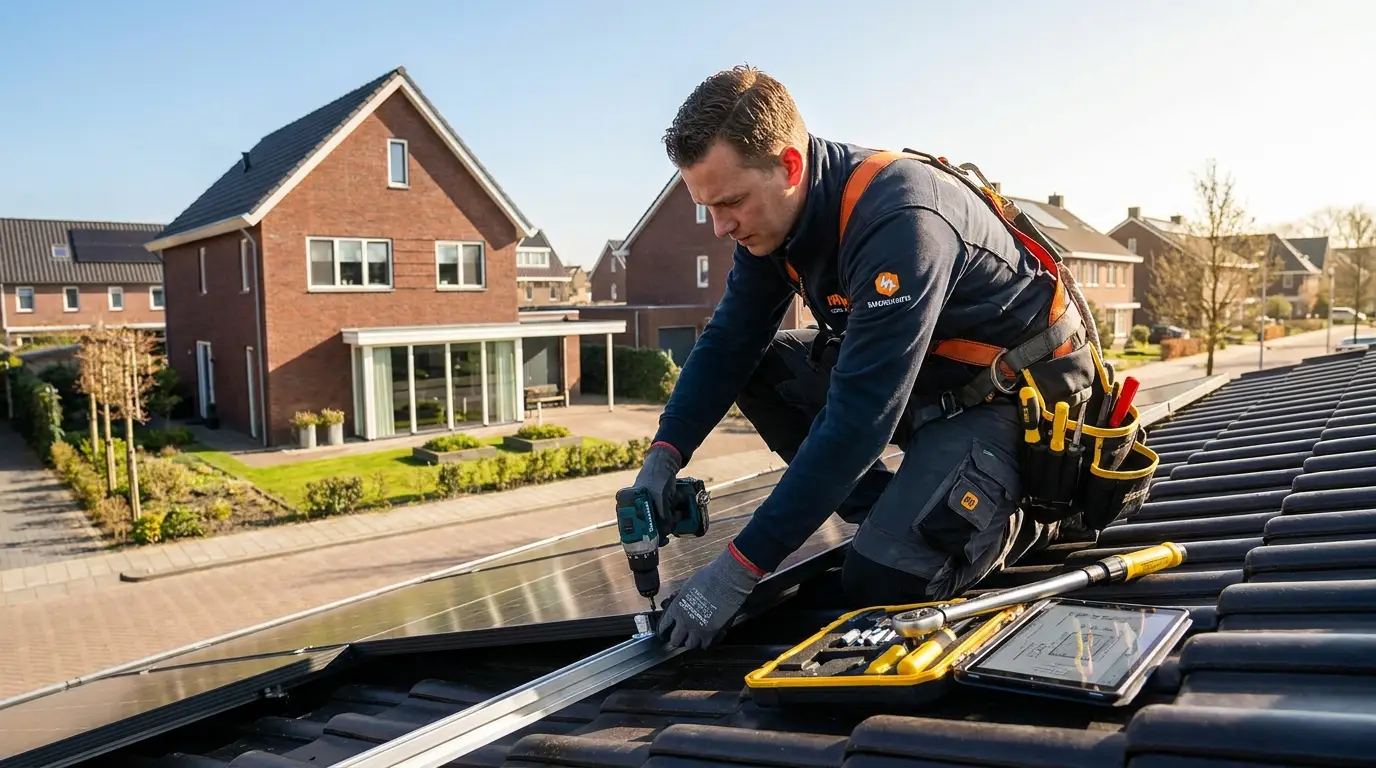
Cost of solar panel maintenance and repair: everything you need to know
Solar panels need little maintenance, but periodic cleaning, inverter checks, and occasional repairs are necessary for optimal output. Costs depend heavily on the type of maintenance: from a simple cleaning for €100–€150 to a full inverter replacement for €800–€2,000. With timely maintenance, you get the most out of your investment and prevent costly malfunctions.
In this article
- ›What does solar panel maintenance and repair cost?
- ›Price overview by type of maintenance or repair
- ›What determines the price?
- ›Hire a contractor or do it yourself?
- ›How does a maintenance or repair visit work?
- ›Money-saving tips for solar panel maintenance and repair
- ›Frequently asked questions
Need a contractor for this?
Describe your job and get quotes from contractors near you.
average price
€550
cleaning + inspection included
average hourly rate
€55
contractor hourly rate (€45–70/hour)
turnaround time
1–2 days
depending on scope
€ Average price by type
| Type of maintenance or repair | Range | Average price |
|---|---|---|
| Solar panel cleaningprofessional cleaning of 10–15 panels, including inspection | €100 – €200 | €140avg.incl. labor |
| Inspection and troubleshooting (most popular)inverter or wiring diagnosis, small repair included | €200 – €700 | €400avg.incl. labor |
| Inverter repairreplacing parts of the existing inverter, labor included | €300 – €700 | €500avg.incl. labor |
| String inverter replacementnew inverter including mounting and connection | €800 – €2,000 | €1,300avg.incl. installation |
| Microinverter replacement (per panel)microinverter replacement including labor | €150 – €450 | €280avg.incl. installation |
| Full maintenance packagecleaning, inspection, inverter check, and small repairs | €250 – €500 | €350avg.incl. labor |
Prices include VAT and are based on an average installation of 10–15 panels in the Netherlands; larger installations or hard-to-reach roofs can increase costs. Based on Google price research.
Material and labor costs
Solar installer hourly rate averages €55–€75/hour. A trip charge is often billed separately (€25–€75); always ask about it when requesting a quote.
Hiring a contractor vs. doing it yourself
| Job | Do it yourself | Via a contractor | Savings doing it yourself |
|---|---|---|---|
| Cleaning solar panelscleaning with demineralized water and a soft brush on an accessible pitched roof | With experienceonly safe if the roof is reachable without scaffolding; fall protection required | €100–€200 | up to €150 |
| Reading the inverter and diagnosing error codeslooking up the error code via the display or monitoring app and determining its meaning | Doablemanufacturer app or manual is enough; no tools needed | €0 | up to €100 |
| Resetting the invertertemporarily restarting the system via the on/off button or app after a power outage | Doablestandard procedure described by the manufacturer; fixes many temporary malfunctions | €0 | up to €250 |
| Checking or repairing DC wiringinspecting or reconnecting cables between solar panels and inverter | Not recommendedDC cables stay live during the day even with the inverter off: serious fire risk | €200–€600 | No recommended savings |
| Replacing or repairing the inverterconnecting a new string inverter or microinverter to the breaker panel | Not recommendedlegally reserved for an NL-TSI certified solar installer; warranty is void if you install it yourself | €300–€2,000 | No legal savings possible |
A certified solar installer is essential as soon as electrical work is involved. DC cables between solar panels and the inverter carry high direct voltage even when the inverter is switched off: touching them is life-threatening. Replacing or repairing the inverter, modifying the wiring, and connecting to the breaker panel are legally reserved for an NL-TSI certified company. If you do it yourself anyway, the manufacturer's warranty on the inverter is void and your homeowners insurance may deny a fire claim. What customers can safely do themselves: keep an eye on the monitoring app, look up error codes in the manual, reset the inverter after a brief power outage, and, provided the roof is safely reachable without scaffolding, clean the panels with demineralized water and a soft brush. Always use proper fall protection when cleaning (safety harness, roof hook) and never work alone.
The full process step by step
Fault inventory and initial remote diagnosis
The solar installer asks you to share the inverter's current error code and the output overview from the monitoring app. Based on this, they assess whether it's a software issue, a defective part, or a panel problem, and which parts they may need to bring.
15–30 min
Quote and scheduling the appointment
You receive an itemized quote that separates labor costs, material costs, and the trip charge. Always ask whether VAT is included and whether the trip charge is waived if several jobs are combined in one visit.
1–3 days
Visual inspection and on-site measurement
The solar installer checks the panels for visible damage, hotspots, and dirt. With a multimeter or thermal imaging camera, they measure the output per string and track down loose MC4 connectors or damaged insulation. The inverter's historical error logs are read out.
30–60 min
Cleaning the panels
Dirty panels are cleaned with demineralized water and a soft roof brush: tap water leaves limescale marks. For heavy soiling from birds or moss, a special cleaning product is used that doesn't harm the panels' coating.
30–90 min
Repair or replacement of defective components
Defective MC4 connectors are replaced, and loose cables are refastened or taped with UV-resistant tape. If the inverter is defective, the solar installer disconnects the existing unit, mounts the new inverter, and connects it to the breaker panel in accordance with NEN 1010 (the Dutch standard for electrical installations). After mounting, they test whether all strings are recognized correctly.
1–4 hours
Verification and monitoring setup
The solar installer checks in the monitoring app whether the output of all strings has returned to the expected level. They reconnect the inverter to your home network and set notification thresholds so you automatically get a notification if output drops in the future.
15–30 min
Service report and warranty information
You receive a written service report listing the work done, parts replaced, and warranty periods. With an inverter replacement, you receive the registration confirmation of the manufacturer's warranty (usually 5–12 years) and, if applicable, an inspection certificate.
15–30 min
6 smart money-saving tips
Frequently asked questions
What does solar panel maintenance cost on average?
On average, you pay €150–€350 per year for regular maintenance including cleaning and inspection. Range: €100 for cleaning only up to €2,000 if the inverter needs replacing.
How long does a maintenance or repair visit take?
Cleaning and inspection usually take 1–3 hours. An inverter replacement or larger repair can take half a day to a full day, depending on the installation.
Do I need a permit for repair or replacement?
No permit is needed for regular maintenance and repair. Replacing the inverter or modifying the wiring requires a certified solar installer (NL-TSI, a Dutch certification for solar installations, or comparable). In most cases, a permit isn't needed.
Can I clean or repair solar panels myself?
You can clean them yourself with water and a soft brush, but working at height is dangerous without proper safety equipment. By law, repairs to inverters and wiring may only be carried out by a certified electrician.
When does the inverter need to be replaced?
A standard string inverter lasts 10–15 years on average. Microinverters last 15–25 years. Signs that replacement is needed: the inverter shows error messages, output drops significantly, or the device no longer turns on.
What are common solar panel malfunctions?
The most common problems are: an inverter that fails or shows error codes, loose or damaged cables, dirty panels that generate less, and hotspots caused by damaged cells. Spotting issues early via the monitoring app saves on repair costs.
Related jobs
Ready to have your solar panels maintained or repaired?
Describe your job and receive quotes from verified solar installers near you.
Within 24 hours
response from a contractor
Verified
all contractors checked
Competitive price
compare quotes