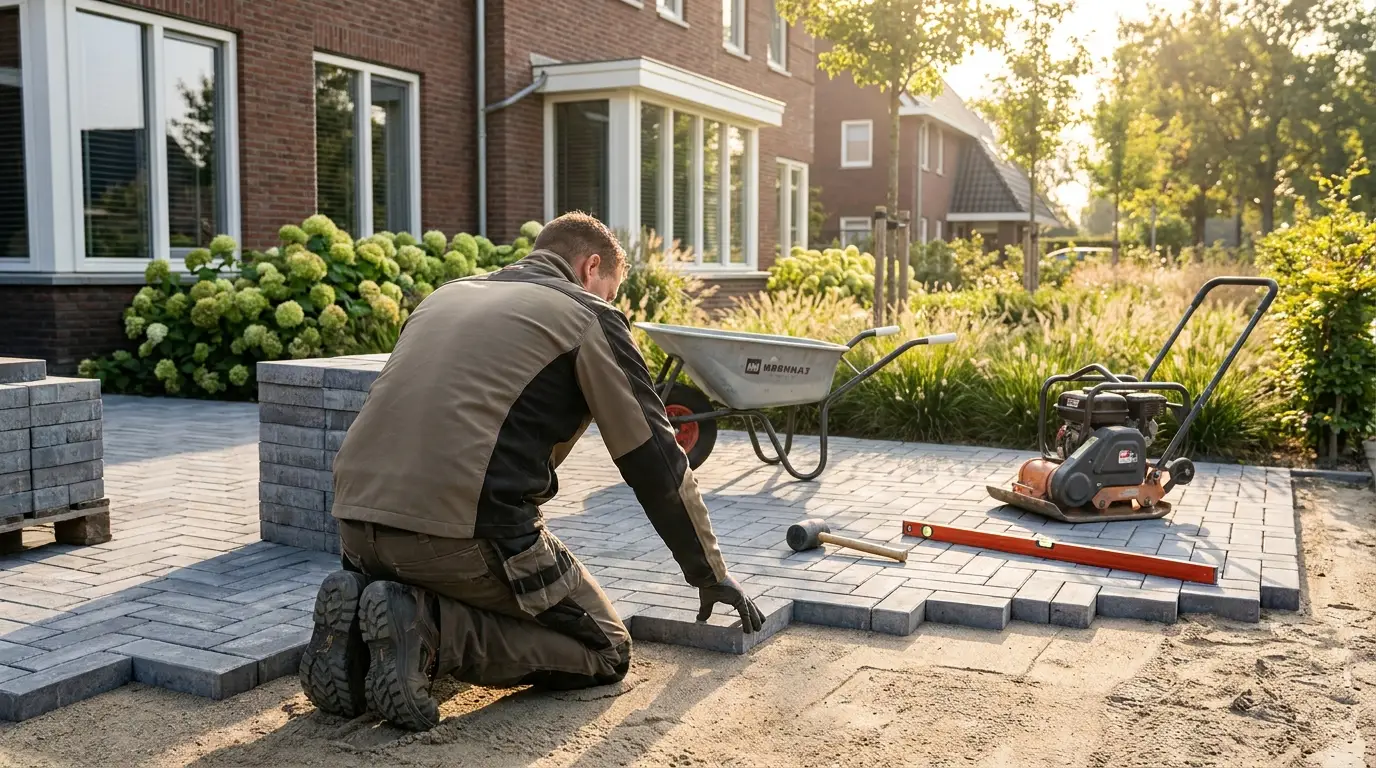
Cost of installing or renovating a driveway: everything you need to know
Installing or renovating a driveway is a sizable investment that instantly improves the look of your home. The cost depends heavily on the material you choose, the surface area, and the condition of the subgrade. On average, you'll pay around €1,000 to €2,500 for a standard 20 m² driveway, including materials and labor.
In this article
- ›What does it cost to install or renovate a driveway?
- ›Prices by material type
- ›Material and labor cost breakdown
- ›Hiring a contractor vs. doing it yourself
- ›How does the process work?
- ›Money-saving tips for your driveway
- ›Frequently asked questions
Need a contractor for this?
Describe your job and get quotes from contractors near you.
average price
€1,750
20 m² driveway, including base and materials
average hourly rate
€48
paver hourly rate (€35–60/hour)
turnaround time
1–3 days
depending on scope and material
€ Average price by type
| Driveway type / material | Range | Average price |
|---|---|---|
| Gravel drivewayloose gravel or gravel grids, quick to install | €300 – €900 | €600avg.incl. installation |
| Concrete pavers (most popular)durable, affordable, many color options | €800 – €1,800 | €1,300avg.incl. installation |
| Clay pavers / waaltjesclassic look, very durable | €1,200 – €2,800 | €2,000avg.incl. installation |
| Concrete tiles or slabsclean and modern, quick to lay | €700 – €1,600 | €1,150avg.incl. installation |
| Asphalt drivewaysmooth finish, suitable for large areas | €1,000 – €2,200 | €1,600avg.incl. installation |
| Natural stone tilesupscale look, higher price per m² | €2,000 – €5,000 | €3,500avg.incl. installation |
Prices are estimates for a driveway of about 20 m², including base and removal of the old paving. Based on Google price research.
Material and labor costs
Paver hourly rate averages €35–60/hour. Machines (excavator, plate compactor) are usually included in the total price or charged separately per half day.
Hiring a contractor vs. doing it yourself
| Job | Do it yourself | Via a contractor | Savings doing it yourself |
|---|---|---|---|
| Installing a gravel drivewayLeveling the subgrade, placing gravel grids or edging, dumping and leveling gravel | DoableVery doable with a rake, shovel, and level; make sure there's enough slope toward the street | €150–€450 | up to €400 |
| Laying concrete paversLeveling a sand bed on a crushed stone base, laying pavers in the desired pattern, tamping, and filling joints with sand | With experienceAn uneven sand bed or too thin a base leads to potholes and shifted pavers within a year | €400–€900 | up to €800 |
| Demolishing and hauling away old pavingBreaking up existing pavers, tiles, or asphalt, loading into a dumpster or trailer, hauling to a recycling center | With experiencePhysically demanding work; rent a mini dumpster or crowbar. Asphalt requires special waste processing | €75–€300 | up to €250 |
| Installing or resurfacing an asphalt drivewayMachine excavation, applying asphalt mix, and rolling with a paving machine | Not recommendedRequires specialized machines and knowledge of mix ratios; doing it yourself is practically impossible | €1,000–€2,200 | No recommended savings |
| Installing edging and drainage ditchesSetting concrete or stone edging on a cement bed, ensuring drainage toward a ditch or storm drain | With experiencePoorly set edging causes sand to wash out and pavers along the edge to shift | €100–€350 | up to €200 |
The base is the foundation of a durable driveway. A base layer of sand and crushed stone that's too thin or poorly compacted is the most common cause of settling, potholes, and water problems: issues that usually only show up after the first winter and are then expensive to fix. For a gravel driveway or simply topping up existing gravel, doing it yourself is fine. Want pavers, clay waaltjes, or asphalt? Then a skilled paver is strongly recommended: they have a plate compactor, level working methods, and years of experience with soil types in your region. Legal obligations also play a role: if you modify the entrance onto the public road without an uitwegvergunning from the municipality, you risk a penalty payment and mandatory restoration.
The full process step by step
Measuring, choosing material, and requesting quotes
Measure the exact area (length × width) and decide which material you want: gravel, concrete pavers, clay waaltjes, concrete tiles, or asphalt. Send at least three pavers a request with the area, the desired material, and whether the old paving needs to be removed. Also mention whether a new entrance onto the public road is included.
1–3 days
Applying for an uitwegvergunning (if applicable)
Is the entrance onto the public road being newly built or modified? Then submit an uitwegvergunning application to your municipality before work begins. This usually costs €50–€200 and takes 2–4 weeks to process. Without a permit, the municipality can reverse the modification.
2–4 weeks (if applicable)
Excavating and installing the base
The paver excavates the existing paving and topsoil to a depth of 20–30 cm. Then a layer of crushed stone or recycled aggregate is applied and compacted with a plate compactor. On top comes an even 3–5 cm sand bed as the direct base layer for the paving.
Half to 1 workday
Setting the edging
Concrete or stone edging is set on a cement bed along the edges of the driveway. It keeps the sand bed and pavers in place and prevents the paving from sinking at the sides. The height is matched to the desired drainage.
1–3 hours
Laying and tamping the paving
Pavers, tiles, or gravel grids are laid in the desired pattern and set level. After laying, pavers and concrete blocks are compacted with a plate compactor (fitted with a rubber mat to prevent damage) and filled with sand or chippings.
1–2 workdays
Final handover and drainage check
The paver checks the driveway for unevenness, checks the slope toward the street or ditch, and clears away excess material. Debris and packaging are hauled away. You walk through the driveway together and sign off on the handover if you're satisfied.
30–60 min
6 smart money-saving tips
Frequently asked questions
What does it cost on average to install a driveway?
On average €1,750 for a 20 m² driveway. The range is €300 (gravel, doing it yourself) to €5,000+ (natural stone, fully done by a contractor). Per m², you'll pay €50 to €125 including labor and base.
How long does it take to install a driveway?
A paver installs a standard 20 m² driveway in 1 to 2 days. For larger jobs, complex patterns, or wet weather, it takes 2 to 3 workdays.
Do I need a permit for a driveway?
On your own property, you usually don't need a permit. If you want to build or modify a new entrance onto the public road, you need permission from the municipality (uitwegvergunning, a Dutch municipal driveway access permit). This usually costs €50 to €200.
Can I install a driveway myself?
Gravel and simple tiles are doable yourself and save a lot on labor costs. For pavers and concrete paving, a good base is crucial. Mistakes in the base lead to settling; a professional paver guarantees a durable result.
What's the best paving for a driveway?
Concrete pavers are the most popular: affordable, durable, and easy to replace if damaged. Clay pavers look better but cost more. For a modern look, large concrete tiles or asphalt are a good alternative.
What does renovating a driveway cost compared to installing a new one?
Renovating is cheaper if the base is still in good condition. You save €100–€400 on excavation and base. Just replacing the top layer costs €25–€60 per m² for pavers, including labor.
Related jobs
Ready to have your driveway installed or renovated?
Describe your job and receive quotes from verified pavers near you.
Within 24 hours
response from a contractor
Verified
all contractors checked
Competitive price
compare quotes