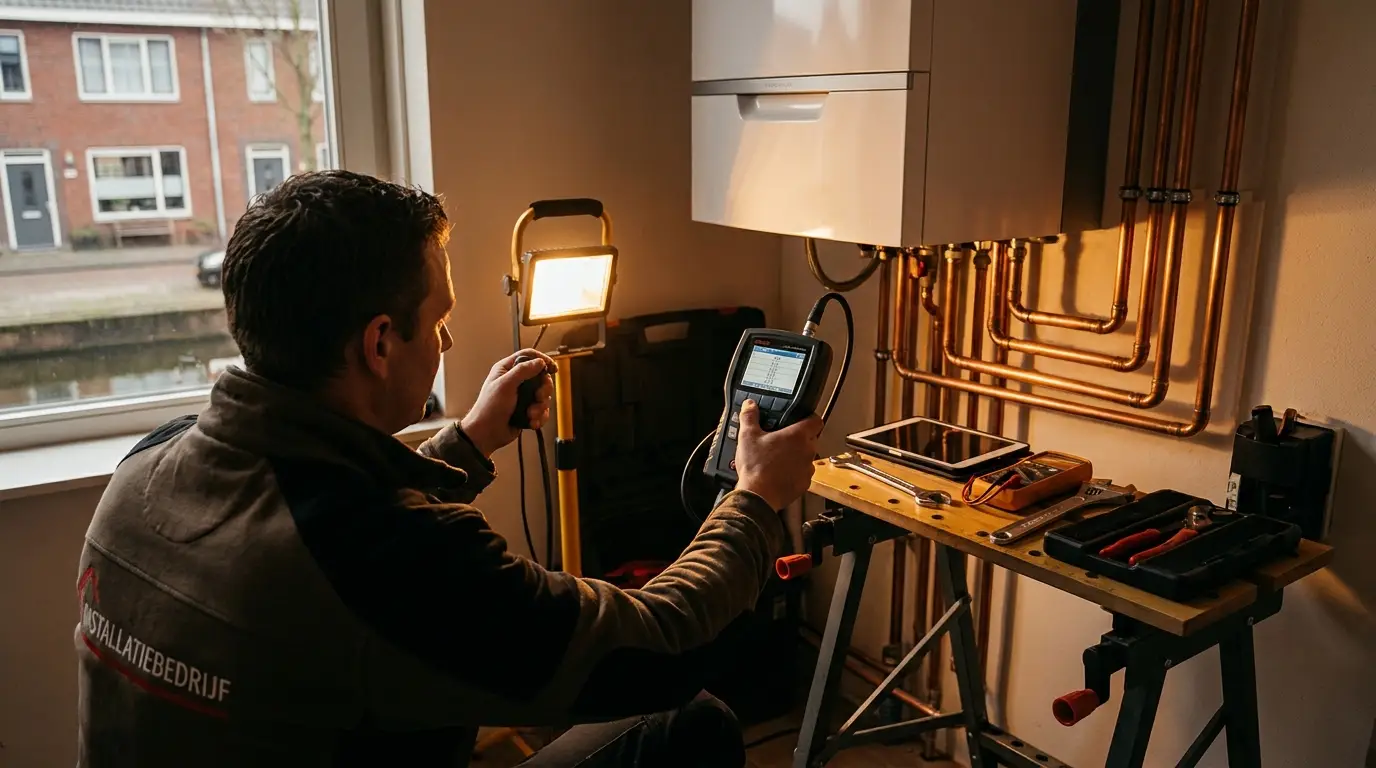
Cost of a flue gas analysis and boiler inspection: everything you need to know
A flue gas analysis and boiler inspection keeps your central heating boiler safe and efficient. The technician measures the combustion gases, checks gas tightness, and tunes the boiler for optimal performance. The cost depends on the type of maintenance, the age of the boiler, and whether any parts need to be replaced.
In this article
- ›What does a flue gas analysis and boiler inspection cost?
- ›Cost by type of maintenance
- ›Material and labor costs
- ›Hiring a contractor vs. doing it yourself
- ›Step-by-step plan: how does it work?
- ›Money-saving tips
- ›Frequently asked questions
Need a contractor for this?
Describe your job and get quotes from contractors near you.
average price
€130
boiler inspection including flue gas analysis
average hourly rate
€65
contractor hourly rate (€55–80/hour)
turnaround time
1–2 hours
depending on the boiler's condition
€ Average price by type
| Type of maintenance | Range | Average price |
|---|---|---|
| Flue gas analysis onlycombustion gas measurement only, no full maintenance | €60 – €120 | €90avg.incl. labor |
| Boiler inspection including flue gas analysis (most popular)full inspection, gas tightness test, water pressure top-off, and report | €95 – €175 | €130avg.incl. labor |
| Annual maintenance contractsubscription including annual boiler inspection and flue gas analysis | €80 – €175 | €120avg.incl. labor |
| Major service with overhaulextensive inspection including cleaning of burner, filters, and heat exchanger | €175 – €320 | €240avg.incl. labor |
| Boiler inspection with minor repairmaintenance plus replacement of a small part such as a sealing ring or filter | €150 – €350 | €230avg.incl. labor |
Prices include VAT and are based on a standard HR boiler; costs may be higher for HR+ or combi boilers. Based on Google price research.
Material and labor costs
HVAC technician hourly rate averages €55–€80/hour. Trip charges are often billed separately and vary by company.
Hiring a contractor vs. doing it yourself
| Job | Do it yourself | Via a contractor | Savings doing it yourself |
|---|---|---|---|
| Performing a flue gas analysisMeasuring CO2, O2, CO, and flue gas temperature with certified equipment | Not recommendedLegally reserved for a licensed gas HVAC technician; consumer equipment isn't calibrated and gives unreliable readings | €60–€120 | No legal savings possible |
| Adjusting the burner to combustion valuesOptimizing the air-gas ratio based on measurement results | Not recommendedIncorrect adjustment leads to incomplete combustion, higher CO emissions, and danger; requires NEN 8025 certification | Part of boiler inspection | No legal savings possible |
| Performing a gas tightness testPressure test for leaks in the gas line and connections | Not recommendedGas leaks are life-threatening; testing and repairing leaks is legally reserved for a licensed HVAC technician | Part of boiler inspection | No legal savings possible |
| Topping off water pressureBringing system pressure to the correct level (usually 1.5 bar) | DoableVia the fill valve at the bottom of the boiler; consult the manual and close it again afterward: safe without tools or certification | €0 yourself / €15–€30 contractor | up to €30 |
| Bleeding radiatorsRemoving air bubbles from the heating circuit so radiators heat evenly | DoableWith a bleed key and a small bucket; takes just a few minutes per radiator and requires no technical knowledge | €0 yourself / €20–€40 contractor | up to €40 |
A flue gas analysis and boiler inspection legally requires a licensed gas HVAC technician with valid NEN 8025 certification. The measuring equipment, a calibrated combustion analyzer, must be calibrated periodically and isn't available as a consumer product. If you tamper with the burner or gas connection yourself, you risk a dangerously high carbon monoxide concentration in your home, loss of the manufacturer's warranty, and your homeowners insurance becoming void in case of damage. What you can do yourself as a resident: top off the system pressure via the fill valve (following the boiler manual) and bleed the radiators with a simple bleed key. These tasks are safe, require no certification, and can save €20–€70 on the total bill. After that, still hire a licensed HVAC technician for the actual flue gas analysis and gas tightness test.
The full process step by step
Book an appointment and make the boiler accessible
Book a licensed gas HVAC technician and make sure the central heating boiler is easy to reach. Remove anything in front of or under it. Don't turn the heating off completely the night before the appointment: the technician prefers to start from operating temperature.
10–15 min preparation
Visual inspection of boiler and flue
The technician inspects the outside of the boiler: the casing, connections, condensate drain, and flue pipe. Visible rust, a sagging flue duct, or a discolored flame are immediate warning signs that they note for further analysis.
10–15 min
Performing the flue gas analysis
The technician inserts the probe of the calibrated combustion analyzer into the flue. The device measures the CO2 level, oxygen level (O2), carbon monoxide level (CO), and flue gas temperature. The results show whether the burner is combusting efficiently and safely, or whether adjustment is needed.
10–20 min
Cleaning the burner, heat exchanger, and filters
The burner and heat exchanger are cleaned of limescale, soot, and dust buildup. A dirty system lowers efficiency and can promote CO formation. Worn filter cartridges or seals are replaced. Based on the flue gas measurement, the technician readjusts the burner's air-gas ratio.
15–30 min
Checking water pressure and gas tightness
The system water pressure is checked and topped off to the correct level if needed. Next, the technician performs a gas tightness test on all connections and joints. Small leaks are fixed on the spot; larger defects are reported in writing.
10–15 min
Final check and startup
After all the work, the technician restarts the boiler and checks operation in all modes: heating and hot water. A second, short flue gas measurement confirms that the adjusted burner is working correctly.
5–10 min
Maintenance report, sticker, and handover
The technician prepares a maintenance report in accordance with the Gasketelwet and puts the maintenance sticker on the boiler. You receive a digital or paper copy. Any points of attention, such as a boiler that will need replacing in two years, are explained verbally and in writing.
5–10 min
6 smart money-saving tips
Frequently asked questions
What does a flue gas analysis and boiler inspection cost on average?
On average €130 for a full boiler inspection including flue gas analysis. Range: €60 for a measurement only, up to €350 for an inspection with a minor repair.
How long does a boiler inspection with flue gas analysis take?
A standard boiler inspection takes 1 to 2 hours. For a major service or if parts need to be replaced, it can take 2 to 3 hours.
Do I need a permit for boiler maintenance?
No, a standard flue gas analysis and boiler inspection doesn't require a permit. However, the technician must be a licensed gas HVAC technician (in accordance with NEN 8025, a Dutch standard for gas appliance maintenance, and the Gasketelwet, the Dutch law on gas boiler safety).
Can I do it myself?
A flue gas analysis may only be carried out by a certified HVAC technician with calibrated measuring equipment. You can top off the water pressure and bleed the radiators yourself, but not the gas measurement or burner adjustment.
When is a boiler inspection most urgent?
Right away if your boiler is more than 10 years old, the flame is orange or yellow instead of blue, a CO detector goes off, or your boiler hasn't been inspected in more than 2 years. An annual inspection prevents breakdowns and dangerous carbon monoxide situations.
What's the difference between maintenance and an inspection?
During maintenance, parts are cleaned, adjusted, and replaced if needed. During an inspection (flue gas analysis), safety and combustion quality are measured. A full service combines both and is the most recommended option.
Related jobs
Ready to have your central heating boiler safely inspected?
Describe your job for free. Checked HVAC technicians near you respond, and you choose who to continue with.
Within 24 hours
response from a contractor
Verified
all contractors checked
Competitive price
compare quotes