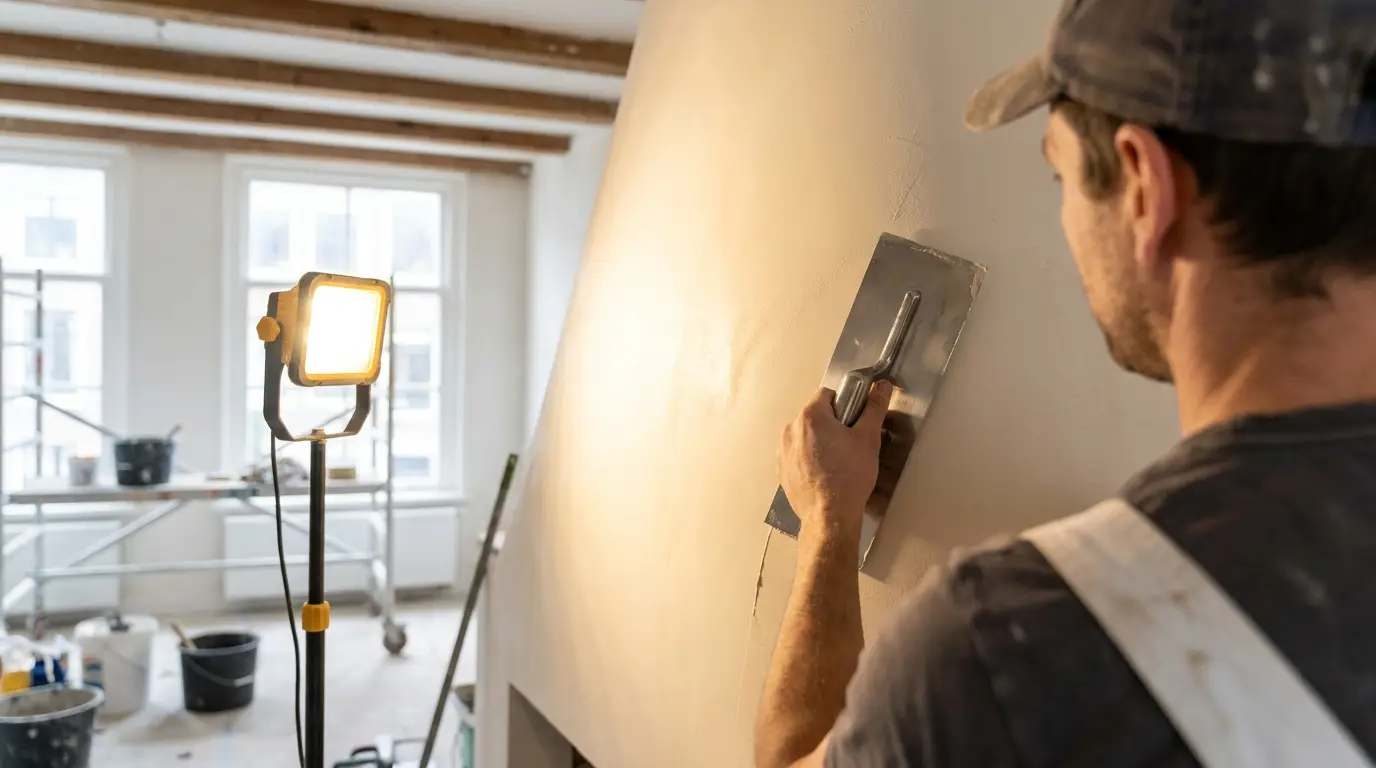
Cost of applying decorative plaster or a wall finish: everything you need to know
Decorative plaster or a wall finish gives walls a decorative and durable finish, from a coarse texture to a smooth Venetian look. The price depends on the type of plaster, the surface area, and the condition of the substrate. On average, you'll pay €15 to €25 per m² in the Netherlands, including labor and materials.
In this article
- ›What does decorative plaster cost per m²?
- ›Price comparison by type of wall finish
- ›Material and labor cost breakdown
- ›Hiring a contractor vs. doing it yourself
- ›Step by step: how does the job work?
- ›Money-saving tips for decorative plaster
- ›Frequently asked questions
Need a contractor for this?
Describe your job and get quotes from contractors near you.
average price
€1,250
average room (±60 m² of wall)
average hourly rate
€48
plasterer hourly rate (€40–55/hour)
turnaround time
1–3 days
depending on scope and type
€ Average price by type
| Wall finish type | Range | Average price |
|---|---|---|
| Textured plaster (spachtelputz)coarse grain, suitable for living rooms and kitchens | €15 – €19 | €17avg.incl. labor |
| Fine-grain decorative plaster (most popular)subtle texture, smooth look, versatile | €18 – €24 | €21avg.incl. labor |
| Venetian plastermulti-layer glossy finish, luxurious look | €25 – €45 | €35avg.incl. labor |
| Lime plaster / tadelaktwaterproof, suitable for bathroom and kitchen | €30 – €55 | €42avg.incl. labor |
| Concrete-look wall finishindustrial look, thin coating on existing wall | €28 – €50 | €39avg.incl. labor |
Prices per m² including materials and labor; Venetian plaster and lime plaster require more coats and drying time, so labor costs are higher. Based on Google price research.
Material and labor costs
Plasterer hourly rate averages €40–€55/hour. Venetian plaster and tadelakt require two to three coats with drying time in between.
Hiring a contractor vs. doing it yourself
| Job | Do it yourself | Via a contractor | Savings doing it yourself |
|---|---|---|---|
| Applying textured plaster (spachtelputz)Coarse-grain texture on a flat, prepped wall; ready-mixed products available at home improvement stores | DoableWith a good primer and a flat substrate, this is very doable for a DIYer; keep your roller strokes even | €80–€130 material costs per 30 m² | up to €270 |
| Applying fine decorative plasterSubtle texture with a smooth surface; requires an even trowel or roller stroke without visible seams | With experienceStreaks and irregularities show once dry; practicing on a test area is strongly recommended | €100–€180 material costs per 30 m² | up to €360 |
| Applying Venetian plasterTwo to three coats, burnished with a stainless steel trowel and finished with wax or sealer for a glossy marble effect | Not recommendedThe technique takes years of practice; a failed coat can hardly be fixed without removing it completely | €200–€350 material costs per 30 m² | No recommended savings |
| Lime plaster or tadelakt in a wet areaWaterproof multi-layer lime finish for bathroom or kitchen; requires sealing seams and corners | Not recommendedIncorrect application leads to moisture getting behind the wall; damage only shows after months | €250–€450 material costs per 30 m² | No recommended savings |
| Applying a concrete-look wall coatingThin decorative coating that gives an industrial concrete look; substrate must be square and flat | With experienceEvery bump or scratch in the substrate shows through in the final result; filling and sanding are essential | €150–€280 material costs per 30 m² | up to €420 |
A skilled plasterer is essential as soon as you choose multi-layer decorative finishes such as Venetian plaster, tadelakt, or lime plaster. These techniques require precisely controlled coat thicknesses, specific drying times between coats, and a burnishing motion that only experience gets right. A mistake in the top coat can almost never be repaired locally: the entire wall has to be redone. In addition, with lime plaster and tadelakt in bathrooms, poor water repellency eventually leads to moisture damage behind the wall. Simple textured plaster (spachtelputz) and coarse-grain products are a realistic DIY project, provided the wall is completely dry, dust-free, and free of peeling paint or wallpaper. Always apply a suitable primer matched to the plaster product first. Fine decorative plaster is doable with some practice, but always test first on an inconspicuous area or a piece of drywall to practice the application motion before you start on the visible wall.
The full process step by step
Inspection and substrate preparation
The plasterer checks the wall for moisture, cracks, loose paint, and remnants of old wallpaper. Anything that could hinder adhesion is removed: flaking layers are scraped off, cracks are opened up with a cutter and filled with a flexible filler or plaster latex. The wall is made dust-free.
1–3 hours
Applying primer or bonding primer
A primer matched to the plaster product is applied to the cleaned wall. This evens out the absorbency of the substrate and keeps the decorative plaster from drying too quickly, which would otherwise cause cracking. The primer dries for 2 to 4 hours before the next coat can be applied.
1–2 hours (excl. drying time)
Applying the first coat of decorative plaster or wall finish
Using a stainless steel trowel, a wide plaster roller, or a rubber float, depending on the product and the desired texture, the plasterer applies the base coat. The thickness, direction of the stroke, and pressure determine the final structure or texture. With textured plaster, the grain patterns are formed during application.
2–5 hours per room
Applying extra coats and burnishing (for premium finishes)
Venetian plaster and lime plaster require two to three coats. Each coat is applied thinly, pressed lightly, and after partial drying rubbed smooth with a steel trowel in circular motions. This creates the characteristic depth and sheen. Drying time between coats is at least 4 to 8 hours.
An extra 2–6 hours per coat
Sealing, waxing, or impregnating
Depending on the type of finish, the decorative plaster is treated after it has fully dried: Venetian plaster gets a wax or acrylic coating for protection and deeper sheen; lime plaster in wet areas is sealed with a water-repellent impregnating product. Concrete look is finished with a matte or glossy varnish.
1–2 hours
Cleanup and handover
Masking film and protective floor covering are removed. The plasterer checks the wall for holes, stains, or thin spots in the finish and repairs them on the spot. Edges at windows, doors, and the ceiling are touched up. The room is left dust-free.
30–60 min
6 smart money-saving tips
Frequently asked questions
How much does applying decorative plaster cost on average?
On average €15–€25 per m². For a living room with ±60 m² of wall surface, you'll typically pay €900–€1,500 including materials and labor. Venetian plaster and premium finishes can run up to €45 per m².
How long does applying decorative plaster take?
A plasterer applies roughly 30–50 m² of decorative plaster per day. An average room (60 m²) is done in 1 to 2 days. Venetian plaster requires more coats and drying time: plan on 2 to 3 days.
Do I need a permit?
No. Applying decorative plaster and wall finishes on the inside of a home doesn't require a permit.
Can I apply decorative plaster myself?
Coarser textured plaster is doable for a DIYer if the wall is flat and clean. Venetian plaster or lime plaster requires technical knowledge and practiced hands; mistakes are hard to correct. Leave complex finishes to a contractor.
Does the wall need to be prepped?
Yes. A good substrate is crucial. Peeling paint or wallpaper must be removed, and the wall should be smooth, dust-free, and dry. A primer is almost always needed for good adhesion.
How long does decorative plaster last?
Properly applied decorative plaster lasts 15 to 30 years. Venetian plaster and lime plaster are even more durable. If part of the wall is damaged, a local repair is possible, but color differences may be visible.
Related jobs
Ready to have decorative plaster applied?
Describe your job and receive quotes from verified plasterers near you.
Within 24 hours
response from a contractor
Verified
all contractors checked
Competitive price
compare quotes