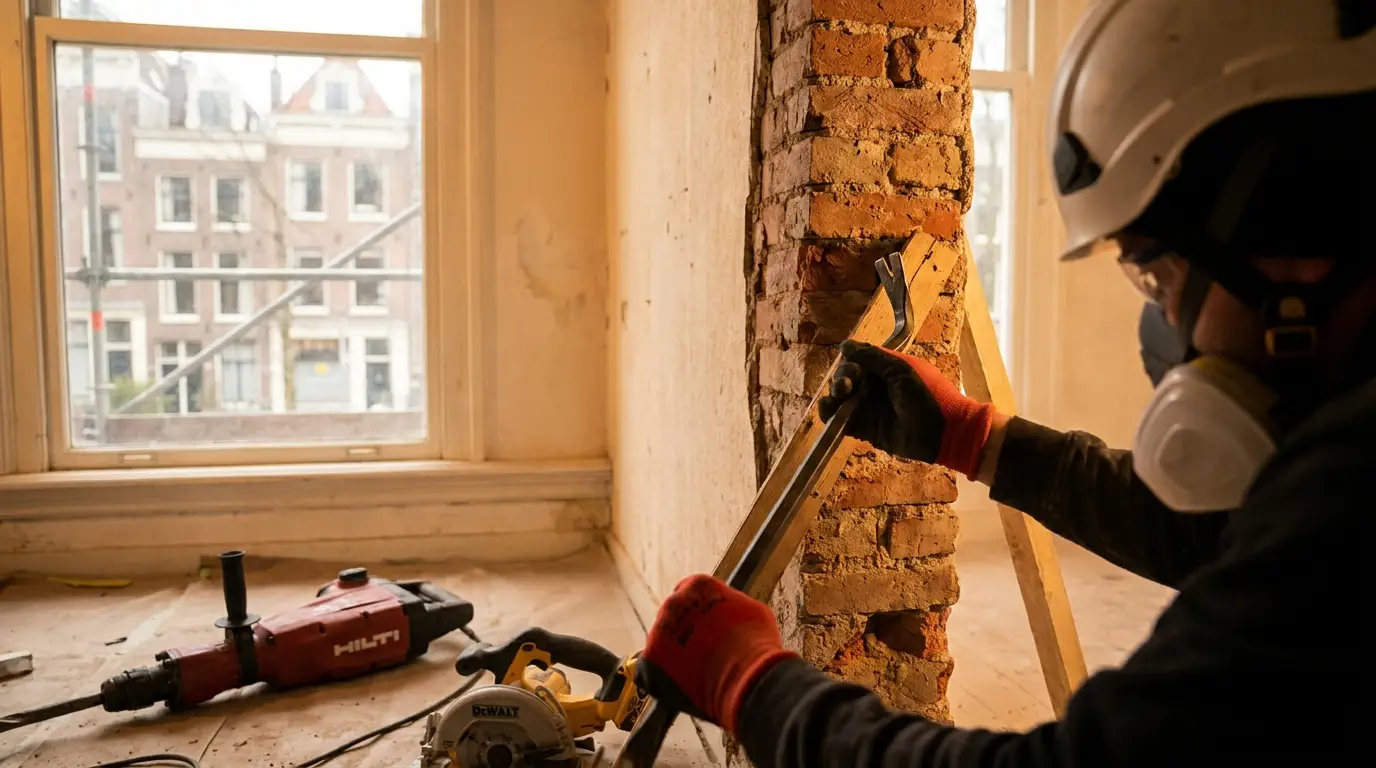
Cost of demolition work: everything you need to know
Demolition is the first step in almost any remodel or renovation: tearing down walls, stripping floors, or gutting an entire interior. The cost depends heavily on the scope, the type of demolition, and the amount of debris that needs to be hauled away. In this overview, you'll find current Dutch prices so you're well prepared.
In this article
- ›What does demolition work cost on average?
- ›Prices by type of demolition work
- ›Labor and material costs
- ›Hiring a contractor vs. demolishing it yourself
- ›How does demolition work go step by step?
- ›Money-saving tips for demolition work
- ›Frequently asked questions
Need a contractor for this?
Describe your job and get quotes from contractors near you.
average price
€1,800
including debris removal
average hourly rate
€40
contractor hourly rate (€30–55/hour)
turnaround time
1–5 days
depending on scope
€ Average price by type
| Type of demolition work | Range | Average price |
|---|---|---|
| Demolishing an interior wallnon-load-bearing wall, including debris cleanup | €300 – €800 | €550avg.incl. labor |
| Stripping a room (most popular)removing floor, walls, and ceiling, approx. 20–30 m² | €800 – €2,200 | €1,500avg.incl. labor |
| Partial interior demolitionmultiple rooms, including fixtures and piping | €1,500 – €4,000 | €2,500avg.incl. labor |
| Full interior demolition of a homeremoving everything down to the shell, approx. 100 m² | €4,000 – €8,500 | €6,000avg.incl. labor |
| Demolishing an addition or outbuildingexterior demolition including foundation removal | €2,000 – €6,000 | €4,000avg.incl. labor |
Prices are estimates and include debris removal; load-bearing structures, asbestos, and exterior demolition are usually more expensive. Based on Google price research.
Material and labor costs
General contractor/demolition contractor hourly rate averages €30–€55/hour. Asbestos removal requires a certified company and is quoted separately.
Hiring a contractor vs. doing it yourself
| Job | Do it yourself | Via a contractor | Savings doing it yourself |
|---|---|---|---|
| Removing a non-load-bearing interior wallDrywall or aerated concrete, no hidden pipes or asbestos | DoableVery manageable with a dust mask (P2), safety glasses, and a hammer or reciprocating saw | €300–€700 (contractor + debris removal) | up to €500 |
| Chipping off floor or wall tileStripping wall or floor tile in a kitchen or bathroom | DoableTime-consuming but doable with a chisel and a rented rotary hammer; disposal is your responsibility | €200–€500 (contractor per room) | up to €350 |
| Opening up a load-bearing wallStructural demolition including installing a steel frame or beam | Not recommendedRequires structural calculations by a structural engineer; mistakes lead to cracking or collapse | €1,200–€3,500 (including steel or beam) | No recommended savings |
| Asbestos abatementRemoving suspected asbestos materials in homes built before 1994 | Not recommendedProhibited by law without an SC-530 certified asbestos removal company; fines and restoration obligations if violated | €500–€3,500+ (certified abatement company) | No legal savings possible |
| Stripping a full roomRemoving ceiling, walls, and floor including baseboards and door and window trim | With experienceDoable if you're handy, but you'll have to arrange debris removal, the demolition notice, and the asbestos check yourself | €800–€2,200 (contractor including disposal) | up to €900 |
A demolition contractor is essential as soon as load-bearing structures are involved, pipes or wiring (gas, water, electrical) are in the way, or asbestos may be present. For homes built before 1994, an asbestos inventory report from a certified company (SC-540, the Dutch certification for asbestos inspection) is required by law before any demolition: demolishing without this report is a criminal offense. Structural demolition also requires calculations from a structural engineer; without them, a general contractor isn't allowed to do the job. You can tackle light demolition yourself, such as non-load-bearing interior walls, baseboards, or tile, with the right personal protection (P2 dust mask, safety glasses, gloves) and rented tools. Do make sure you know in advance whether pipes run behind the wall: hitting a hidden water line can easily cost €500 extra.
The full process step by step
Inspection, asbestos check, and plan of action
The demolition contractor assesses on site which walls are load-bearing, whether pipes or wiring run through the structures to be demolished, and whether asbestos may be present. For homes built before 1994, an inventory report (SC-540) is requested first. The contractor then draws up a work plan and determines whether a demolition notice to the municipality is required (for more than 10 m³ of waste, to be filed at least four weeks before the start).
1–3 hours (+ possibly 1–2 weeks waiting time for the demolition notice)
Protecting the area and shutting off utilities
The work area is sealed off with dust barriers and plastic sheeting so fine dust doesn't spread. Adjacent rooms, floors, and doors are covered. Power to the demolition zone is shut off at the meter cabinet (where the electricity meter and the breaker panel are); gas and water are shut off or rerouted by a plumber. Demolition only starts once all utilities are safe.
1–3 hours
Carrying out the demolition
The contractor demolishes systematically from top to bottom: first the ceiling, then the walls, then the floor (or only the parts included in the job). Load-bearing structures are only removed after temporary shoring or a support structure is in place. Usable materials such as doors, radiators, or bathroom fixtures are set aside for reuse or sale.
1–5 workdays (depending on scope)
Sorting and hauling away debris
Demolition waste is sorted on site into categories: concrete and masonry, wood, drywall, metal, and general waste. Delivering sorted waste to the processing facility lowers disposal fees by 20–40%. The dumpster or large bag is picked up and taken to a licensed processor. The contractor provides proof of proper disposal.
0.5–1 day
Final inspection and handover
The demolition contractor checks that all parts to be demolished have been removed, that no loose pipes or wiring are left behind, and that adjacent structures are undamaged. Dust barriers are removed and the space gets a basic cleaning. You receive the invoice with a breakdown of labor hours, disposal costs, and any additional work.
1–2 hours
6 smart money-saving tips
Frequently asked questions
What does demolition work cost on average?
On average, you'll pay €20–€55 per m² for demolition work. Stripping a complete room typically costs €800–€2,200. A full interior demolition of a home (approx. 100 m²) can run €4,000–€8,500 including debris removal.
How long does demolition work take?
Stripping a single room takes 1–2 workdays. A partial interior demolition of multiple rooms takes 2–3 days. A full interior demolition of a row house can take 3–5 workdays, depending on the team and the scope.
Do I need a permit for demolition work?
For small indoor demolition jobs (less than 10 m³ of waste), you usually don't need a permit. As soon as more than 10 m³ of demolition waste is produced, you're required to file a demolition notice with the municipality at least four weeks in advance. Also check whether asbestos is present; that always requires a certified asbestos inventory report.
Can I do demolition work myself?
If you're handy, you can tackle light demolition yourself, such as removing non-load-bearing interior walls or chipping off tile. Heavy demolition, load-bearing structures, or work near electrical, gas, and pipes are better left to a contractor. Also watch out for asbestos in homes built before 1994: demolishing it yourself is then prohibited by law.
What does debris removal cost for demolition work?
A small 3 m³ dumpster costs €125–€165. Medium-sized dumpsters (6–10 m³) run €200–€350. For large projects, expect €450 or more. Delivering sorted waste (concrete, wood, and metal separately) lowers disposal fees.
How can I save on demolition work?
Compare at least three quotes through a platform like VakmanBaas. Do small demolition jobs yourself. Sort debris yourself to lower disposal fees. Schedule demolition together with other remodeling work so the contractor can come several days in a row: that saves on travel time and mobilization costs.
Related jobs
Ready to have your demolition work done professionally?
Describe your job and receive quotes from verified demolition contractors near you.
Within 24 hours
response from a contractor
Verified
all contractors checked
Competitive price
compare quotes