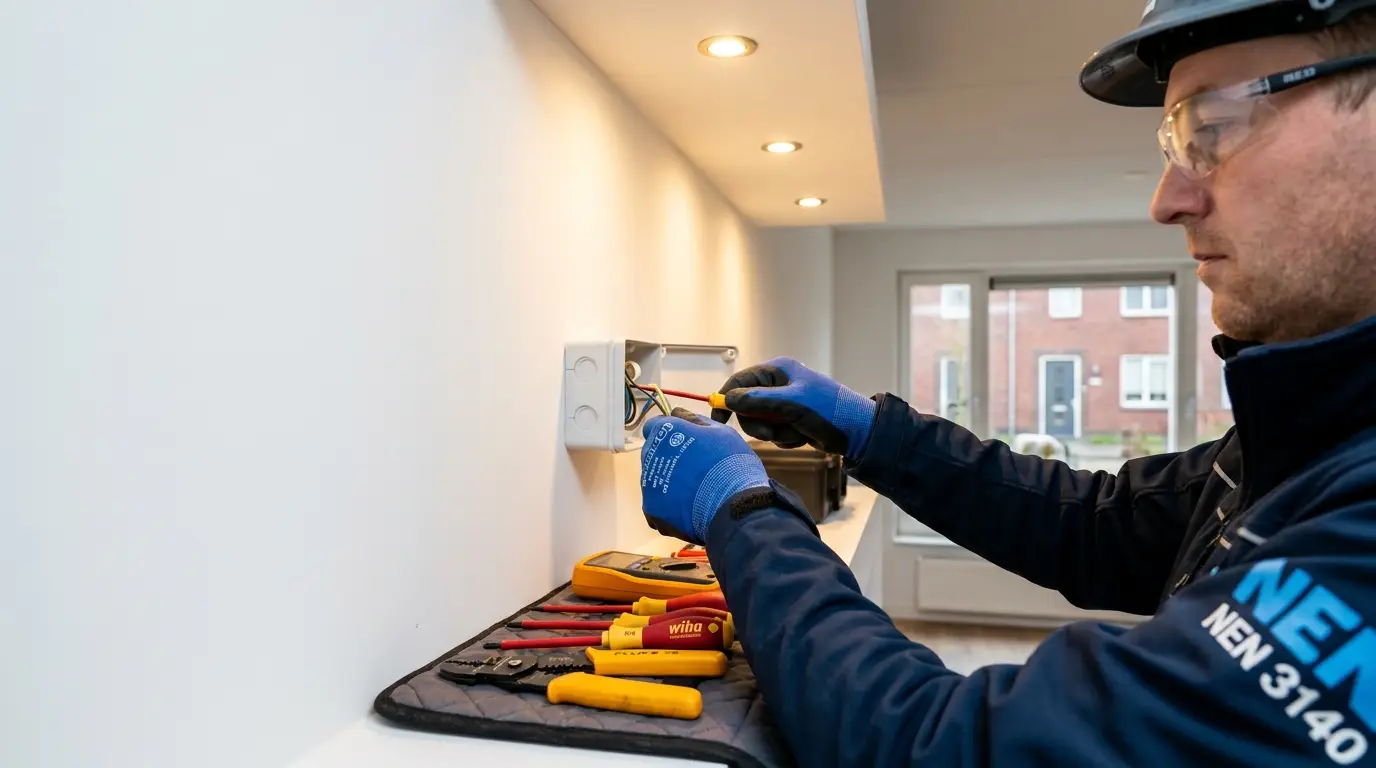
Cost of installing outlets and switches: everything you need to know
Having outlets or switches installed is a common electrical job in Dutch homes: from adding a single outlet to replacing every switch in the house. The price depends on the number of points, the wiring needed, and the electrician's hourly rate. On this page, you'll find a clear overview of all costs.
In this article
- ›Average cost of outlets and switches
- ›Price overview by type of installation
- ›Material and labor costs
- ›Hire an electrician or do it yourself?
- ›How does the installation work?
- ›Money-saving tips for electrical work
- ›Frequently asked questions
Need a contractor for this?
Describe your job and get quotes from contractors near you.
average price
€125
per outlet or switch, incl. labor
average hourly rate
€58
electrician hourly rate (€45–75/hour)
turnaround time
1–2 days
depending on number of points
€ Average price by type
| Type of outlet or switch | Range | Average price |
|---|---|---|
| Replacing an outlet (same spot)Existing outlet is replaced like-for-like, no new wiring | €50 – €100 | €70avg.incl. installation |
| Adding an outlet to an existing circuit (most popular)New outlet in a spot with existing wiring nearby | €75 – €150 | €110avg.incl. installation |
| Outlet with new wiringRunning a new circuit or new cable from the breaker panel | €150 – €350 | €230avg.incl. installation |
| Replacing or installing a switchStandard light switch, single or double switch | €60 – €130 | €90avg.incl. installation |
| Installing a dimmer or smart switchIncluding a compatible dimmer or smart home switch (Philips Hue, etc.) | €80 – €200 | €140avg.incl. installation |
| Multiple points at once (5+)Discounted rate for a larger job, price per point | €55 – €120 | €85avg.incl. installation |
Prices include standard materials and labor; new wiring or circuit expansion is charged separately. Based on Google price research.
Material and labor costs
Electrician hourly rate averages €45–€75/hour. A trip charge is often added to the first invoice; with multiple points on one day, it's dropped.
Hiring a contractor vs. doing it yourself
| Job | Do it yourself | Via a contractor | Savings doing it yourself |
|---|---|---|---|
| Replacing an outlet like-for-likeSwapping an existing outlet in exactly the same location for a new one, existing wiring stays untouched | DoableSwitch off the right circuit at the breaker panel and verify with a voltage tester before touching the wires | €5–€30 (materials only) | up to €70 |
| Replacing a switch on existing wiringSwapping a standard single or double switch, reusing the same electrical box and wiring | DoablePay attention to the wire colors (live, neutral, traveler) and photograph the wiring before disconnecting | €5–€25 (materials only) | up to €90 |
| Adding an outlet in a new locationRunning cable from an existing outlet or junction box to a new recessed location, without changes to the breaker panel | With experienceRequires knowledge of cable routing, maximum circuit load, and NEN 1010 standards for box depth | €20–€60 (materials) | up to €110 |
| Installing a dimmer or smart switchReplacing an existing switch with a dimmer or smart home switch, including app pairing | With experienceDimmers require dimmable LED bulbs; smart switches sometimes need a neutral wire that older homes lack | €20–€80 (device) | up to €100 |
| Running a new circuit from the breaker panelInstalling a dedicated connection in the meter cabinet for heavier appliances or distant outlets | Not recommendedWork in the breaker panel is legally reserved for licensed electrical companies (NEN 1010); mistakes lead to fire hazards and insurance problems | €100–€300 (materials) | No legal savings possible |
For swapping an outlet or switch like-for-like in the same location (without new wiring), you can do the work yourself as a DIYer. Always switch off the relevant circuit at the breaker panel first and check with a voltage tester or contact tester before touching the wires. As soon as new cables need to be run, an extra electrical box needs to be cut into masonry, or changes to the breaker panel are needed, a licensed electrical company is legally required. This also applies to connecting switches with a neutral wire in older homes, where the wiring doesn't always meet the current NEN 1010 standard. A fixed installation done without certification can lead to your fire insurance rejecting a claim in case of damage.
The full process step by step
Assessment and site evaluation
The electrician takes stock of how many outlets and switches you want, notes the exact locations, and assesses the current breaker panel. They check whether existing circuits have enough capacity or whether a new circuit is needed, and determine the most efficient cable route for each point.
30–60 min
Preparing materials and confirming the quote
Based on the assessment, the right electrical boxes, outlets, switches, and cable materials (NYM-J or installation wire) are selected. For smart switches, hub compatibility is checked. Experienced electricians carry standard materials in their van, so simple jobs can start the same day.
0–1 day (if ordering is needed)
De-energizing and laying out the cable route
The relevant circuits are switched off and locked (lockout procedure). Then the cable route is laid out: channels are cut into the walls, or existing cavity walls and utility shafts are used to hide cables out of sight.
30–90 min per route
Mounting electrical boxes and running wiring
Electrical boxes are mounted to size in the wall or installed surface-mounted. The cable is run from the power source to the new location, including the ground wire. With multiple points, the electrician works systematically circuit by circuit to prevent mistakes.
1–3 hours per point (depending on route)
Connecting and finishing outlets and switches
Wires are neatly connected to the terminals of the outlet or switch, including the ground wire. Cover plates are attached and neatly finished. For dimmers, the load capacity is set; for smart switches, the app pairing is configured and tested.
15–30 min per point
Measuring, testing, and handover
All new points are measured for voltage, phase sequence, and grounding with an installation tester. The electrician tests whether the residual current device (RCD), the European counterpart of a GFCI, responds correctly and walks the customer through the new setup. With more than 25 new points or a modified breaker panel, an inspection report is drawn up.
30–60 min
6 smart money-saving tips
Frequently asked questions
How much does installing outlets and switches cost on average?
On average, you'll pay €75 to €150 per point for an outlet or switch, including labor. With new wiring, costs rise to €150–€350 per point. If you have multiple points done at once, you benefit from a lower rate per point.
How long does installing outlets and switches take?
Replacing a single outlet takes 30–60 minutes. A larger job of 5 to 10 points with new wiring takes half a workday to a full workday. Total lead time including scheduling is usually 1–2 days.
Do I need a permit for outlets or switches?
You don't need a building permit to install or replace outlets and switches. However, work on the fixed installation must be done by a licensed electrical company, and the installation must comply with NEN 1010 (the Dutch standard for electrical installations).
Can I replace an outlet or switch myself?
As a DIYer, you may replace an outlet or switch like-for-like in the same location, provided the circuit is switched off and no new wiring is needed. As soon as channeling, drilling, or running new cables is required, a licensed electrician is legally required.
What are smart switches, and are they more expensive to install?
Smart switches (smart home, such as Philips Hue, IKEA Tradfri, or KNX) can be controlled via an app or voice assistant. Installation takes a bit longer than a standard switch because of configuration. Expect €80–€200 per switch, including the device itself.
How many outlets do I need per room?
The Bouwbesluit (the Dutch building code) doesn't set a minimum number, but a common guideline is at least 2–4 double outlets per living room, 2 per bedroom, and at least 3 in the kitchen near the countertop. Too few points lead to the use of extension cords, which creates a fire hazard.
Related jobs
Ready to have your outlets and switches installed?
Describe your job and receive quotes from verified electricians near you.
Within 24 hours
response from a contractor
Verified
all contractors checked
Competitive price
compare quotes