Cost of interior plastering: everything you need to know
Interior plastering gives walls and ceilings a sleek, finished look. The cost depends on the type of plaster, the surface area, and the condition of the substrate. In this overview, you'll find current prices per m², hourly rates, and everything that determines the final price.
In this article
- ›Average cost of interior plastering
- ›Prices by type of plaster
- ›Material and labor costs
- ›Hire a contractor or do it yourself?
- ›How does the plastering process work?
- ›Money-saving tips for plastering
- ›Frequently asked questions
Need a contractor for this?
Describe your job and get quotes from contractors near you.
average price
€1,400
average per room (paint-ready plaster)
average hourly rate
€48
contractor hourly rate (€40–55/hour)
turnaround time
1–3 days
depending on surface area and type
€ Average price by type
| Plaster type | Range | Average price |
|---|---|---|
| Spray-applied skim coatthin sprayed layer for light repair and leveling | €400 – €900 | €650avg.incl. labor |
| Paint-ready plaster (most popular)smooth plaster ready to paint right away, 1–2 coats | €900 – €2,000 | €1,400avg.incl. labor |
| Wallpaper-ready plasterextra smooth and flat for wallpaper without visible seams | €1,100 – €2,400 | €1,700avg.incl. labor |
| Traditional lime plasterdurable, breathable finish for older homes | €1,500 – €3,500 | €2,500avg.incl. labor |
| Decorative plaster (beton ciré / tadelakt)luxury decorative plaster with a distinctive look | €3,000 – €8,000 | €5,000avg.incl. labor |
Prices include materials and 9% VAT (homes older than 2 years); excluding any crack treatment or removal of existing plaster. Based on Google price research.
Material and labor costs
Plasterer hourly rate averages €40–55/hour excluding VAT. For homes older than 2 years, 9% VAT applies to labor instead of 21%.
Hiring a contractor vs. doing it yourself
| Job | Do it yourself | Via a contractor | Savings doing it yourself |
|---|---|---|---|
| Repairing small damage or a crackfilling a hole or crack up to ~15 cm with skim plaster and leveling it | DoableEasy to do yourself with ready-made filler, a putty knife, and sandpaper; practicing on a test patch pays off | €10–40 materials | up to €120 saved |
| Applying a spray-applied skim coatspraying a thin leveling coat over an existing but worn wall surface | With experienceRequires renting spray equipment (€80–150/day) and practiced technique; uneven thickness shows immediately in raking light | €400–900 contractor | up to €200 saved |
| Smooth plastering a whole room (paint-ready)finishing the walls and/or ceiling of an entire room evenly and ready to paint | Not recommendedSmooth plastering takes years of trowel experience and knowledge of drying times; imperfections show in raking light and are costly to fix | €900–2,000 contractor | No recommended savings |
| Applying lime plaster to old wallstraditional breathable plasterwork for older or historic homes | Not recommendedLime mortar requires specific mixing ratios and working times; incorrect application leads to cracking or delamination within a few months | €1,500–3,500 contractor | No recommended savings |
| Decorative plaster (beton ciré / tadelakt)luxury decorative plaster with a special polishing technique for a unique wall or floor look | Not recommendedSpecialized technique requiring multiple coats, specific waxes, and polishing steps; failed work is extremely costly and time-consuming to remove | €3,000–8,000 contractor | No legal savings possible |
For small touch-ups (sealing a crack, filling a gap, or patching a slightly damaged area), a DIYer can get by fine with ready-made skim plaster. However, choose a skilled plasterer as soon as it involves a whole room, lime plaster in an older home, or decorative plaster. Plasterers work with special gypsum mixes and steel trowels that take years of skill: the smallest irregularity shows on the wall in raking light and is then nearly impossible to correct invisibly without replastering the entire surface. In addition, every type of substrate (concrete, gypsum blocks, aerated concrete, or old plasterwork) needs a different preparation and primer coat, which an experienced contractor can assess at a glance.
The full process step by step
Substrate inspection and moisture measurement
The plasterer examines the walls and ceiling for cracks, loose old plaster, efflorescence, and moisture problems. With a moisture meter, they check whether the substrate is dry enough: plaster on a wet substrate will peel sooner or later. Damaged spots are marked and chipped away if needed.
30–90 min
Preparing and priming the substrate
Dusty or highly absorbent substrates get a primer coat to guarantee adhesion and prevent the plaster from drying out too quickly. Smooth concrete walls are first roughened or given a bonding plaster.
30–60 min + drying time
Filling cracks and imperfections
Existing cracks are widened with a gouge, thoroughly blown clean, and filled with crack repair mortar or fiberglass mesh. Large holes or recesses are pre-filled and finished flat. Only once this is completely dry does the plasterer move on to the main coat.
30 min – 2 hours
Applying the plaster coat(s)
Depending on the chosen type of plaster, the contractor applies one or two coats: with a spray machine for a spray-applied skim coat, or with a wide Venetian trowel for traditional plaster. Each coat is spread evenly to a consistent thickness of 2–4 mm. With multiple coats, drying time is needed in between.
4–8 hours per room
Smoothing and checking in raking light
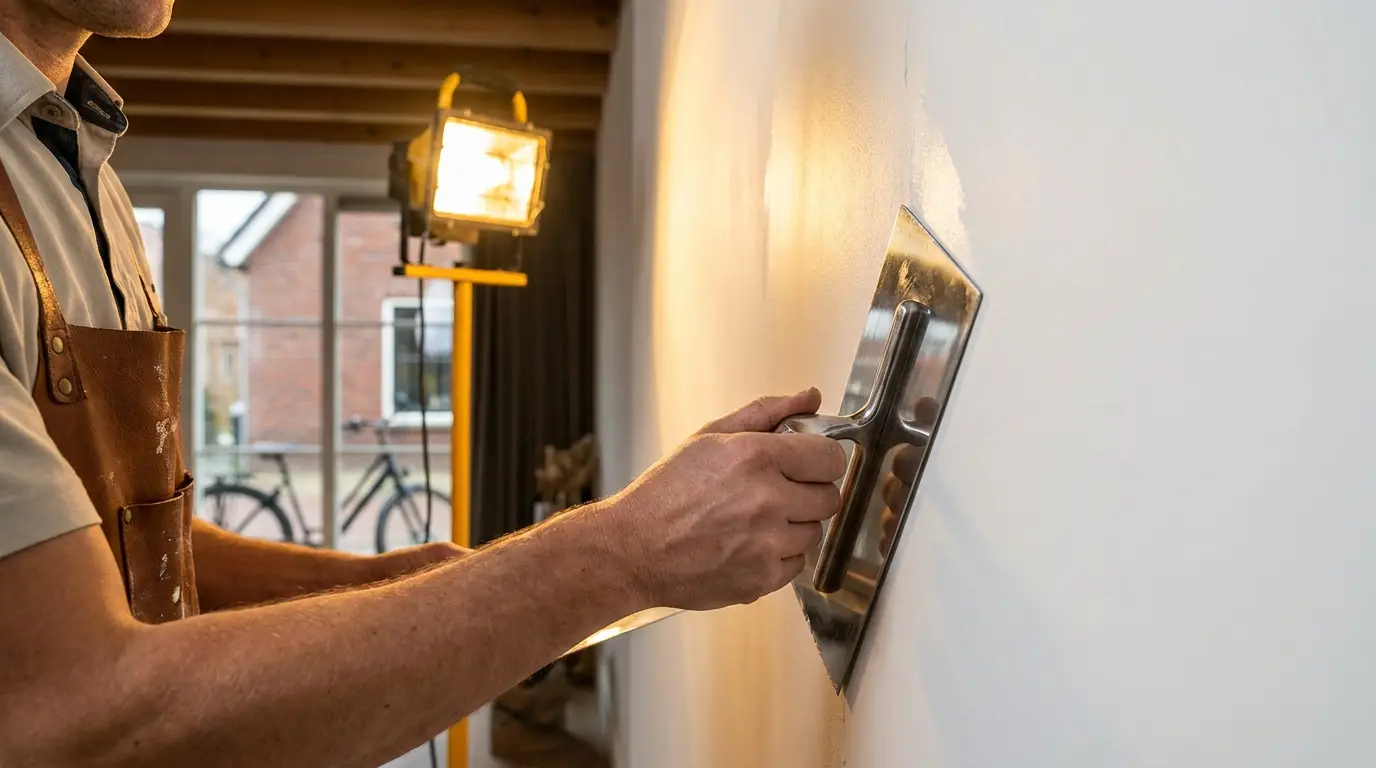
After application, the plasterer smooths the surface with a damp trowel and wipes away excess plaster. They then assess the result with a work light at a raking angle: even small imperfections of less than a millimeter become visible this way and are touched up immediately.
1–2 hours
Drying time and final inspection
The plaster dries for at least 24–48 hours at normal room temperature (18–20 °C). Avoid high heating or drafts: that causes cracks from drying too fast. Only when the surface is completely light in color and no longer feels cold may you paint, prime, or wallpaper.
24–48 hours drying time
6 smart money-saving tips
Frequently asked questions
What does interior plastering cost on average?
On average, you'll pay €1,400 for a 20–25 m² room with paint-ready plaster. The range runs from €400 for a spray-applied skim coat to €8,000 for luxury decorative plaster.
How long does interior plastering take?
A 20–25 m² room is finished in 1 to 2 workdays. After that, at least 24–48 hours of drying time is needed before you can paint or wallpaper. Larger jobs take 3 to 5 days.
Do I need a permit for interior plastering?
No, interior plastering doesn't require a building permit. It's a finishing job and isn't subject to permit requirements. If you live in a historic building, check whether additional rules apply.
Can I do plastering myself?
Simple skim coating or repairing small damage is manageable for a DIYer. Smooth plastering for a whole room, however, requires craftsmanship and the right tools. Mistakes are hard to correct and end up costing more. A plasterer reliably delivers a smooth, cleaner result.
Is there a lower VAT rate for plastering?
Yes. For homes older than 2 years, the reduced VAT rate of 9% applies to labor. This can save you hundreds of euros compared with the standard rate of 21%.
What affects the price of plastering the most?
The biggest factors are: the type of plaster (skim coat, smooth, decorative), the surface area to be plastered in m², the condition of the existing substrate (crack-free, dry, clean), and the region. In the Randstad (the densely populated western Netherlands), hourly rates are on average 10–15% higher than elsewhere.
Related jobs
Ready to have your walls professionally plastered?
Describe your job and receive quotes from verified plasterers near you.
Within 24 hours
response from a contractor
Verified
all contractors checked
Competitive price
compare quotes