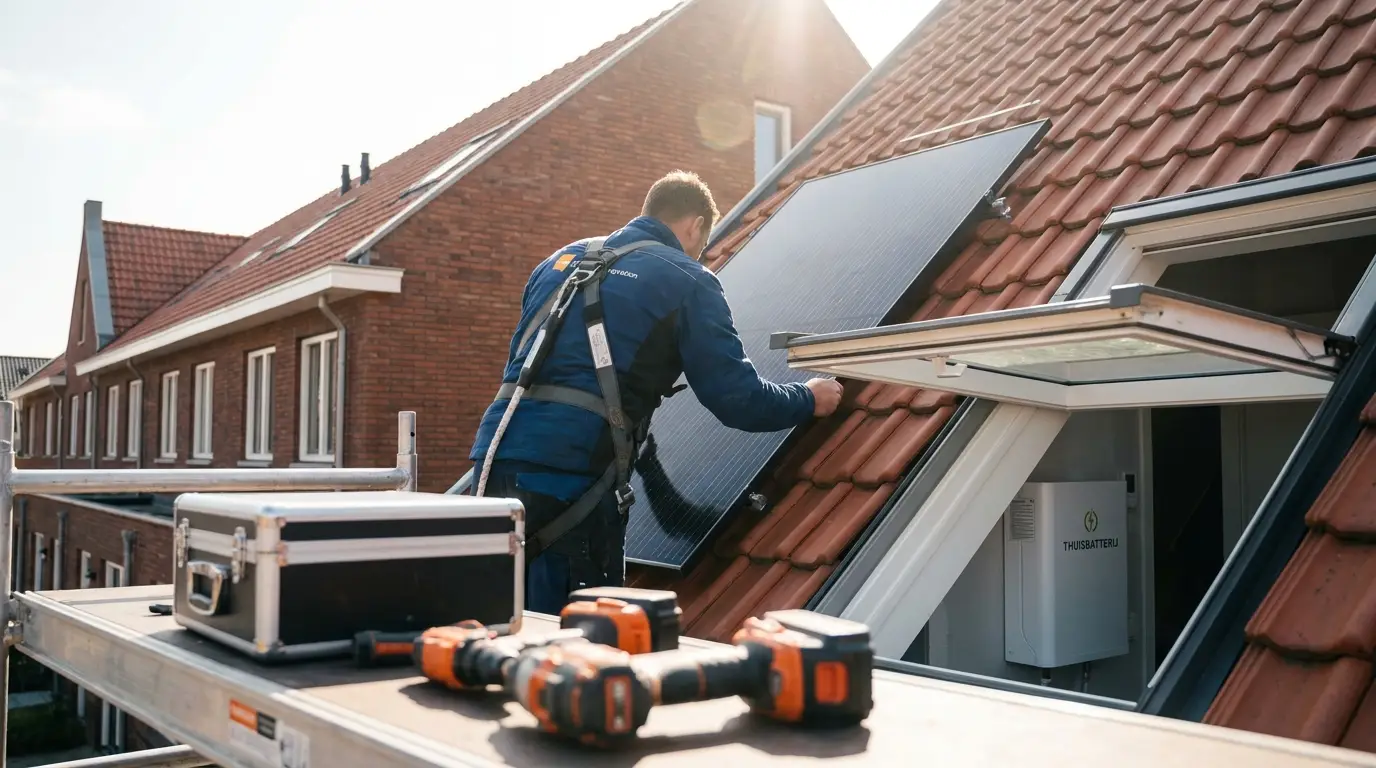
Cost of installing a home battery or energy storage: everything you need to know
A home battery stores your surplus solar power so you can use it in the evening or on cloudy days. The total price depends heavily on the capacity in kWh, the brand, and the complexity of the installation. In this overview, you'll find current prices by type, what an electrician charges, and how you can save on costs.
In this article
- ›What does it cost to install a home battery?
- ›Prices by capacity and system type
- ›Material and labor cost breakdown
- ›Hire a contractor or install it yourself?
- ›How does the installation work, step by step?
- ›Money-saving tips for a home battery
- ›Frequently asked questions
Need a contractor for this?
Describe your job and get quotes from contractors near you.
average price
€7,500
10 kWh battery including installation
average hourly rate
€65
electrician hourly rate (€55–95/hour)
turnaround time
1–2 days
depending on system complexity
€ Average price by type
| Home battery type | Range | Average price |
|---|---|---|
| Small home battery 5 kWhSuitable for a small household or to supplement a limited solar panel system | €3,500 – €6,000 | €4,800avg.incl. installation |
| Home battery 10 kWh (most popular)Ideal for an average family with 4–6 kWp of solar panels; covers evening and nighttime use | €6,500 – €11,500 | €7,500avg.incl. installation |
| Large home battery 15 kWhFor a large home or household with high usage and a large solar panel area | €9,500 – €15,000 | €12,000avg.incl. installation |
| Stackable system (modular)Expandable system; start small and add extra modules later | €5,000 – €14,000 | €8,500avg.incl. installation |
| All-in-one inverter + batteryCombined system with a hybrid inverter; saves on installation costs | €7,000 – €13,000 | €9,500avg.incl. installation |
Prices include VAT and standard installation work; extra circuits in the breaker panel or complex cabling are quoted separately. Based on Google price research.
Material and labor costs
Electrician hourly rate averages €55–95/hour. Installation time for a standard home battery is 4–10 hours; expanding the breaker panel or using multiple inverters increases this.
Hiring a contractor vs. doing it yourself
| Job | Do it yourself | Via a contractor | Savings doing it yourself |
|---|---|---|---|
| Connecting the home battery to the breaker panelRunning cables, adjusting the circuit layout, and setting up safety protection | Not recommendedLegally reserved for a NEN 1010 certified electrician; violations void your warranty and insurance | €300–€700 | No legal savings possible |
| Connecting and configuring the hybrid inverterElectrical link to the solar panel system and setting the charge/discharge profile | Not recommendedWrong voltage or polarity permanently damages the inverter and voids the manufacturer's warranty | €200–€400 | No legal savings possible |
| Wall mounting the battery housingInstalling the mounting bracket, drilling cable entry holes, and sealing | With experiencePurely mechanical work; the electrical connection afterward must always be done by the electrician | €100–€200 | up to €150 |
| Setting up app connection and monitoringConnecting to the inverter app, Wi-Fi network, and any home automation | DoableStep-by-step instructions are in the manual or manufacturer's app; no electrical knowledge required | €50–€150 | up to €100 |
| Handling registration with the grid operatorFilling out and submitting the registration form for systems above 800 VA | DoableThe grid operator offers an online form; you'll need the technical specifications from the electrician | €50–€100 | up to €75 |
The core of a home battery installation (connecting to the low-voltage grid, modifying the breaker panel, and linking the inverter) is legally reserved for a certified electrician with NEN 1010 certification (the Dutch standard for electrical installations). Doing this work yourself isn't just dangerous (risk of fire and short circuits), it also voids your product warranty and homeowners insurance. What you can do yourself: wall mount the battery housing before the electrician arrives, configure the app connection and monitoring after installation, and fill out the registration form for the grid operator (required for systems above 800 VA). That way you save labor hours on the parts that don't require a trade qualification, while the critical electrical work is done safely by a contractor.
The full process step by step
Site assessment and system advice
The electrician inspects your meter cabinet (where the electricity meter and the breaker panel are), the type and capacity of your existing inverter (if you have solar panels), the available wall space for the battery, and your average energy use via the smart meter. Based on this, they recommend the optimal capacity in kWh and which battery type (wall-mounted, floor-standing, or all-in-one) fits best.
1–2 hours
Compare quotes and choose a system
You receive an itemized quote with the battery brand, capacity in kWh, inverter type, and all installation costs broken down. Always request at least two quotes and check whether the chosen system is compatible with your existing inverter or grid connection: not every battery system works with every inverter.
1–5 business days
Grid operator registration (for systems above 800 VA)
For energy storage systems above 800 VA, registration with the grid operator is mandatory. The electrician usually handles this, but ask about it explicitly before the installation date. Without registration, problems can arise during an inspection or with an insurance claim after damage.
1–5 business days
Installation and cabling
The electrician mounts the battery on the wall or floor, runs the power cables to the breaker panel and/or inverter, and installs the data cable for communication. If needed, an extra circuit is added to the breaker panel. All connections are grounded and fitted with the right protection (fuses, residual current device (RCD), the European counterpart of a GFCI).
4–8 hours
Commissioning and parameter configuration
After the electrical connection, the system is started up. The electrician sets the charge and discharge profile (at what time and at what power price the battery charges), links the system to the inverter, and verifies communication with your smart meter. The first charge and discharge cycle is tested live.
1–2 hours
App connection and user instructions
The electrician connects the system to the matching monitoring app on your smartphone, so you can follow the charge level, self-consumption ratio, and energy balance in real time. You'll get an explanation of how to adjust charging profiles and what to watch for in case of malfunctions.
30–60 min
Handover and documentation
You receive the complete installation documentation: technical drawing, warranty certificates for the battery and inverter, the completed grid operator registration form, and any inspection reports. Keep these safe: you'll need them when selling your home or filing an insurance claim.
30 min
6 smart money-saving tips
Frequently asked questions
What does a home battery cost on average, including installation?
On average €7,500 for a 10 kWh system. Range: €3,500 for a small 5 kWh battery to well over €15,000 for a large modular system of 15+ kWh.
How long does it take to install a home battery?
In a standard situation, installation takes one day. With a more complex connection, an extra circuit in the breaker panel, or a larger system capacity, it can take two days.
Do I need a permit for a home battery?
Usually not. A battery placed indoors doesn't require a building permit. However, the electrician must be certified, and for systems above 800 VA the regional grid operator must be notified.
Can I install a home battery myself?
No. By law, only a certified electrician may connect to the low-voltage grid. Doing it yourself brings fire and safety risks and can void your warranty.
Is there a subsidy for a home battery?
There's currently no national subsidy for private individuals. Some municipalities and provinces offer local programs. Businesses can use the EIA (Energie-investeringsaftrek, a Dutch tax deduction for energy investments).
How quickly does a home battery pay for itself?
The payback period is usually between 8 and 14 years, depending on energy prices, self-consumption, and capacity. With high energy prices and a large solar panel system, it can be faster.
Related jobs
Ready to have your home battery installed?
Describe your job for free. Checked electricians near you respond, and you choose who to continue with.
Within 24 hours
response from a contractor
Verified
all contractors checked
Competitive price
compare quotes