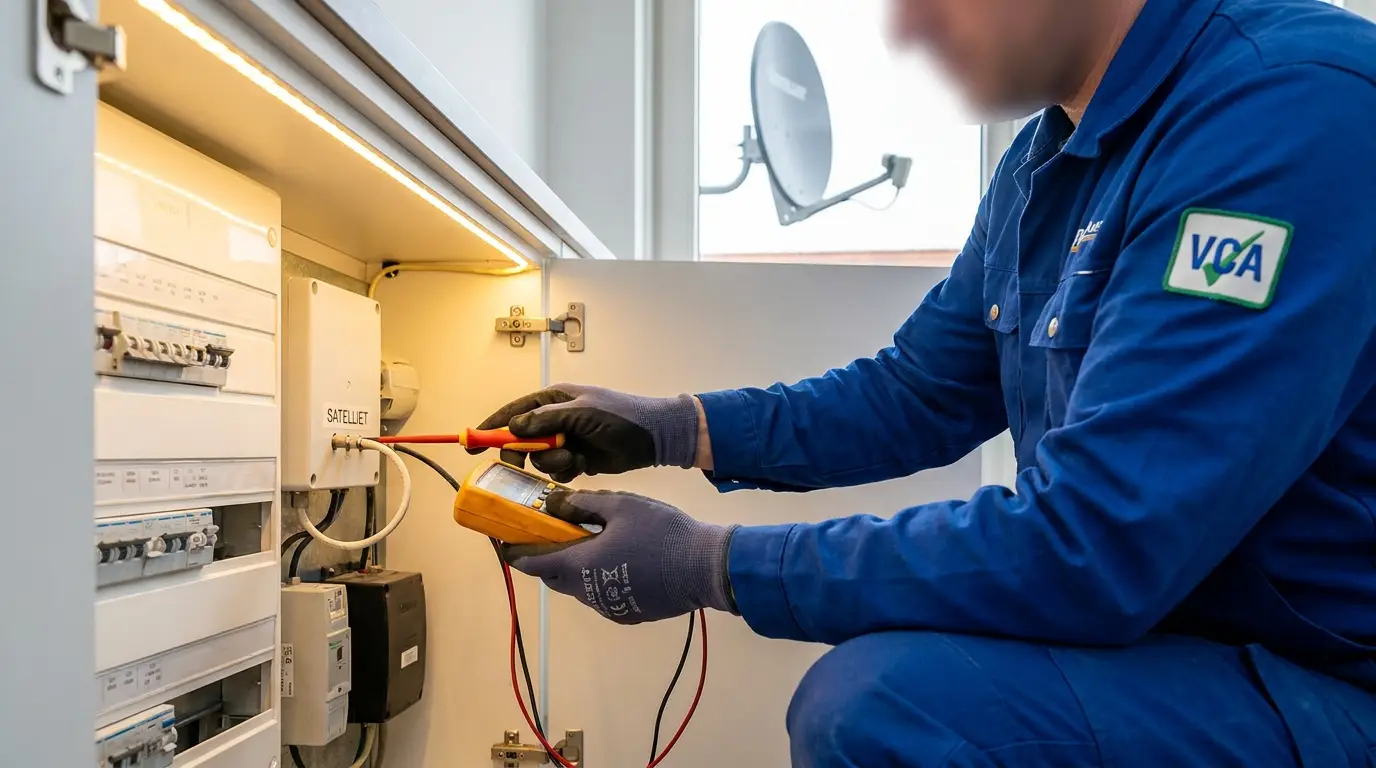
Cost of installing or repairing TV satellite connections: everything you need to know
A satellite connection gives you sharp TV sound and picture without depending on a cable subscription. The cost depends on the number of connection points, the condition of the existing cabling, and how easy it is to reach the dish. A contractor takes care of the right coax cable, LNB connection, and signal quality in one visit.
In this article
- ›What does installing or repairing a satellite connection cost?
- ›Prices by type of job
- ›Material and labor costs
- ›Hire a contractor or do it yourself?
- ›Step by step: how does the installation work?
- ›Money-saving tips for satellite connections
- ›Frequently asked questions
Need a contractor for this?
Describe your job and get quotes from contractors near you.
average price
€275
installation including materials
average hourly rate
€60
contractor hourly rate (€50–75/hour)
turnaround time
1–2 days
depending on scope
€ Average price by type
| Satellite job type | Range | Average price |
|---|---|---|
| Repairing an existing connectionfixing a loose connector, faulty LNB, or cable fault | €75 – €200 | €130avg.incl. labor |
| Installing a single connection (most popular)1 TV point with coax cable, connector, and signal measurement | €120 – €300 | €200avg.incl. installation |
| Multiple connection points (2–4 TVs)splitter, extra coax cables, and setting up all connection points | €250 – €550 | €380avg.incl. installation |
| New satellite installation with dish mountingmounting and aligning the dish, fitting the LNB, and running cabling | €350 – €750 | €520avg.incl. installation |
| Complete multi-room installation with new cablingfull cable route through the home, multiple TV points, signal quality measurement | €500 – €1,100 | €750avg.incl. installation |
Prices are estimates based on Google price research; the final price depends on the number of connection points, the cable length, and the condition of the existing installation. Based on Google price research.
Material and labor costs
Electrician/installer hourly rate averages €55–75/hour. A trip charge is usually billed separately (€25–€55).
Hiring a contractor vs. doing it yourself
| Job | Do it yourself | Via a contractor | Savings doing it yourself |
|---|---|---|---|
| Replacing an F-connector or coax cable endCrimping or screwing on a damaged or loose connector at the end of a coax cable | DoableOnly requires an F-connector, coax stripper, and basic technique: no special equipment | €5–€20 materials | up to €80 |
| Replacing the LNB (dish already correctly aligned)Removing a faulty LNB and fitting an identical model without disturbing the dish position | With experienceThe dish may shift during the swap: realignment is then needed | €20–€80 materials | up to €110 |
| Precisely aligning a satellite dishAiming the dish at the correct azimuth and elevation for maximum signal quality | Not recommendedWithout a professional signal meter (BER/SNR meter), correct alignment is nearly impossible | €100–€250 through a contractor | No recommended savings |
| Running new coax cable through a wall or floorPlanning the cable route, drilling a hole, and installing satellite-grade cable | Not recommendedThe wrong cable quality or poor shielding leads to persistent signal loss | €150–€400 through a contractor | No recommended savings |
| Installing a satellite splitter for a second TVInstalling a signal splitter or DiSEqC switch so multiple TVs share the dish | With experiencePassive splitters weaken the signal: use an active satellite splitter and check the signal level | €15–€50 materials | up to €90 |
For small fixes such as replacing a loose F-connector or an identical LNB, a handy DIYer can do the work themselves, provided the dish is already correctly aligned. As soon as the dish direction is at stake, professional equipment is essential: a satellite installer works with a BER/SNR signal meter that lets them set the azimuth and elevation accurately to within tenths of a degree. That prevents picture interference in less-than-ideal weather and guarantees that all TV points in the home receive the same strong signal. When running new cabling through walls or floors, the choice of cable is also crucial: satellite requires coax cable with low attenuation values (for example, Tri-Shield or Quad-Shield, class A). Regular antenna cable or cheap cable from the hardware store doesn't meet this standard and causes loss precisely at the higher frequencies satellite signals use (950–2150 MHz). A contractor knows the requirements, has the right materials on hand, and delivers the installation with a signal measurement as proof of quality.
The full process step by step
On-site inspection and assessment
The installer assesses the existing situation: the condition and direction of the dish, the LNB type, the cable route, and the condition of the coax cables. The desired number of TV connection points and the most practical cable route through the home are mapped out. Any obstacles in the line of sight (trees, roof edge, neighboring buildings) are assessed for their effect on reception.
15–30 minutes
Selecting materials and planning the cable route
Based on the inspection, the right parts are selected: satellite-grade coax cable (Tri- or Quad-Shield), the matching LNB type (single, twin, quad, or octo depending on the number of receivers), F-connectors, wall plates, and possibly a DiSEqC switch or active splitter. The cable route is planned to stay as hidden as possible via raceways, cable channels, or existing pipe chases.
20–40 minutes
Mounting the dish and connecting the LNB
For a new installation, the satellite dish is attached to the exterior wall, the roof, or a mast with corrosion-resistant brackets. The LNB is mounted on the dish arm, and the coax cable is connected with a weatherproof F-connector. For an existing dish, the LNB is replaced or the mounting is checked for rust and looseness.
30–60 minutes
Running coax cable and installing connection points
The satellite cable is routed from the dish to the desired TV locations in the home: along the exterior wall, through raceways, or (if desired) built into the wall. In each room, a wall plate is fitted with an F-connection or coax wall outlet. All connections are expertly crimped or screwed on for a loss-free connection.
1–3 hours
Precisely aligning the dish with a signal meter
Using a professional BER/SNR signal meter, the dish is precisely aimed at the desired satellite: for most European channels, that's Astra 19.2° East or Hotbird 13° East. The installer adjusts the azimuth, elevation, and skew step by step until signal strength and quality reach optimal values. This is the most critical step and can't be done without a signal meter.
20–45 minutes
Testing all TV points and setting up the receiver
Each connection point in the home is measured for signal level. The contractor connects a receiver or TV and runs a channel scan to check that all desired channels are available. With multiple connection points, the signal quality per point is also recorded.
20–30 minutes
Handover and instructions for use
The contractor explains to the customer how to use the installation: what to do about picture interference in heavy weather (rain fade), how to rescan the receiver after a satellite system update, and when a dish check makes sense. The installation details (satellite, signal levels, LNB type) are handed over or emailed for future maintenance.
10–15 minutes
6 smart money-saving tips
Frequently asked questions
What does installing or repairing a satellite connection cost on average?
On average you'll pay €130 to €380, depending on the type of job. A simple repair (loose connector or faulty LNB) starts at around €75; a complete new installation with multiple TV points can run to €750 or more.
How long does it take to install a satellite connection?
A single connection is done in 1 to 2 hours. For multiple connection points or entirely new cabling through the home, a contractor will plan for half a workday to a full workday.
Do I need a permit for a satellite dish?
In most municipalities, you don't need a permit for a dish smaller than 1 meter that isn't visible from the street. Renters do need permission from their landlord. Always check the local rules or the bestemmingsplan (the municipal zoning plan).
Can I install or repair a satellite connection myself?
Replacing a connector or cable is something you can do yourself. Accurately aiming the dish and measuring signal quality, however, requires a signal meter and technical knowledge. A contractor saves you time and prevents unnecessary signal loss.
What are common causes of poor satellite reception?
The most common causes are a faulty or misaligned dish, a worn LNB, damaged coax cable, loose F-connectors, or trees whose growth blocks the line of sight to the satellite.
What's the difference between a single, twin, and quad LNB?
A single LNB connects 1 receiver. A twin LNB supports 2 receivers at once (handy with a PVR recorder). A quad LNB can feed 4 receivers at once. Your choice partly determines the price of the installation.
Related jobs
Ready to have your satellite connection installed or repaired?
Describe your job and receive quotes from verified antenna and satellite installers near you.
Within 24 hours
response from a contractor
Verified
all contractors checked
Competitive price
compare quotes