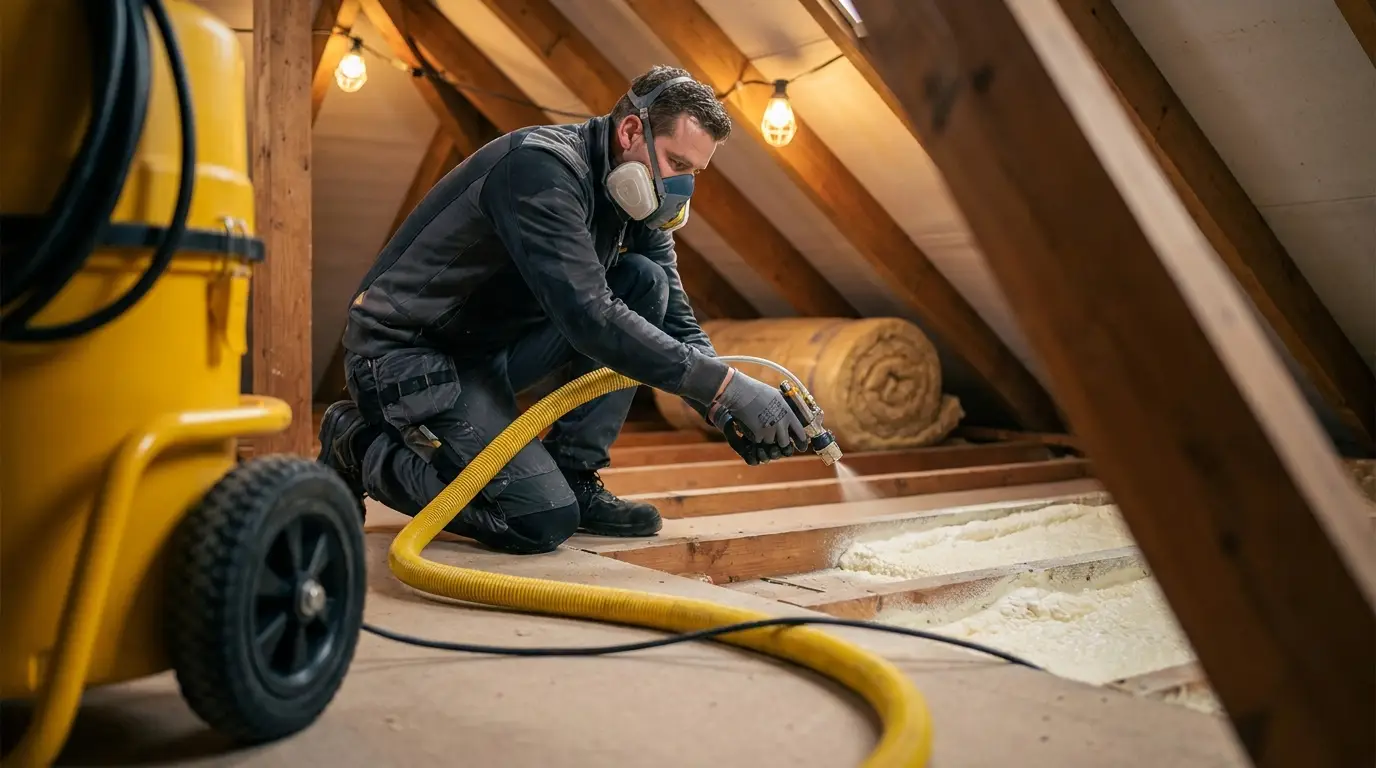
Cost of insulating a floor: everything you need to know
Floor insulation is one of the most effective ways to save energy in a Dutch home. The cost depends heavily on the insulation method (crawl space, cavity floor, or floor from above), the insulation material, and the surface area. In this overview, you'll find current prices per m², what's included, and when you're eligible for a subsidy.
In this article
- ›What does floor insulation cost?
- ›Prices by insulation method
- ›Material and labor costs
- ›Hire a contractor or do it yourself?
- ›Step-by-step process
- ›Subsidy and payback period
- ›Save on your floor insulation
Need a contractor for this?
Describe your job and get quotes from contractors near you.
average price
€2,200
average for 50 m² incl. labor
average hourly rate
€45
contractor hourly rate (€40–55/hour)
turnaround time
1–2 days
depending on surface area and method
€ Average price by type
| Insulation method | Range | Average price |
|---|---|---|
| EPS beads via crawl spaceCheapest method; beads are blown into the crawl space | €800 – €1,800 | €1,300avg.incl. installation |
| PUR spray foam via crawl space (most chosen)Most popular choice; fast application, high R-value, airtight | €1,200 – €2,800 | €2,000avg.incl. installation |
| Insulation boards (PIR/XPS) via crawl spaceMore durable boards; suitable for hard-to-reach crawl spaces | €1,500 – €3,200 | €2,300avg.incl. installation |
| Floor insulation from above (floating floor)No need to break open the floor; insulation under the new finished floor | €2,500 – €5,000 | €3,500avg.incl. installation |
| Ground insulation (sheeting/blanket on crawl space floor)Budget option; keeps out moisture and cold from the ground | €600 – €1,400 | €1,000avg.incl. installation |
Prices include VAT and labor for a floor area of about 50 m²; larger or hard-to-reach crawl spaces can increase the cost. Based on Google price research.
Material and labor costs
Insulation contractor hourly rate averages €40–55/hour. PUR spray foam requires certified equipment and a licensed installer.
Hiring a contractor vs. doing it yourself
| Job | Do it yourself | Via a contractor | Savings doing it yourself |
|---|---|---|---|
| Ground insulation (laying sheeting/blanket)Rolling out insulation sheeting or a blanket on the crawl space floor to keep out cold and moisture from below | DoableAn accessible crawl space (min. 50 cm high) and basic tools are enough; no specialist knowledge required | €10–20/m² material | up to €500 |
| Blowing in EPS beadsBlowing polystyrene beads through openings in the floor or crawl space to fill the cavity | With experienceRequires renting a blowing machine and carefully sealing all openings; poor sealing causes thermal bridges | €15–25/m² material | up to €600 |
| Spraying PUR foamApplying polyurethane foam under pressure to the underside of the floor in the crawl space | Not recommendedRequires professional two-component spray equipment, personal protective equipment (respiratory protection), and a recognized certificate; consumer products don't reach the required R-value | €30–50/m² via contractor | No recommended savings |
| Installing PIR or XPS boardsCutting rigid insulation boards precisely to size and fastening them to the joists or the underside of the floor slab | With experiencePrecision work around pipes and joists; poorly fitted seams cause thermal bridges that greatly reduce the insulating effect | €20–35/m² material | up to €800 |
| Floating floor from aboveApplying insulation on the existing floor and covering it with a new finished floor (screed or dry construction) | Not recommendedThe floor level rises 6–12 cm; doors, baseboards, radiators, and stairs must be adjusted; incorrect buildup leads to creaking or springy floors | €50–90/m² via contractor | No recommended savings |
For the two most popular methods, PUR spray foam and professionally installed PIR boards, a certified insulation contractor is essential. PUR requires two-component spray equipment that you can't rent as a private individual, and the applicator must hold a recognized certificate (BRL 2880, a Dutch quality certification for insulation work, or equivalent). Without this certificate, you can't apply for the ISDE (a Dutch government subsidy for sustainable energy) through RVO (the Netherlands Enterprise Agency). In addition, homes built before 1994 are subject to an asbestos requirement: a certified asbestos company must clear the crawl space before any work begins. If you like to do things yourself, ground insulation (sheeting or a crawl space blanket) and laying loose EPS beads yourself are good options if the crawl space is accessible enough. Keep in mind that the R-value of do-it-yourself solutions is usually lower than that of professionally sprayed PUR, so you'll save less energy and won't be eligible for the full ISDE subsidy.
The full process step by step
Inspecting the crawl space and floor structure
The insulation contractor inspects the crawl space for accessibility, clearance height, moisture level, and the presence of asbestos-containing materials. For homes built before 1994, they explain the asbestos requirement. Based on a measurement of the current R-value and the floor structure (wooden joist floor or concrete slab), they recommend the most suitable insulation method and put it in a quote.
30–60 min
Preparation and protection
Excess debris, dirt, and old insulation remnants are removed from the crawl space. If moisture readings are elevated, the crawl space floor is covered with a vapor-retarding sheet to prevent condensation. Connections around pipes, ducts, and foundation beams are marked in advance so no gaps form later.
30–90 min
Applying the insulation material
Depending on the chosen method, the contractor sprays PUR foam in even layers against the underside of the floor, blows in EPS beads through inlet openings, or mounts PIR or XPS boards to the joists with clips or brackets. They work systematically from back to front so they don't crawl over fresh material and no pressure spots form in the insulation.
3–6 hours (50 m²)
Sealing seams and installing the vapor barrier
All seams, connections around pipes, and edges along the walls are sealed with insulation tape or extra PUR. Where needed, a vapor barrier is installed on the warm side of the insulation to prevent moisture diffusion from the home. This is a critical step: a missing or misplaced vapor barrier is the most common cause of wood rot in floor structures.
30–60 min
Checking crawl space ventilation
After insulating, the contractor checks whether the crawl space ventilation is still sufficient. An insulated crawl space has a different air balance than an uninsulated one; too little ventilation can lead to moisture buildup. If needed, vents are added or adjusted.
15–30 min
Final inspection and installation statement
The contractor checks the insulation layer for holes, gaps, missed spots, and the correct thickness using a temperature measurement or visual inspection. They draw up an installation statement with the achieved R-value, the material used, and the certificate number. This document is required for the ISDE subsidy application with RVO.
15–30 min
6 smart money-saving tips
Frequently asked questions
What does floor insulation cost on average?
On average €2,200 for a floor of about 50 m², including labor and VAT. Range: €800 for ground insulation up to €5,000 for a floating floor installed from above.
How long does it take to insulate a floor?
Usually 1 to 2 workdays for an average home of 50–80 m². PUR spray foam via the crawl space is typically the fastest method and is done in 1 day.
Do I need a permit for floor insulation?
No, insulating a floor in the Netherlands doesn't require a building permit. It's an interior insulation measure that's permit-free.
Can I insulate the floor myself?
Ground insulation (sheeting on the crawl space floor) is something you can do yourself for about €10–20 per m² in material costs. PUR spray foam and PIR boards require specific equipment and expertise; for these, hiring a contractor is recommended.
How much will I save on my energy bill?
Floor insulation can lower your natural gas use by 10–15%, depending on the insulation value before and after. With an average gas use of 1,500 m³ per year, that's a saving of about €150–250 per year.
Which insulation material is best for the floor?
PUR spray foam scores highest on insulation value and airtightness, but it's more expensive than EPS beads. EPS beads are suitable for crawl spaces with irregular surfaces. PIR boards are durable and a good fit if you want a longer service life.
Related jobs
Ready to have your floor professionally insulated?
Describe your job and receive quotes from verified insulation contractors near you.
Within 24 hours
response from a contractor
Verified
all contractors checked
Competitive price
compare quotes