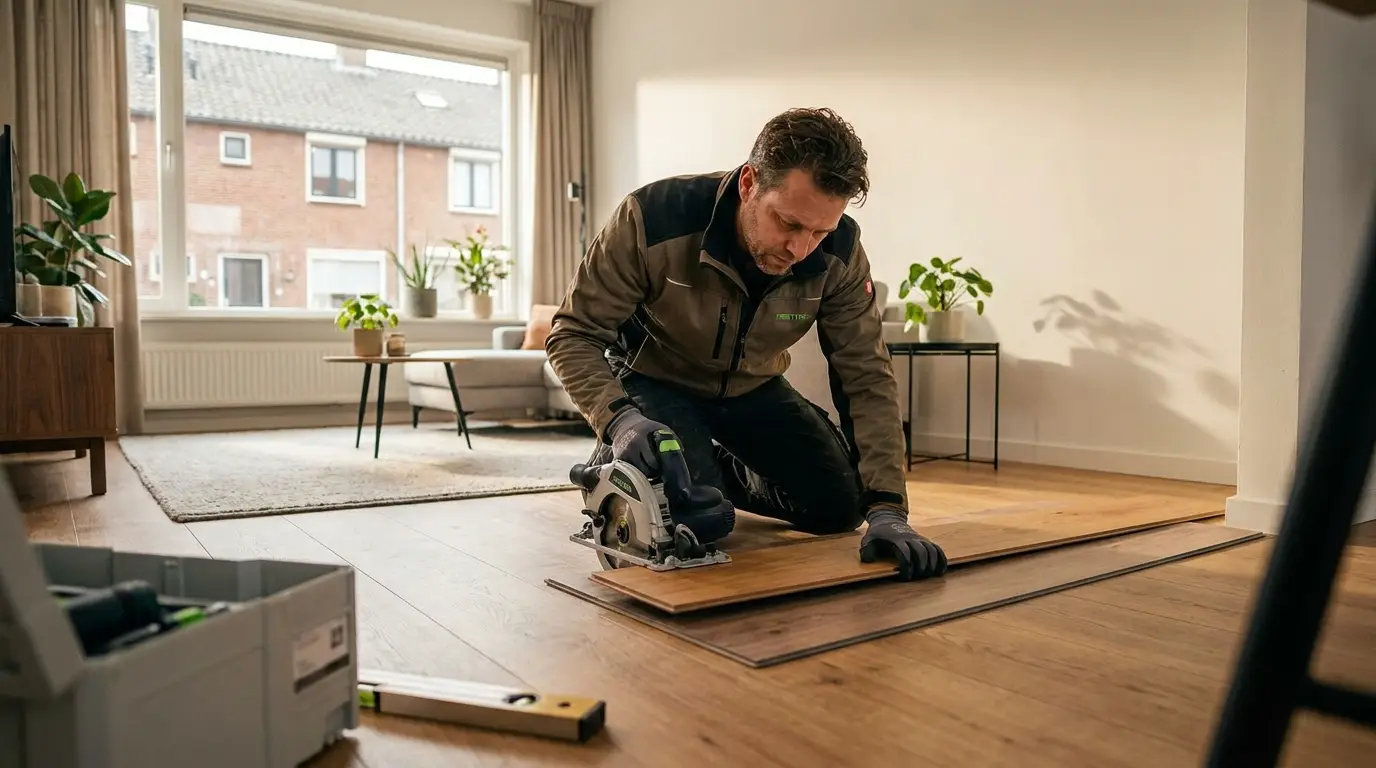
Cost of floor repair: everything you need to know
A damaged floor doesn't have to be replaced right away: scratches, squeaky boards, loose tiles, or a damaged board can often be repaired well by a contractor. The price depends heavily on the type of floor (wood, laminate, tile, or concrete), the nature of the damage, and the scope of the repair work. For a small local repair you'll easily pay €100–€350, while more extensive repair work on a larger floor area can run up to €1,500.
In this article
- ›Average cost of floor repair
- ›Price by type of damage
- ›Material and labor costs
- ›Hire a contractor or do it yourself?
- ›How does a floor repair work?
- ›Money-saving tips for floor repair
- ›Frequently asked questions
Need a contractor for this?
Describe your job and get quotes from contractors near you.
average price
€450
for a local floor repair
average hourly rate
€50
flooring contractor (€40–65/hour)
turnaround time
1–3 days
depending on scope and type of damage
€ Average price by type
| Type of floor repair | Range | Average price |
|---|---|---|
| Scratch or dent repairlocal treatment of scratches, dents, or stains with filler and finishing | €50 – €200 | €120avg.incl. labor |
| Replacing a board or strip (most popular)replacing 1 to 5 boards of wood or laminate flooring, including touch-up | €150 – €600 | €350avg.incl. labor |
| Repairing loose or cracked tilesre-adhering tiles, touching up grout, or replacing cracked tiles | €150 – €700 | €400avg.incl. labor |
| Fixing a squeaky floorfinding the cause of the squeak, securing boards, reinforcing the subfloor | €200 – €600 | €380avg.incl. labor |
| Extensive floor repairrepair work over a larger area, multiple types of damage combined | €600 – €1,500 | €950avg.incl. labor |
Prices include labor for an average repair; large areas or combined damage increase the cost. Based on Google price research.
Material and labor costs
Carpenter/flooring contractor hourly rate averages €40–65/hour. Prices may be higher for hard-to-reach floor sections or custom matching work.
Hiring a contractor vs. doing it yourself
| Job | Do it yourself | Via a contractor | Savings doing it yourself |
|---|---|---|---|
| Touching up scratches with a repair kitmixing filler to color, applying it, and buffing it out on damaged laminate or wood | DoableRepair kits are available for €10–€30; the result depends on how accurate the color match is | €10–€30 | save up to €150 |
| Securing squeaky boardsfinding the cause of the squeak and securing the board with screws, adhesive, or subfloor repair | With experienceThe cause must be identified correctly first: the wrong approach makes the squeaking worse | €20–€60 | save up to €280 |
| Replacing a few laminate boardsremoving damaged click boards, clicking in replacement material, and finishing the floor | With experienceSame batch or color-fast match needed; the click system takes practice and precise alignment | €40–€150 | save up to €300 |
| Repairing loose or cracked tilesbreaking out tiles, leveling the base, re-adhering, and touching up grout | Not recommendedThe wrong tile adhesive or grout quickly leads to tiles coming loose again; color differences when replacing are clearly visible | €150–€700 | No recommended savings |
| Spot sanding and refinishing parquetsanding the damaged area by hand or machine, applying a coat of varnish, and finishing to color | Not recommendedA floor sander is too aggressive for beginners; visible sanding marks or color differences are almost unavoidable | €300–€900 | No recommended savings |
For light surface damage (small scratches in laminate or a squeaky board you can reach through the crawl space), doing it yourself is a realistic option, as long as you can reorder the exact flooring batch and have the right tools. Once the damage goes deeper (loose tiles, moisture damage in the subfloor, or parquet that needs color matching and varnishing), a flooring contractor is essential. Poorly done tile repairs come loose again, and incorrectly color-matched parquet always stands out. There are no legal certification requirements for floor repair, but the combination of color accuracy, choice of adhesive, and flatness tolerance makes this skilled work that's best left to a contractor for more complex damage.
The full process step by step
Damage inspection and cause analysis
The flooring contractor thoroughly examines the damaged area: they tap tiles to detect hollow spots, check whether boards are loose due to subfloor problems or moisture, and determine whether a local repair is enough or a larger section needs replacing.
30–60 min
Arranging materials and color match
For wood and laminate floors, the existing batch is matched as closely as possible: color, texture, and size are decisive. For parquet, a repair filler is mixed to color on site. Tiles are reordered from the manufacturer where possible or found among the owner's leftover stock.
1–2 days (material delivery)
Clearing the work area and preparing the base
Furniture is moved aside, the area to be repaired is marked off with masking tape, and the base is cleaned. For tile work, old adhesive and grout are fully removed so the new adhesive bonds to a dust-free, flat base.
30–90 min
Carrying out the repair
Depending on the floor type, boards are replaced or secured, tiles are set with the right flexible tile adhesive, small scratches are filled with filler, or parquet is spot sanded. The contractor works from the wall toward the center to avoid stepping on freshly repaired sections.
1–4 hours
Finishing: color matching, varnishing, or grouting
After the repair, the floor is finished: varnish or oil on wood boards, grout on tiles, or polishing on laminate. The product used determines the drying time: from a few hours for quick-drying grout to 24 hours for multiple coats of varnish on parquet.
2–24 hours (incl. drying time)
Inspection, handover, and aftercare
The contractor and customer go over the repaired floor together, checking for color differences, unevenness, or loose parts. Any issues are touched up right away. The contractor tells you when the floor can bear full use again and what maintenance extends the life of the repair.
15–30 min
6 smart money-saving tips
Frequently asked questions
What does floor repair cost on average?
On average €100–€1,500 depending on the type of floor and the severity of the damage. A scratch repair costs €50–€200, replacing boards €150–€600, and extensive repair work €600–€1,500.
How long does a floor repair take?
Small repairs are done in 1 to 4 hours. Replacing boards or tiles takes 1 workday on average. More extensive repair work, including drying time, can take 2 to 3 days.
Do I need a permit for floor repair?
No, you don't need a permit to repair an existing floor. It's a standard maintenance job on your own home.
Can I repair a floor myself?
You can treat small scratches yourself with a repair kit (€10–€30). Replacing boards or tiles requires some experience; misalignment or color differences are clearly visible afterward. A contractor delivers a better end result for more complex damage.
When is replacing better than repairing?
If more than 30–40% of the floor is affected, the subfloor is damp or rotten, or the material is no longer available in the same color, full replacement is often cheaper in the long run.
What causes a squeaky floor and what does it cost to fix?
Squeaking is caused by dry or loose wood, an uneven subfloor, or insufficient expansion space. A contractor identifies the cause and fixes it for €200–€600 on average.
Related jobs
Ready to have your floor repaired professionally?
Describe your job and receive quotes from verified flooring contractors near you.
Within 24 hours
response from a contractor
Verified
all contractors checked
Competitive price
compare quotes