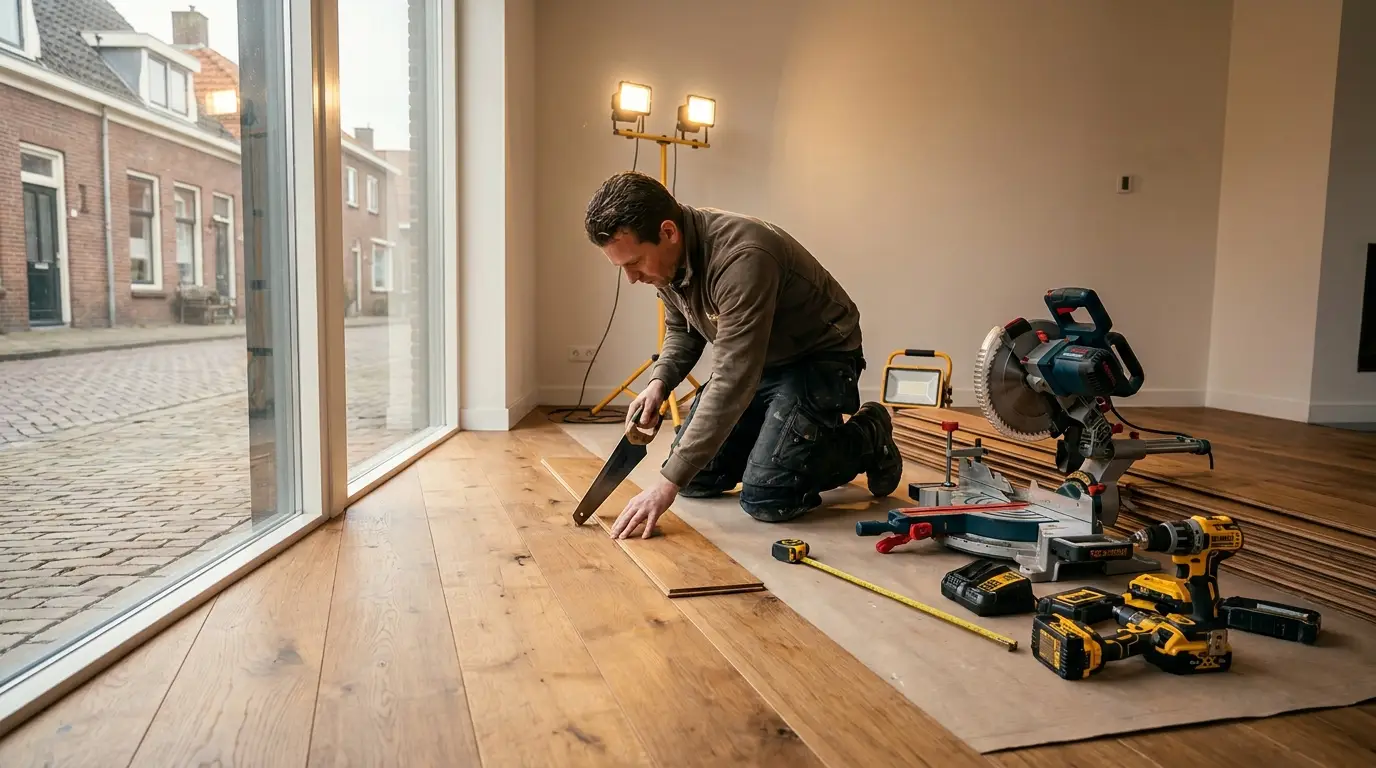
Cost of removing a floor: everything you need to know
Removing a floor seems simple, but the type of floor, how it's fastened, and the disposal of debris have a big impact on the price. Tile floors take the most work, while floating laminate comes up quickly. On average, you pay €8 to €30 per m², including labor costs. Read everything here about the cost per floor type, what contractors charge, and when you can save.
In this article
- ›How much does it cost to remove a floor?
- ›Cost by floor type
- ›Material and labor costs
- ›Hiring a contractor vs. doing it yourself
- ›How does the process work?
- ›Money-saving tips for floor removal
- ›Frequently asked questions
Need a contractor for this?
Describe your job and get quotes from contractors near you.
average price
€850
average for one room (~40 m²)
average hourly rate
€45
contractor hourly rate (€35–65/hour)
turnaround time
0.5–2 days
depending on floor type and scope
€ Average price by type
| Floor type | Range | Average price |
|---|---|---|
| Floating laminate or click PVCQuick to remove, no glue or screws | €280 – €520 | €380avg.incl. labor |
| Carpet or floor coveringIncluding removal of underlayment and tack strips | €200 – €480 | €320avg.incl. labor |
| Laminate or parquet (glued down)Most common in Dutch homes | €450 – €900 | €650avg.incl. labor |
| Ceramic tile floorLabor-intensive, debris disposal included | €700 – €1,400 | €1,000avg.incl. labor |
| Poured floor or concrete floorBreaking work required, higher labor costs | €1,200 – €2,500 | €1,700avg.incl. labor |
| Floor removal for the whole houseIncluding all rooms, hallway, and living room | €1,800 – €4,500 | €2,800avg.incl. labor |
Prices are estimates for a room of about 40 m², including labor costs and disposal. Glued-down floors and tiles cost more due to extra tools and demolition time. Based on Google price research.
Material and labor costs
Carpenter/floor installer hourly rate averages €35–€65/hour. For larger areas, contractors usually charge a fixed price per m².
Hiring a contractor vs. doing it yourself
| Job | Do it yourself | Via a contractor | Savings doing it yourself |
|---|---|---|---|
| Removing floating laminate or click PVCDetaching click-lock planks without glue or screws | DoableA pry bar and hammer are enough; no expertise needed | €0–€50 | up to €440 saved |
| Removing carpet and floor coveringPulling up carpet, removing underlayment and tack strips | DoablePhysical work with no risk of damaging the subfloor | €0–€60 | up to €430 saved |
| Removing glued-down parquet or laminatePulling up the glue layer with a scraper or oscillating tool | With experienceReal risk of damaging the screed; repair costs €15–€25/m² | €50–€150 (tool rental) | up to €750 saved |
| Removing a ceramic tile floorBreaking tiles, hauling debris, and milling adhesive residue | Not recommendedHeavy breaking work; risk of cracks in the screed and injury from tile shards | €150–€400 (pry bar/angle grinder rental) | Not recommended |
| Removing a poured or concrete floorRemoving the poured layer with professional demolition equipment | Not recommendedRequires industrial demolition hammers; mistakes damage the structural floor | €300–€600 (equipment) | No recommended savings |
Most DIYers can easily remove floating laminate, click PVC, and carpet themselves: all you need is a pry bar, a hammer, and some time. Once glue is involved, things change: breaking up glued-down parquet or a tile floor without damaging the screed takes experience with demolition tools. Cracks or dips in the subfloor cost an average of €15–€25 per m² extra to level and quickly wipe out your savings. For poured and concrete floors, professional equipment is essential: a demolition contractor has industrial demolition hammers, dust extraction, and the know-how to keep the structural floor intact. If in doubt, always ask a contractor for a no-obligation inspection: most floor installers will give you honest advice on site about what you can do yourself.
The full process step by step
On-site inspection and quote
The contractor assesses on site what type of floor is there, how it's fastened (floating, glued, or screwed), and the condition of the underlying screed. Based on that, they draw up a fixed price per m² or an hourly estimate. Request at least three quotes to compare prices properly.
30–60 min (visit) + 1–2 days (quote)
Clearing and covering the room
Furniture and loose items are moved. Doors, frames, baseboards, and adjacent flooring are covered with drop cloths and protective film to prevent dust and damage. Ventilation is ensured during dusty work such as milling.
30–60 min
Removing the floor
The approach depends on the floor type: floating laminate or click PVC is pried up plank by plank, tiles are broken with a demolition hammer or electric chipping hammer, and glued-down parquet is pulled up with a scraper or vibrating demolition hammer. For larger areas, contractors often work in pairs.
2–8 hours (depending on type and area)
Removing adhesive residue and inspecting the screed
After demolition, leftover adhesive is milled or ground down to a flat surface. The contractor inspects the screed for cracks, dips, and height differences. Necessary repairs are done right away or quoted separately.
1–3 hours
Hauling debris and waste processing
The demolition material is sorted (ceramic, wood, plastic) and hauled away in a dumpster or construction waste bins. Ceramic tiles and concrete are heavy: expect a full 4 m³ dumpster per 40 m² room.
1–2 hours
Final inspection and handover
The room is vacuumed and handed over flat. The contractor points out any unevenness or damp spots in the subfloor that need to be repaired before the new floor goes in, and records this in writing in the handover report.
30 min
6 smart money-saving tips
Frequently asked questions
How much does it cost to remove a floor on average?
On average €8–€30 per m², depending on the floor type. For a 40 m² room, expect €320–€1,200 including labor. Floating laminate is the cheapest; a glued-down tile floor the most expensive.
How long does it take to remove a floor?
40 m² of floating laminate is done in half a day. Glued-down parquet takes 1 day. A tile floor takes 1.5–2 full workdays per room.
Do I need a permit to remove my floor?
No, regular floor removal doesn't require a permit. In an apartment with a VvE (the homeowners association of an apartment building), the deed of division can set restrictions on noise or on how the new floor is fastened.
Can I remove a floor myself?
You can remove floating laminate, click PVC, and carpet yourself. Glued-down parquet, tiles, or poured floors require professional tools. Damage to the screed can easily cost an extra €15–€25 per m² to repair.
How much does it cost to haul away the removed floor?
Disposal costs €100–€250 on average for one room. Renting a 4 m³ dumpster is about €150. Removing adhesive residue after tiles adds €225–€475 on top of the standard demolition price.
Does the contractor also remove adhesive residue?
Not always by default. Ask in advance for it to be explicitly included in the quote. Sanding or milling off adhesive residue costs an extra €5–€10 per m² on average and is needed for the new floor to bond properly.
Related jobs
Ready to have your floor removed?
Describe your job and receive quotes from verified floor installers near you.
Within 24 hours
response from a contractor
Verified
all contractors checked
Competitive price
compare quotes