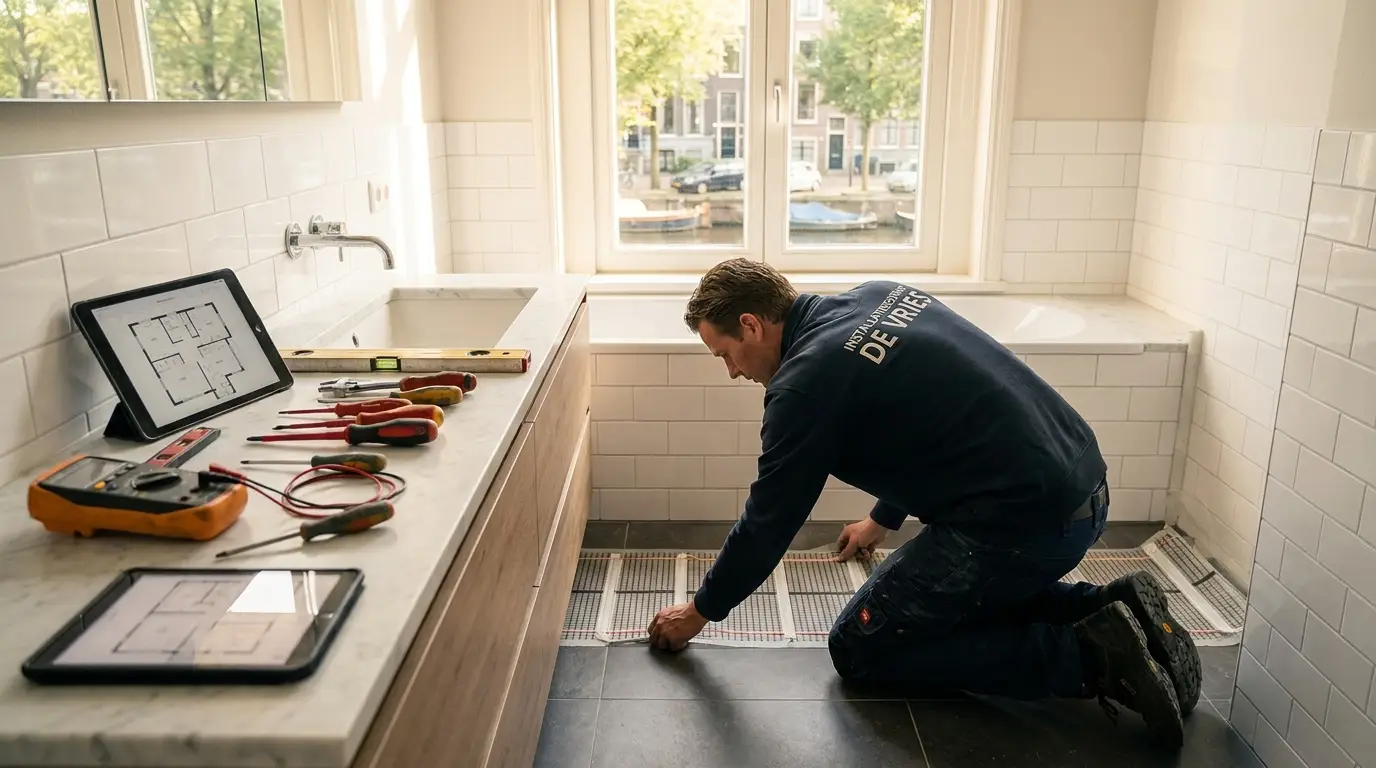
Cost of electric radiant floor heating in the bathroom: everything you need to know
Electric radiant floor heating in the bathroom feels warm and comfortable underfoot and is ideal as a supplement to your existing heating. The total cost depends on the floor area, the type of heating system, and the tile floor that goes on top. In this overview, you'll find current prices per m², installation costs, and handy tips to save money.
In this article
- ›How much does electric radiant floor heating in the bathroom cost?
- ›Prices by type of system
- ›Material and labor costs
- ›Hire a contractor or do it yourself?
- ›How does the installation work?
- ›Money-saving tips
- ›Frequently asked questions
Need a contractor for this?
Describe your job and get quotes from contractors near you.
average price
€900
including mat and installation (approx. 8 m²)
average hourly rate
€55
contractor hourly rate (€45–65/hour)
turnaround time
1–2 days
depending on floor area and floor work
€ Average price by type
| Heating system type | Range | Average price |
|---|---|---|
| Loose heating cable systemFlexible cable in self-leveling compound, suitable for irregular rooms | €500 – €900 | €700avg.incl. installation |
| Heating mat (most popular)Cable on fiberglass mesh, quick to lay under tile, ideal for standard bathrooms | €650 – €1,200 | €900avg.incl. installation |
| Infrared heating filmThin film under laminate or click vinyl, no tile adhesive needed | €500 – €950 | €725avg.incl. installation |
| Electric mat with smart thermostatHeating mat including Wi-Fi thermostat and app control | €800 – €1,500 | €1,150avg.incl. installation |
| Extended system for a large bathroom (12+ m²)Multiple mats or cable for a large bathroom, including installation | €1,200 – €2,200 | €1,700avg.incl. installation |
Prices apply to a bathroom of approx. 8 m² including installation; larger rooms or extra tiling increase the cost. Based on Google price research.
Material and labor costs
Electrician hourly rate averages €45–€65/hour. The connection in the meter cabinet falls under NEN 1010 and must be done by a licensed electrician.
Hiring a contractor vs. doing it yourself
| Job | Do it yourself | Via a contractor | Savings doing it yourself |
|---|---|---|---|
| Unrolling and positioning the heating matLaying the mat in a serpentine pattern on the bathroom floor before tiling | DoableFollow the manufacturer's instructions, use clips or tape to secure the mat (don't walk on or cut the cable) | €80–€150 savings | up to €150 |
| Resistance test with a multimeterChecking the cable's resistance value before and after laying | With experienceUsing a multimeter is doable, but interpreting the readings and matching them to the specifications requires basic electrical knowledge | €40–€80 savings | up to €80 |
| Mounting and wiring the thermostatInstalling and setting a wall thermostat with sensor probe in the bathroom | Not recommendedStrict moisture zones (zone 1/2) apply in a bathroom; 230V wiring and IP44 requirements make a licensed electrician mandatory for this work | €80–€150 | No recommended savings |
| Connection to the breaker panel (dedicated RCD circuit)Installing a separate protected circuit for the floor heating per NEN 1010 | Not recommendedLegally required to be done by a licensed electrician; an incorrect connection in a wet room creates an immediate risk of electrocution and voids the warranty | €150–€250 | No legal savings possible |
| Tiling over the heating matSetting and grouting floor tiles over the system with flexible tile adhesive | With experienceTiling over a heating mat requires flexible adhesive and care; a damaged cable after tiling costs hundreds of euros extra | €150–€400 savings | up to €400 |
Laying the heating mat or cable on the bathroom floor is the only step a DIYer with some patience can do themselves, provided the cable isn't damaged and the mat stays properly taut. Everything involving electrical work in a bathroom, however, is bound by strict NEN 1010 requirements and moisture zone rules (IP44 or higher). The connection to the breaker panel, the RCD (residual current device, the European counterpart of a GFCI) protection, and the thermostat in damp zones may only be done by a certified electrician. If you do this yourself, you lose not only the warranty on the system but also your home insurance coverage in case of water damage or fire. A licensed electrician also measures the cable's resistance before and after laying: a measurement that provides immediate proof in case of a defect and is essential for the warranty documentation. For small bathrooms (up to 8 m²), you'll usually pay for 3–4 hours of installation work; that's the item where you can cut back the least without introducing risks.
The full process step by step
Measuring and system advice
The electrician measures the open floor area in the bathroom, excluding the fixed layout of the shower, bathtub, toilet, and vanity. Based on the measurement, they advise on wattage per m² (usually 100–150 W/m² as supplemental heating), the type of system (mat, loose cable, or film), and the most suitable thermostat.
30–60 min
Preparing the bathroom floor
The existing subfloor is thoroughly cleaned and inspected for differences in height. Unevenness is smoothed out with self-leveling compound so the heating cable lies flat without air pockets. An uneven subfloor leads to cold spots and can damage the cable over time.
1–3 hours
Laying the heating mat or cable
The mat or loose cable is secured to the floor in a serpentine pattern with the included clips or double-sided fixing tape, with a spacing of approx. 8–10 cm. At least 5 cm of clearance is kept along the walls. The thermostat's sensor probe is run through a separate conduit between the loops so it can be replaced later.
1–2 hours
Resistance test before tiling
Before even one tile is laid, the electrician measures the heating cable's resistance with a multimeter. The measured value must match the manufacturer's specification on the identification label. A deviation indicates damage in the cable: at this point, repair is still inexpensive.
15–30 min
Thermostat and meter cabinet connection
The wall thermostat is mounted at approx. 1.5 m height outside damp zones, or with the required IP44 protection inside the bathroom. The electrician installs a dedicated RCD-protected circuit (30 mA) in the breaker panel per NEN 1010 and connects it to the thermostat wiring.
1–2 hours
Laying tile or finished flooring
The floor tiles are set over the mat with flexible tile adhesive (at least class S1). Rigid adhesive can damage the cable as it expands. After setting, the adhesive needs at least 24 hours to cure before the system may be switched on for the first time. Grouting follows after that.
4–8 hours
Final test, adjustment, and handover
Once fully cured, the floor heating is started up slowly: the first days at a low temperature setting to prevent thermal shock in the tile adhesive. The electrician sets the schedule on the thermostat, checks that everything works, and hands over the warranty documentation including the resistance readings.
30–60 min
6 smart money-saving tips
Frequently asked questions
How much does electric radiant floor heating in the bathroom cost on average?
On average €900 for a bathroom of approx. 8 m², including heating mat and installation. The range is €500–€2,200 depending on floor area, choice of system, and thermostat.
How long does installation take?
Laying the heating mat or cable takes 2–4 hours. Including the connection in the meter cabinet (where the electricity meter and the breaker panel are) and any tiling, plan on 1 to 2 workdays in total.
What are the annual energy costs of electric radiant floor heating in the bathroom?
With average use of 1 hour per day and a typical electricity price, you'll pay about €60–€100 per year for a bathroom of 6–10 m². That's considerably less than continuous use.
Do I need a permit?
No, you don't need a building permit. The electrical connection must, however, be done by a licensed electrician in accordance with NEN 1010 (the Dutch standard for electrical installations) and the moisture zone requirements for bathrooms.
Can I lay electric radiant floor heating myself?
Laying the mat is DIY-friendly. The connection to the breaker panel must always be done by a certified electrician. In a bathroom, extra safety requirements apply to electrical installations (IP44 or higher).
Which flooring is suitable for electric radiant floor heating?
Tile and natural stone conduct heat best and are the most common combination. Special infrared film is suitable under click vinyl or laminate. Thick wood floors are less suitable because of their low heat transfer.
Related jobs
Ready to have electric radiant floor heating installed in your bathroom?
Describe your job and receive quotes from verified electricians near you.
Within 24 hours
response from a contractor
Verified
all contractors checked
Competitive price
compare quotes