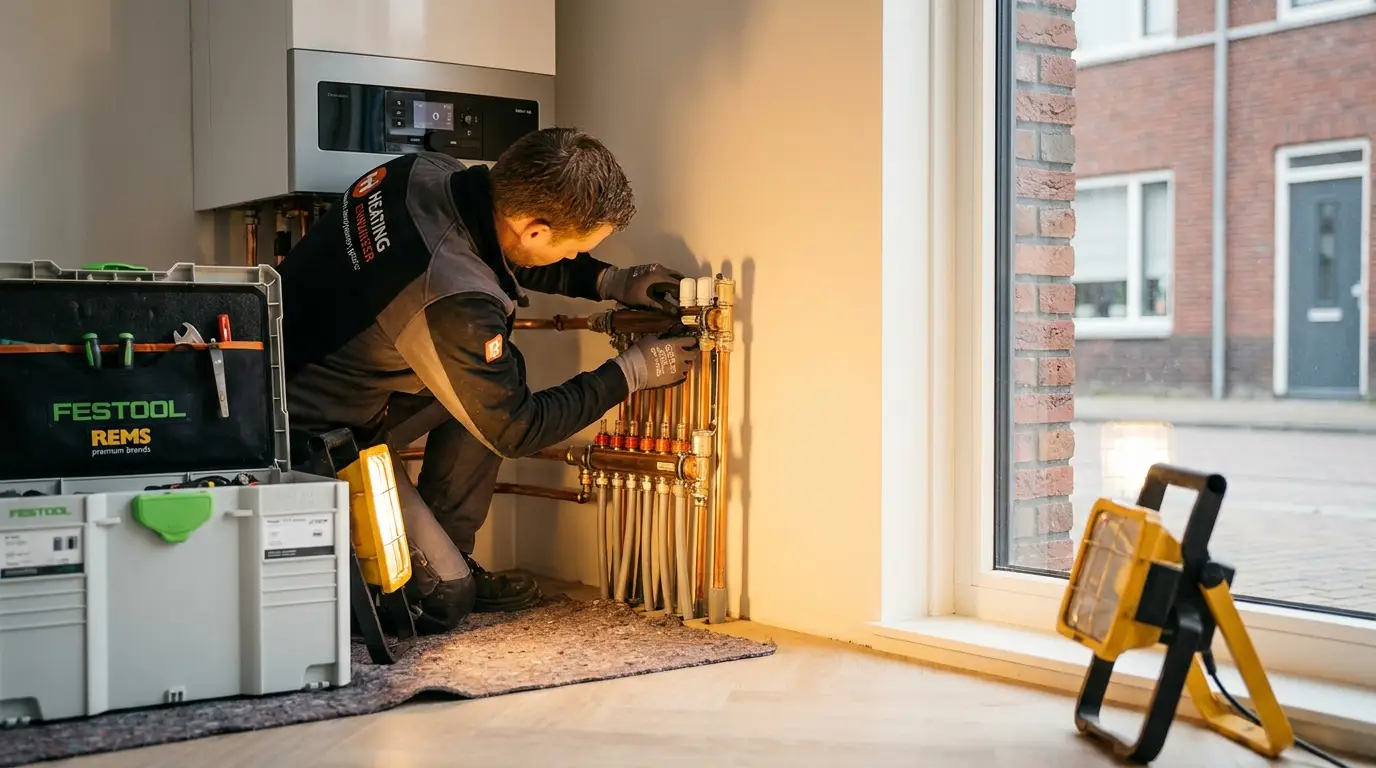
Cost of installing or replacing radiant floor heating: everything you need to know
Radiant floor heating distributes heat evenly and is more energy efficient than traditional radiators. The cost depends heavily on the type of system (hydronic or electric), the floor area, and whether you need to break open existing floors. In this overview, you'll find current prices, averages by type, and handy money-saving tips.
In this article
- ›Average cost of radiant floor heating
- ›Cost by type of system
- ›Material and labor costs
- ›Hire an HVAC technician or do it yourself?
- ›Step-by-step installation process
- ›Money-saving tips for radiant floor heating
- ›Frequently asked questions
Need a contractor for this?
Describe your job and get quotes from contractors near you.
average price
€3,200
including materials and installation per room
average hourly rate
€58
contractor hourly rate (€50–65/hour)
turnaround time
1–4 days
depending on type and floor area
€ Average price by type
| Type of radiant floor heating | Range | Average price |
|---|---|---|
| Electric radiant floor heating (mat or film)Ideal for a bathroom or small room, quick installation | €800 – €2,000 | €1,300avg.incl. installation |
| Hydronic radiant floor heating, new construction (most popular)Embedded in screed, can be combined with a heat pump | €2,000 – €4,500 | €3,000avg.incl. installation |
| Hydronic radiant floor heating, existing homeRetrofit system on existing floor, raises floor approx. 2 cm | €2,500 – €6,000 | €4,000avg.incl. installation |
| Replacing radiant floor heating (pump or pipes)Partial replacement of faulty parts | €400 – €1,500 | €850avg.incl. installation |
| Radiant floor heating for the whole home (hydronic)Complete system 80–120 m², including manifold and boiler connection | €5,000 – €10,000 | €7,000avg.incl. installation |
Prices include materials and standard installation; extra costs for breaking open floors or replacing the boiler are not included. Based on Google price research.
Material and labor costs
HVAC technician hourly rate averages €50–65/hour. Hydronic radiant floor heating often also requires a plumber or boiler technician for the boiler connection.
Hiring a contractor vs. doing it yourself
| Job | Do it yourself | Via a contractor | Savings doing it yourself |
|---|---|---|---|
| Rolling out and securing an electric heating matLay out mats according to the pattern and fix them to insulation film with double-sided tape or clips | With experienceTechnically feasible, but kinks or overlaps in the mat cause short circuits: precise work is essential | €150–€400 | up to €400 |
| Electrical connection and thermostat wiringConnect the heating cable to the breaker panel and wire the thermostat | Not recommendedLegally required to be done by a certified electrician (NEN 1010); a faulty connection creates a fire hazard and voids the warranty | €150–€300 | No recommended savings |
| Laying PE pipes for hydronic radiant floor heating (new construction)Fix tubing in a serpentine pattern on insulation boards with clip rails or clips | With experienceFeasible for a technically minded DIYer, but incorrect spacing or overly tight bends greatly reduce heat output | €300–€700 | up to €700 |
| Connecting the manifold to the boiler or heat pumpConnect the manifold's supply and return lines to the existing heating system | Not recommendedRequires a licensed HVAC technician; an incorrect connection causes leaks and pressure problems, and voids the warranty on the boiler or heat pump | €200–€600 | No recommended savings |
| Monitoring the screed curing by heatingRaise the temperature daily according to the heating protocol and monitor the system for 4–6 weeks | FeasibleEasy to do yourself if the HVAC technician gives you the curing protocol in writing: no expertise required | €0 | up to €150 |
With radiant floor heating, there's a clear line between what you're allowed to do yourself and what must legally be done by a contractor. The connection to the central heating system or heat pump is reserved for a licensed HVAC technician or plumber: this is required for the warranty on the installation and the boiler. Electrical connections above 3.6 kW must be handled by a certified electrician in accordance with NEN 1010 (the Dutch standard for electrical installations); a faulty connection can lead to fire or a failed result in any home inspection. You can lay the pipes or mats yourself to a limited extent, provided you strictly follow the prescribed spacing (usually 10–15 cm), minimum bend radii, and insulation requirements. Mistakes at this stage are virtually impossible to fix after the screed is poured without completely breaking open the floor. As the occupant, you can monitor and carry out the curing by heating after installation yourself: always ask the HVAC technician for a written protocol.
The full process step by step
Inspection, system choice, and quote
The HVAC technician assesses the floor structure, usable floor area, insulation value of the subfloor, and the capacity of the existing central heating system or heat pump on site. Based on this, they recommend the most suitable system, hydronic or electric, and prepare a detailed quote with a breakdown of material and labor costs.
1–2 hours
Floor preparation and installing the insulation layer
The existing floor is checked for flatness, load-bearing capacity, and moisture content. Uneven spots are leveled. Then insulation boards or insulation film are installed to minimize heat loss downward (basement, crawl space) and let the system work efficiently.
Half a day to a full day
Installing pipes or heating mat
For hydronic radiant floor heating, PE pipes are fixed in a serpentine pattern on clip rails or insulation boards with a fixed spacing of 10–15 cm. For electric systems, heating mats or film are rolled out tightly without overlaps. The manifold or thermostat connection point is mounted in its final position.
1–2 days
Connection to the central heating system or breaker panel
The pipes are connected through the manifold to the boiler or heat pump and integrated into the heating circuit. The HVAC technician sets the flow regulators for each loop to the correct flow rate. For electric systems, a certified electrician connects the system to the breaker panel and installs the wireless or wired thermostat.
2–4 hours
Pressure test, pouring screed, or laying the finished floor
The hydronic radiant floor heating system is tested for leaks under increased pressure: the pipes stay pressurized while the screed is poured. In new construction, the screed is then poured over the pipes. With retrofit systems, a finished floor (tile, parquet, or laminate) can be installed right away.
1–2 hours for the pressure test; screed dries 4–6 weeks
Commissioning, balancing, and user instructions
Once the screed has cured, the HVAC technician gradually heats up the system following the curing protocol to prevent cracks. They balance the loops for even heat distribution in each room and explain to the occupants how to set the thermostat, weekly schedule, and nighttime setbacks.
1–2 hours; curing by heating 4–6 weeks
6 smart money-saving tips
Frequently asked questions
How much does it cost to install radiant floor heating on average?
On average €3,200 for a typical system per room or zone. Range: €800 (small electric mat) to €10,000 (complete hydronic radiant floor heating system for a whole home). The price per m² is between €35 and €75, excluding installation.
How long does it take to install radiant floor heating?
Electric mat in a bathroom: 1 day. Hydronic radiant floor heating in an existing home: 2–4 days, including the boiler connection and the curing of the screed by heating (which then takes several more weeks).
Do I need a permit?
No, radiant floor heating doesn't require a building permit. However, the boiler connection must be done by a licensed HVAC technician, and electrical connections above 3.6 kW by a certified electrician.
Can I install radiant floor heating myself?
You can lay the heating mats yourself to a limited extent, but the electrical or boiler connection must always be done by a contractor. Installation mistakes can lead to water damage or fire hazards.
Can radiant floor heating be combined with a heat pump?
Yes, hydronic radiant floor heating and heat pumps are an ideal combination. Heat pumps work most efficiently at low supply temperatures (30–40°C), which is exactly the operating range of radiant floor heating.
What are the annual maintenance costs?
Hydronic radiant floor heating needs little maintenance; bleeding the system and checking the manifold costs around €75–€150 per year as part of boiler maintenance. Electric systems are virtually maintenance-free.
Related jobs
Ready to have your radiant floor heating installed or replaced?
Describe your job and receive quotes from verified HVAC technicians near you.
Within 24 hours
response from a contractor
Verified
all contractors checked
Competitive price
compare quotes