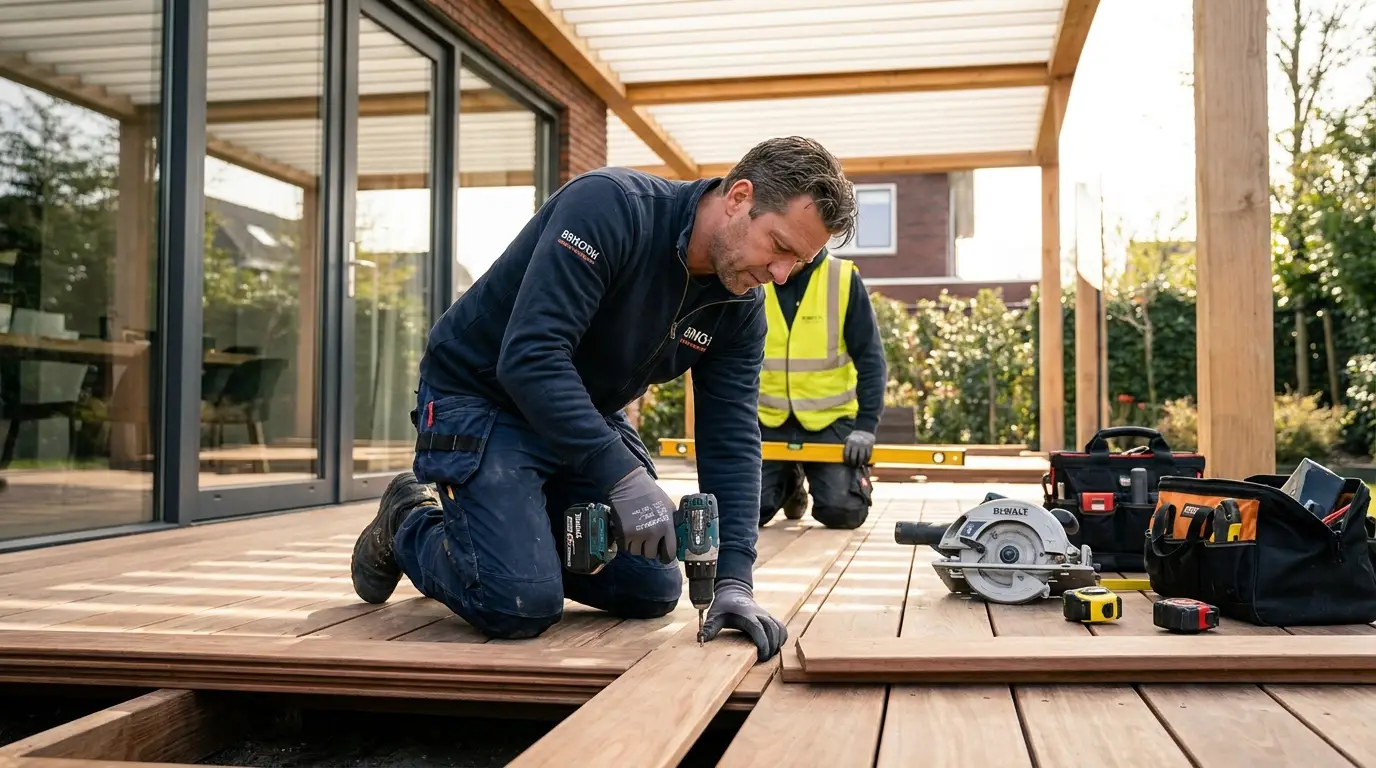
Cost of installing or replacing a deck: everything you need to know
A deck gives your yard, balcony, or patio a clean look and stays low-maintenance for years. The cost depends heavily on the material you choose (softwood, hardwood, or composite), the surface area, and the groundwork needed. In this overview, you'll find current prices per m², labor costs, and handy money-saving tips.
In this article
- ›Average cost of installing a deck
- ›Prices by material type
- ›Material and labor cost breakdown
- ›Hiring a contractor vs. installing it yourself
- ›Step-by-step work process
- ›Money-saving tips for your deck
- ›Frequently asked questions
Need a contractor for this?
Describe your job and get quotes from contractors near you.
average price
€2,200
complete, including material and labor
average hourly rate
€55
landscaper hourly rate (€35–75/hour)
turnaround time
1–3 days
depending on surface area and material
€ Average price by type
| Deck type | Range | Average price |
|---|---|---|
| Softwood / Douglas firaffordable entry-level choice, yearly oiling recommended | €600 – €1,400 | €900avg.incl. installation |
| Bangkirai hardwood (most popular)durable, stable, warm look (for 20 m²) | €1,500 – €3,200 | €2,200avg.incl. installation |
| Composite deckvirtually maintenance-free, slip-resistant, and colorfast | €2,200 – €4,500 | €3,200avg.incl. installation |
| Deck replacement (removing the existing one)including dismantling and hauling away old wood | €1,800 – €4,000 | €2,800avg.incl. installation |
| Roof garden or balcony decklightweight materials required, including drainage | €2,500 – €6,000 | €3,800avg.incl. installation |
Prices are estimates for a standard deck of about 20 m²; different sizes, sloped ground, or extra groundwork can affect the final price. Based on Google price research.
Material and labor costs
Landscaper hourly rate averages €35–€75/hour. Hardwood decks require heavier saws; composite often involves hidden clip systems that take more installation time.
Hiring a contractor vs. doing it yourself
| Job | Do it yourself | Via a contractor | Savings doing it yourself |
|---|---|---|---|
| Softwood deck on level groundDouglas fir or spruce boards on a simple wood substructure, small to medium area | DoableQuite doable with basic tools and a weekend of DIY experience; plenty of tutorials available | €600–€1,400 | up to €700 |
| Installing a Bangkirai hardwood deckHeavy tropical wood; requires a precise substructure and custom cutting | With experienceRequires a table saw or plunge saw, knowledge of load-bearing structures, and experience drilling into hardwood | €1,500–€3,200 | up to €1,200 |
| Composite deck with hidden clip systemWood-plastic composite boards with manufacturer-specific clips and cutting requirements | With experienceManufacturer instructions are strict: the wrong clips or gap size cause buckling in the heat | €2,200–€4,500 | up to €1,500 |
| Balcony or roof garden deckDeck on a roof or balcony where drainage, weight calculations, and waterproofing come into play | Not recommendedMistakes in drainage or weight distribution can lead to leaks or structural damage: the risk isn't worth it | €2,500–€6,000 | No recommended savings |
| Dismantling and hauling away an old deckRemoving existing boards and substructure, sorting them for disposal or drop-off | DoablePhysical work but no specific expertise needed; saves directly on the landscaper's labor bill | €200–€600 | up to €400 |
A professional landscaper or carpenter is essential as soon as the deck sits on a raised structure, such as a balcony, roof, or patio above a crawl space. In these locations, the load-bearing structure must be calculated for the combined weight of wood, people, and planters, and the drainage must connect to the existing roof assembly. One drainage mistake is enough to cause a leak that damages the insulation or concrete floor below. For a ground-level deck on flat terrain, it's a different trade-off: someone with DIY experience can install a softwood deck themselves. Hardwood calls for heavier saws (table saw, plunge saw) and knowledge of the right screw connections for tropical wood, which otherwise splits. Composite has brand-specific requirements for clips and gap sizes: the instructions differ widely from brand to brand. If you don't figure this out in advance, you risk boards that buckle or come loose after the first hot summer day.
The full process step by step
Measuring and material advice
The landscaper measures the exact area and checks the ground for flatness, height differences, and drainage. Based on this, they recommend the most suitable material (softwood, hardwood, or composite) to fit your budget, how intensively you'll use it, and how much maintenance you want. The desired board direction and any patterns are also discussed.
30–60 min
Preparing the ground
The ground is cleared of roots, loose debris, and irregularities. For a ground-level deck, gravel beds, concrete footings, or ground screws are placed at the correct on-center spacing. For a roof or balcony deck, the existing slope is checked and, if needed, extra drainage pads or adjustable pedestals are used.
1–3 hours
Installing and leveling the substructure
The joists are placed on the footings or pedestals and carefully leveled. The landscaper follows the recommended on-center spacing for each material type: composite usually needs closer spacing than hardwood to prevent sagging. The level is checked in multiple directions.
2–4 hours
Laying and fastening the deck boards
The boards are cut to size and fastened according to the manufacturer's specifications: with stainless steel screws (hardwood/softwood) or hidden clips (composite). A consistent gap of about 5–8 mm is kept for drainage and thermal expansion of the material. At the edges, the boards are trimmed neatly straight.
3–8 hours
Finishing, treatment, and final inspection
Cuts in hardwood are immediately treated with hardwood end-grain oil to prevent drying out and cracking. The landscaper checks the entire deck for loose screws, protruding clips, uneven boards, and proper drainage. Leftover material and sawdust are cleaned up, and the deck is handed over clean.
1–2 hours
6 smart money-saving tips
Frequently asked questions
What does it cost to install a deck on average?
On average €2,200 for a hardwood deck of about 20 m². The range runs from €600 (softwood, small area) to well over €6,000 (composite balcony deck with drainage).
What's the price per m² for a deck?
Softwood costs €30–€60/m² complete, hardwood (Bangkirai) €80–€160/m², and composite €110–€225/m², including the substructure and installation labor.
How long does it take to install a deck?
A landscaper typically installs a deck of 15–25 m² in 1 to 2 days. For a replacement (including removing the old deck), plan on 2–3 days.
Do I need a permit for a deck?
For a ground-level deck up to 0.3 m high, you usually don't need a permit. On a roof or balcony, or for a deck higher than 0.5 m, additional requirements apply. Always check with your municipality.
Can I install a deck myself?
A softwood deck on level ground is quite doable yourself. For hardwood, composite, or sloped ground, a contractor with the right saws and knowledge of the substructure is strongly recommended.
What does it cost to remove an old deck?
Dismantling and hauling away a 20 m² deck typically costs €200–€600, depending on the type of wood and the construction. Many landscaper quotes for a replacement already include this.
Related jobs
Ready to have your deck installed or replaced?
Describe your job and get quotes from verified landscapers near you.
Within 24 hours
response from a contractor
Verified
all contractors checked
Competitive price
compare quotes