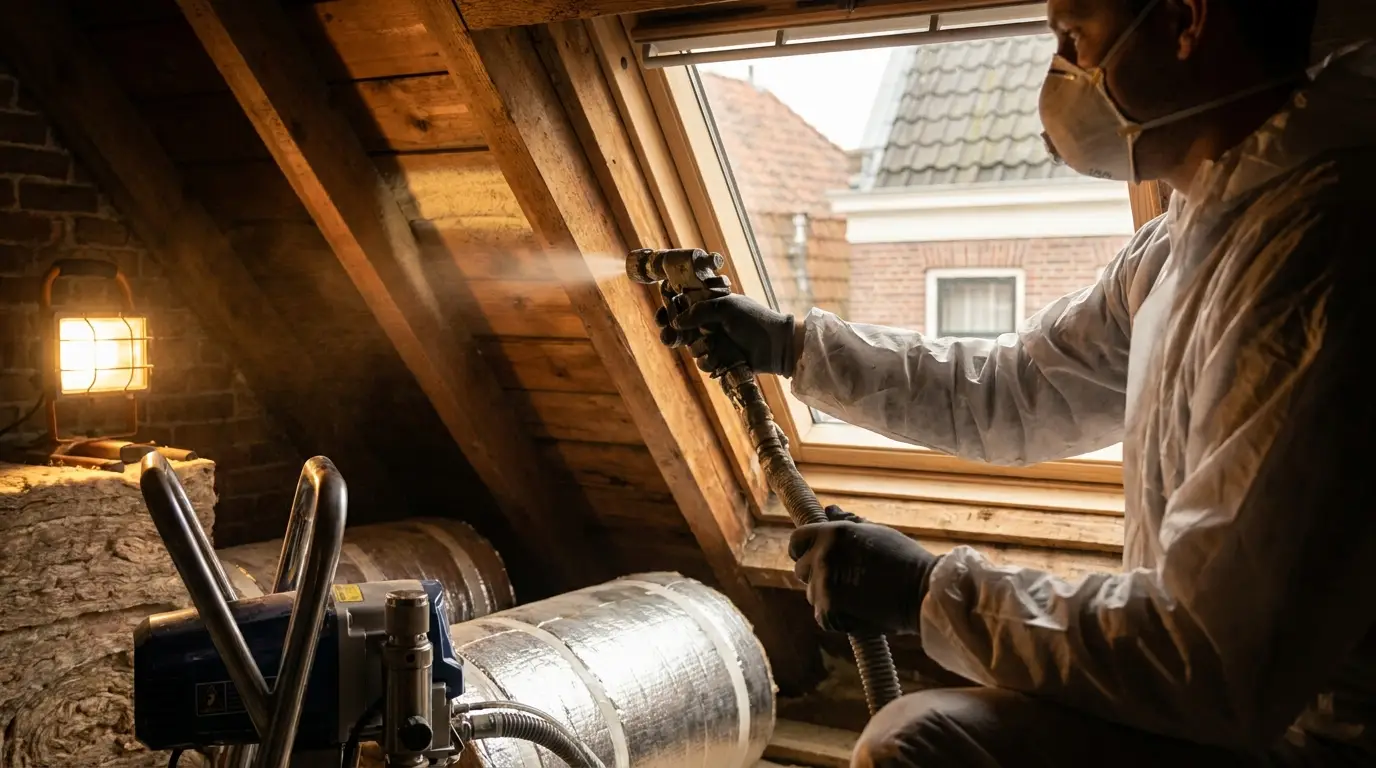
Cost of thermal insulation: everything you need to know
Thermal insulation covers all measures that limit heat loss in your home: floor, roof, cavity wall, and exterior wall insulation. The cost depends heavily on the type of insulation, the surface area, and the insulation material you choose. A well-insulated home can save hundreds of euros a year on the energy bill and qualifies for government subsidies.
In this article
- ›What does thermal insulation cost on average?
- ›Prices by type of insulation
- ›Material and labor costs
- ›Hire a contractor or do it yourself?
- ›Step by step: how does the process work?
- ›Subsidies and tax benefits
- ›Money-saving tips
Need a contractor for this?
Describe your job and get quotes from contractors near you.
average price
€2,800
including material and labor
average hourly rate
€48
contractor hourly rate (€40–55/hour)
turnaround time
1–5 days
depending on type and scope
€ Average price by type
| Insulation type | Range | Average price |
|---|---|---|
| Cavity wall insulationblown in through drill holes, approx. 40–80 m² of exterior wall | €700 – €1,800 | €1,200avg.incl. installation |
| Floor insulation (most popular)insulation boards under the ground floor, approx. 60–90 m² | €1,000 – €3,500 | €1,900avg.incl. installation |
| Roof insulation: pitched roof, insideinstalling insulation boards between the rafters | €1,500 – €4,000 | €2,500avg.incl. installation |
| Roof insulation: flat roofinsulation layer on top of or under the roofing | €2,000 – €5,500 | €3,500avg.incl. installation |
| Exterior wall insulation, outsideinsulation boards on the exterior wall with a new render coat, approx. 60–100 m² | €4,000 – €10,000 | €6,500avg.incl. installation |
Prices include material and labor for an average Dutch row house; a current quote determines the exact cost. Based on Google price research.
Material and labor costs
Insulation company / general contractor hourly rate averages €40–55/hour. With ISDE-certified companies, 9% VAT applies to labor costs for homes older than two years.
Hiring a contractor vs. doing it yourself
| Job | Do it yourself | Via a contractor | Savings doing it yourself |
|---|---|---|---|
| Floor insulation (crawl space)Wedging insulation boards or batts under the ground floor from the crawl space | DoablePhysical work in a tight space: wear a dust mask, knee pads, and gloves; the crawl space must be at least 50 cm high | €400–€900 | up to €1,000 |
| Roof insulation inside (pitched roof)Installing insulation boards between and under the rafters with a vapor retarder membrane | With experienceReaching the correct Rd value requires precise placement; membrane seals at roof penetrations and the ridge are critical: poor work leads to condensation problems | €600–€1,500 | up to €1,200 |
| Blown-in cavity wall insulationBlowing insulation beads or flakes into the cavity wall through drill holes with a blowing machine | Not recommendedProfessional blowing equipment costs more than a contractor; the wrong fill pressure or material type causes moisture intrusion and mold growth in the cavity | €700–€1,800 | No recommended savings |
| Exterior wall insulation, outsideGluing and anchoring insulation boards to the exterior wall, finished with a reinforcement layer and decorative render | Not recommendedRequires scaffolding, knowledge of adhesive mortars, and the right detailing around window frames; incorrectly installed exterior wall insulation doesn't qualify for the ISDE subsidy | €4,000–€10,000 | No recommended savings |
| Insulating a flat roof (cold or warm roof)Installing insulation boards on the flat roof under or above the roofing | Not recommendedCombining insulation, vapor barrier, and roofing requires specialized knowledge; a mistake in the build-up leads to leaks or condensation in the roof structure | €2,000–€5,500 | No recommended savings |
For cavity wall insulation and exterior wall insulation on the outside, a certified insulation company is essential. Only work done by an ISDE-certified contractor qualifies for a government subsidy: DIYers are explicitly excluded. Cavity wall insulation also requires professional blowing machines and knowledge of wall construction; the wrong choice of insulation material or insufficient fill pressure can lead to structural moisture problems and mold growth. Floor insulation from the crawl space and roof insulation on the inside are doable for a handy DIYer with some construction experience. The key is the vapor retarder membrane: it must be installed airtight and sealed correctly at all penetrations. Always use materials with the required Rd value for your climate zone, and check that the crawl space is accessible and dry enough before you start.
The full process step by step
Home assessment and comparing quotes
The contractor visits your home for a structural inspection: they measure the surface area to be insulated, check the cavity width or roof structure, and determine the right insulation material and the required Rd value. Request at least three quotes to compare prices and material advice.
Inspection visit 1–2 hours; quotes 2–5 business days
Submit the ISDE subsidy application
Submit the subsidy application to RVO before the work starts. Make sure the company you chose is on the list of certified installers. The application includes the type of insulation measure, the surface area in m², and the chosen insulation value.
Application 30–60 min; approval 1–3 weeks
Preparation and material delivery
The insulation company orders the insulation material (fiberglass, EPS, PUR, or mineral wool) to size. If needed, scaffolding is scheduled for exterior wall insulation or the roof edge. You make sure there's clear access to the crawl space, attic hatch, or exterior walls.
1–3 business days
Installing the insulation
For cavity wall insulation, contractors drill holes in the exterior wall at regular intervals and blow the insulation material into the cavity under pressure; the holes are then neatly sealed. For floor and roof insulation, boards are cut to size, wedged or glued in place, and sealed with a vapor retarder membrane at all seams and joints.
1–5 workdays depending on type and surface area
Finishing and sealing
Drill holes in the exterior wall are finished with color-matched mortar sealant. The vapor retarder membrane is taped airtight around roof penetrations, sealant joints, and seams. For exterior wall insulation, the reinforcement layer follows, and finally the decorative render finish.
Half a day to a full day
Inspection, measurement, and handover
The contractor checks the finished insulation for thermal bridges, air leaks, and the Rd value achieved. You receive a completion certificate with the measured insulation values and the material used: you'll need this document to settle the ISDE subsidy with RVO.
1–2 hours
6 smart money-saving tips
Frequently asked questions
What does thermal insulation cost on average?
On average €2,800, but the price varies widely by type. Cavity wall insulation costs €700–€1,800, floor insulation €1,000–€3,500, roof insulation €1,500–€5,500, and exterior wall insulation on the outside €4,000–€10,000. The surface area, the material, and accessibility determine the final price.
How long does it take to install thermal insulation?
Cavity wall insulation is done in 1 day. Floor insulation takes 1–2 days. Roof insulation (from the inside) takes 1–3 days. Exterior wall insulation can take 3–5 workdays depending on the surface area and scaffolding.
How much will I save on my energy bill?
A well-insulated home can save €300–€900 a year on heating costs. The savings depend on the type of insulation, the size of the home, and your current gas use. When you combine several measures, the payback period is 5–12 years on average.
Can I get a subsidy for thermal insulation?
Yes. Through the ISDE subsidy (a Dutch government subsidy for sustainable energy), you receive a contribution per m² for certified insulation work. In addition, 9% VAT applies to labor costs for homes older than two years (instead of 21%). Always hire an officially energy label certified company to qualify for a subsidy.
Which insulation material is best?
Fiberglass and mineral wool are affordable and widely used. EPS boards are moisture resistant and suitable for floors and roofs. PUR foam has the highest insulation value per centimeter and is ideal where space is limited, but it's also the most expensive. Choose based on location, budget, and the desired Rd value (the thermal resistance of the insulation layer).
Can I install thermal insulation myself?
Floor insulation and roof insulation (inside) are doable for a handy DIYer. Cavity wall insulation and exterior wall insulation on the outside, however, require professional equipment and expertise. Only insulation work done by certified companies qualifies for the ISDE subsidy.
Related jobs
Ready to have your home properly insulated?
Describe your insulation job and receive quotes from verified insulation contractors near you.
Within 24 hours
response from a contractor
Verified
all contractors checked
Competitive price
compare quotes