Cost of installing or maintaining a solar panel system: everything you need to know
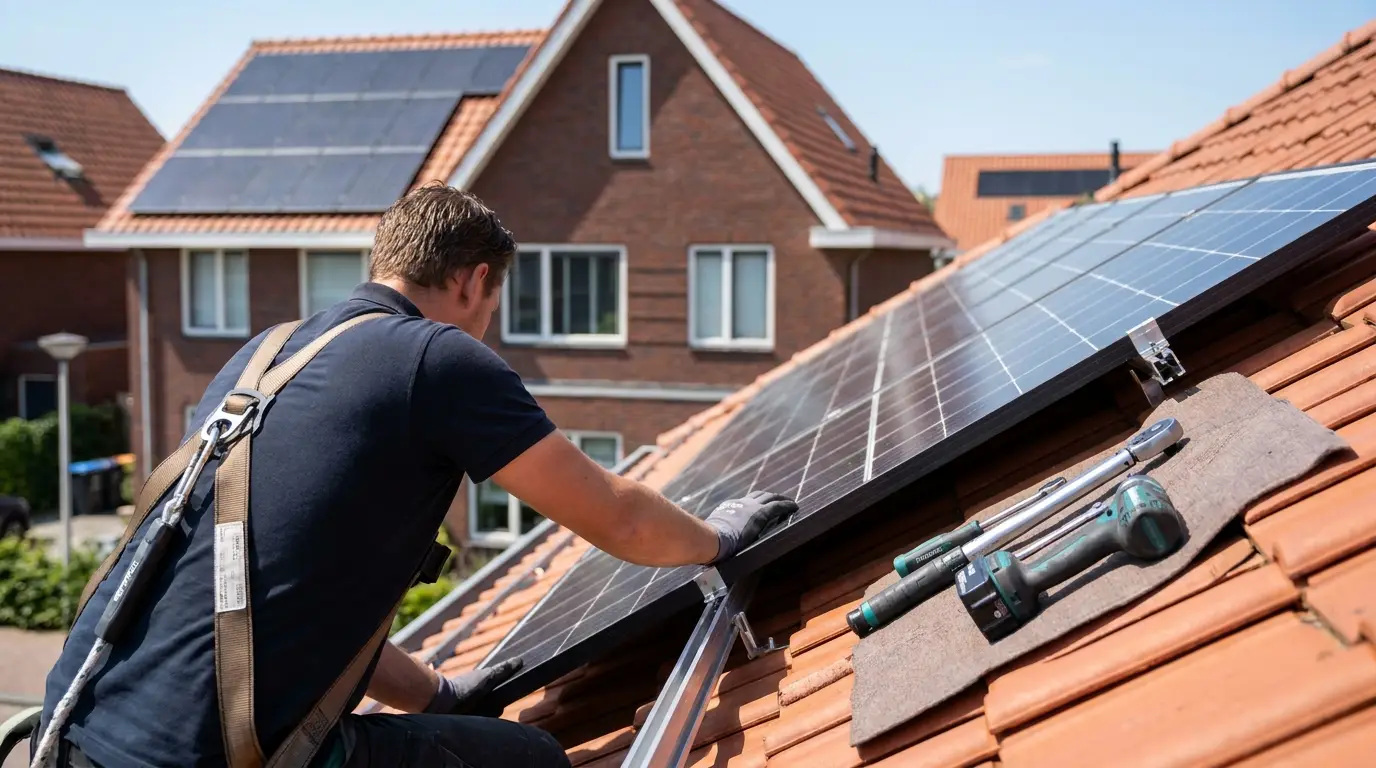
Having a solar panel system installed is an investment that pays for itself through lower energy bills and net metering. The total price depends on the number of panels, the type of inverter, and the complexity of your roof structure. Maintenance, such as cleaning and an inverter check, keeps your system running at peak output for years.
In this article
- ›How much does it cost to install a solar panel system?
- ›Prices by type of system
- ›Material and labor costs
- ›Hire a solar installer or do it yourself?
- ›Step-by-step installation process
- ›Money-saving tips for solar panels
- ›Frequently asked questions
Need a contractor for this?
Describe your job and get quotes from contractors near you.
average price
€4,500
complete installation incl. inverter
average hourly rate
€65
contractor hourly rate (€55–80/hour)
turnaround time
1–2 days
depending on system size
€ Average price by type
| System type | Range | Average price |
|---|---|---|
| Small system (4–6 panels)suitable for a 1–2 person household, approx. 1,500–2,200 Wp | €2,000 – €3,500 | €2,800avg.incl. installation |
| Standard system (8–10 panels, most popular)suitable for an average family, approx. 3,000–3,800 Wp | €3,500 – €5,500 | €4,500avg.incl. installation |
| Large system (12–16 panels)suitable for high usage or a heat pump, approx. 4,500–6,000 Wp | €5,000 – €7,500 | €6,200avg.incl. installation |
| System with home batterystandard system + storage battery for your own daytime use | €7,000 – €12,000 | €9,000avg.incl. installation |
| Maintenance & cleaning (annual)professional cleaning + technical inverter inspection | €100 – €250 | €175avg.incl. labor |
Prices include inverter, mounting system, and grid registration; higher-efficiency panels or a battery are not included in this overview. Based on Google price research.
Material and labor costs
Solar installer (licensed electrical) hourly rate averages €55–80/hour. Solar panel prices have dropped sharply in recent years; buy panels with at least a 25-year product warranty.
Hiring a contractor vs. doing it yourself
| Job | Do it yourself | Via a contractor | Savings doing it yourself |
|---|---|---|---|
| Installing mounting rails and panels on a pitched roofLifting roof tiles, anchoring rails, clamping panels in place, and sealing watertight | With experienceRequires working safely at height and knowledge of roof structures and watertight penetrations; mistakes quickly lead to leaks | €300–€500 | up to €400 |
| Running DC cabling from panels to inverterCrimping MC4 connectors, mounting cable trays on roof and facade, routing cabling to the inverter location | With experienceTechnically feasible for a DIYer with electrical experience, but polarity or connector errors create a risk of fire or failure | €100–€250 | up to €200 |
| Connecting the inverter to the breaker panel (AC side)Connecting the inverter's AC side to the meter cabinet and installing an RCD | Not recommendedLegally required to be done by an NEN 1010 certified electrician; doing it yourself is illegal and voids the manufacturer's warranty | €200–€400 | No legal savings possible |
| Grid registration and commissioning with the grid operatorRegistering the system with the regional grid operator (e.g., Stedin, Enexis) and setting up net metering with your energy supplier | Not recommendedThe grid operator requires a solar installer they recognize for technical approval; without approval, you may not feed power back | €50–€150 | No recommended savings |
| Annual cleaning of the solar panelsHosing panels with water and wiping with a soft brush or squeegee to remove dust and bird droppings | DoableEasy to do yourself on a low or ground-level roof; higher roofs require a ladder or scaffolding: weigh the savings against the risk of falling | €100–€200 | up to €200 |
The electrical connection of a solar panel system to the low-voltage grid falls under NEN 1010 (the Dutch standard for electrical installations) and the Netcode Elektriciteit (the Dutch grid code for electricity): this work may only be done by a licensed electrician. If you do it yourself, you risk fire, overloading the meter cabinet (where the electricity meter and the breaker panel are), and voiding both the manufacturer's warranty on the inverter and your homeowners insurance. The grid registration with the regional grid operator can also only be submitted by a certified company. What you can do yourself as a DIYer: the mechanical mounting of the rails and panels on the roof (provided you can work safely at height and seal the roof penetration watertight), running the DC cabling from the roof array to the inverter location indoors, and the annual cleaning of the panels. As for the inverter: reading error codes through the included app and restarting it is doable; internal repairs always require a contractor.
The full process step by step
Roof inspection and system design
The solar installer inspects the load-bearing capacity, orientation, and pitch of your roof and maps any shading from a chimney, skylight, or neighboring building. Based on this, they determine the optimal number of panels, the inverter position, and the cabling route. The inverter type (string, micro, or power optimizer) is also decided here.
1–2 hours
Quote, ordering materials, and scheduling
Once you approve the quote, the panels, inverter, rails, and cabling are ordered. Popular brands and larger systems sometimes have a delivery time of 1–3 weeks. The solar installer schedules the workday(s) and lets you know when you need to be home for access to the meter cabinet.
1–3 weeks lead time
Mounting rails and panels on the roof
The installers lift roof tiles, attach the anchoring clips to the rafters, and place the aluminum mounting rails. The panels are clamped into the rails and electrically connected in strings. The roof penetration is sealed watertight with EPDM boots.
3–6 hours
Running DC cabling to the inverter
The DC cabling (positive and negative per string) is routed from the roof through cable trays to the inverter location inside the home. The inverter is mounted in a dry, well-ventilated spot (usually the meter cabinet alcove, shed, or garage).
1–2 hours
AC connection to the breaker panel
The licensed electrician connects the inverter's AC side to the breaker panel and, if needed, installs an extra residual current device (RCD), the European counterpart of a GFCI, or circuit. Only this part is legally reserved for a certified electrician (NEN 1010).
1–2 hours
Grid registration and commissioning
The solar installer submits the grid registration to the regional grid operator (Stedin, Enexis, Liander, or Rendo) and configures the monitoring app. You receive confirmation from the grid operator, after which you're officially allowed to feed power back. The net metering settings are passed on to your energy supplier.
30–60 min (+ a few business days' wait for the grid operator)
Handover, documentation, and instructions
You receive the warranty documents for the panels and inverter, the electrical inspection report, and the user manual for the monitoring app. The solar installer walks you through how it works and explains what to check first if there's a malfunction.
30 min
6 smart money-saving tips
Frequently asked questions
How much does it cost to install a solar panel system on average?
On average €4,500 for a system of 8–10 panels, including inverter and mounting. The range is €2,000 (small system) to €12,000 (large system with battery).
How long does solar panel installation take?
A standard installation takes 1 to 2 days. For larger systems or a complex roof structure, plan on 2 to 3 days.
Do I need a permit for solar panels?
In most cases, no. Solar panels fall under permit-free construction, unless your home is a historic building or is located in a protected historic district. If in doubt, check with your municipality.
Can I install solar panels myself?
In principle, you can mount solar panels yourself, but the electrical connection to the grid must be done by a licensed solar installer. Doing it yourself without certification is risky and can void your warranty.
How much does solar panel maintenance cost per year?
Professional maintenance costs €150–€200 per year on average, including cleaning and a technical check of the inverter. After 10–15 years, the inverter needs to be replaced, which costs €1,000–€2,000.
When will I have earned back my investment?
With an average system of €4,500 and annual savings of €700–€900 on your energy bill, the payback period is 5 to 7 years. With a home battery, it can be shorter if you're home a lot during the day.
Related jobs
Ready to have your solar panel system installed or maintained?
Describe your job and receive quotes from verified solar installers near you.
Within 24 hours
response from a contractor
Verified
all contractors checked
Competitive price
compare quotes