Cost of installing or replacing solar panels: everything you need to know
Having solar panels installed is an investment that pays for itself over time through lower energy bills and net metering. The total price depends on the number of panels, the type of inverter, and the complexity of your roof. In this article, you'll find current prices, a cost breakdown by type of installation, and handy money-saving tips.
In this article
- ›What does installing solar panels cost on average?
- ›Price overview by type of installation
- ›Cost breakdown: material and labor
- ›Hire a solar installer or do it yourself?
- ›Step by step: how does the installation work?
- ›Money-saving tips for your solar panels
- ›Frequently asked questions
Need a contractor for this?
Describe your job and get quotes from contractors near you.
average price
€4,500
10 panels including installation
average hourly rate
€55
contractor hourly rate (€45–65/hour)
turnaround time
1–2 days
depending on scope
€ Average price by type
| Installation type | Range | Average price |
|---|---|---|
| Small installation (6–8 panels)suitable for a 1–2 person household, up to 3,200 Wp | €2,500 – €3,800 | €3,200avg.incl. installation |
| Standard installation (10–12 panels, most popular)suitable for a family, about 4,500–5,600 Wp including inverter | €3,900 – €5,500 | €4,500avg.incl. installation |
| Large installation (14–16 panels)suitable for a large household or high usage, up to 7,500 Wp | €5,500 – €8,000 | €6,500avg.incl. installation |
| Inverter replacement (existing panels)replace the inverter after 10–15 years, panels are kept | €900 – €2,000 | €1,400avg.incl. installation |
| Panel replacement (upgrade existing system)remove old panels and install new higher-wattage panels | €3,000 – €6,500 | €4,500avg.incl. installation |
Prices include VAT, a standard mounting system, and commissioning; extra costs may apply for complex roofs, flat roofs, or a heavy-duty grid connection. Based on Google price research.
Material and labor costs
Solar installer hourly rate averages €55–75/hour. The electrical connection to the meter cabinet and grid registration with the grid operator are legally required and require a certified installation company.
Hiring a contractor vs. doing it yourself
| Job | Do it yourself | Via a contractor | Savings doing it yourself |
|---|---|---|---|
| Mounting the rail system and panels on the roofDrilling brackets, attaching mounting rails, and clamping panels | With experienceWorking at height requires fall protection; incorrect mounting causes roof leaks or wind damage | €400–€700 | up to €700 |
| Connecting the inverter to the meter cabinet230V cabling, RCBO, and grid synchronization | Not recommendedLegally reserved for a NEN1010-licensed electrician | €200–€400 | No legal savings possible |
| Running DC cabling from panels to inverterConnecting solar panels in series or parallel with MC4 connectors | With experienceDC voltage can reach 600V; wrong polarity permanently damages the inverter | €150–€300 | up to €300 |
| Registering feed-in with the grid operatorSubmitting an online form for net metering and the smart meter | DoableFree to submit yourself via your grid operator's website; only requires name and address details and an EAN code | €75–€130 | up to €130 |
| Replacing a faulty inverter in an existing systemRemoving the old inverter, configuring and connecting the new one | Not recommendedPanels are always under DC voltage as soon as light hits them; replacement requires a certified solar installer | €900–€2,000 | No legal savings possible |
Solar panels have a clear legal boundary: the electrical connection of the inverter to the meter cabinet is legally reserved for a NEN1010 (the Dutch electrical installation standard) licensed installation company. If you do this yourself, product and performance warranties are voided, the grid operator may refuse the feed-in connection, and you could lose any subsidies. Roof mounting (attaching the rail system and clamping the panels) can in principle be done by a DIYer, provided proper roof penetrations are used and certified fall protection is worn. Note: the DC cabling between the panels and the inverter is always live during the day whenever there's daylight. Handling it without experience risks a dangerous arc flash. So only combine doing it yourself with tasks that don't involve life-threatening voltage, and always leave the electrical connection to a contractor.
The full process step by step
Research and requesting quotes
Map out your annual usage, check your roof's orientation (south-facing is optimal; east-west is a good alternative), and measure the available roof area. Request at least three quotes from solar installers with a recognized quality mark (Zonnekeur or EPBD-certified), so you can compare system advice and prices side by side.
1–2 weeks
Roof inspection and technical system design
The solar installer checks whether the roof structure can handle the extra weight of about 12 kg per panel, measures the pitch, and checks the condition of the roof tiles and any shading (chimneys, dormers, trees). Based on this, they draw up a final design: number of panels, type of inverter, cabling route, and any breaker panel expansion.
Half a day
Mounting the rail system and panels
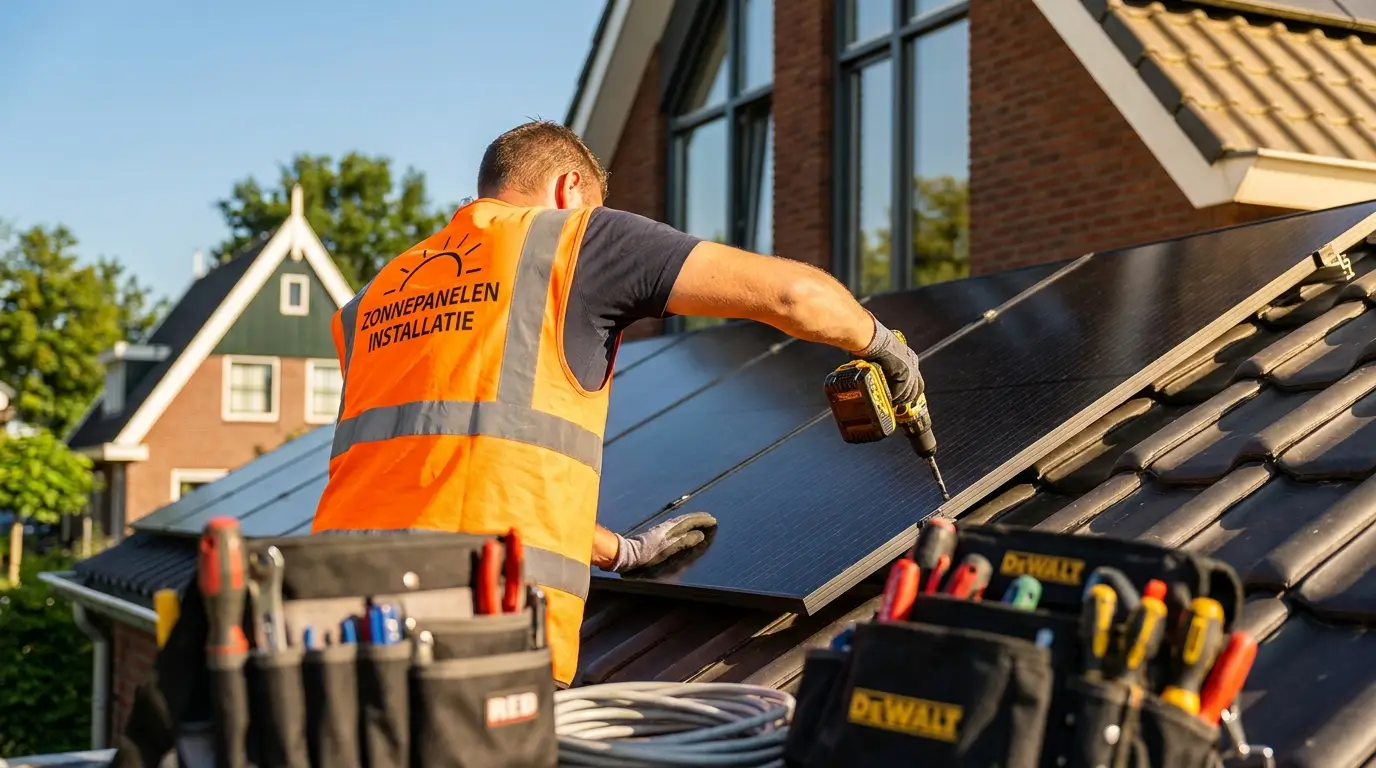
Installers drill the roof penetrations, attach the aluminum mounting rails to the roof structure, and clamp the solar panels in place. A standard installation of 10 panels is usually completed in one workday. A flat roof with a ballast system or a complex roof shape may require a second day.
1–2 days
DC cabling and inverter placement
The panels are connected to the inverter via MC4 connectors in the correct series or parallel configuration. The solar installer places the inverter in a dry, ventilated location (usually near the meter cabinet or in a shed) and routes the DC cable correctly.
1–2 hours
Electrical connection to the meter cabinet
The NEN1010-licensed electrician connects the AC side of the inverter to a separate circuit in the breaker panel and installs the required RCBO (a breaker with built-in residual current protection). If the panel is outdated or undersized, a breaker panel upgrade may be needed, which adds extra costs.
2–4 hours
Commissioning, testing, and registration with the grid operator
The system is started up, the inverter tests grid synchronization, and the solar installer verifies output via the monitoring app. Then the feed-in is registered with the grid operator; the smart meter is switched remotely to two-way metering. This administrative process usually takes two to four weeks.
1–2 hours + 2–4 weeks waiting for the grid operator
Handover, documentation, and warranty transfer
You receive the complete installation documentation: as-built drawing, warranty certificates (panel product warranty 10–15 years, performance warranty 25 years, inverter warranty 5–10 years), and an explanation of the monitoring app. Keep these documents for any damage claims or future expansion.
1 hour
6 smart money-saving tips
Frequently asked questions
What does installing solar panels cost on average?
On average €4,500 for an installation of 10 panels including inverter and mounting. The range is between €2,500 (small installation) and €8,000 (large installation of 16 panels).
How long does it take to install solar panels?
A standard installation of 8 to 12 panels takes one workday. Larger systems or complex roof surfaces can take two days.
Do I need a permit for solar panels?
For most regular homes, no permit is needed. If you live in a protected historic district, or your home is a municipal or national landmark building, you'll need to consult the municipality beforehand.
Can I install solar panels myself?
Mounting the panels on the roof yourself is legally allowed, but the electrical connection (inverter, meter cabinet, where the electricity meter and the breaker panel are, and grid connection) must be done by a licensed electrician. Installing it yourself without an inspection can void warranties and cause problems with the regional grid operator.
When should I replace my solar panels or inverter?
Solar panels last 25–30 years; most manufacturers offer a performance warranty of 80% after 25 years. Inverters have a shorter lifespan of 10–15 years and are the most common reason for replacement. Replacing only the inverter costs €900–€2,000 on average.
What does an installation of 10 solar panels produce?
A system of 10 panels (approx. 4,650 Wp) produces an average of 3,800–4,400 kWh per year in the Netherlands. At an energy price of €0.23 per kWh, the annual savings are about €870–€1,000. The payback period is usually 6–9 years.
Related jobs
Ready to have your solar panels installed or replaced?
Describe your job and receive quotes from verified solar installers near you.
Within 24 hours
response from a contractor
Verified
all contractors checked
Competitive price
compare quotes